Cattle prices and buying in West Pomerania (województwo zachodniopomorskie)
The price you get for cattle in West Pomerania depends on weight, dressing percentage, the settlement basis and complete paperwork. We give no amounts here because quotes change every week. We show how to read a buyer's offer and what to check before you sell.
verifiedFrom the team that has organised work on poultry farms for years.
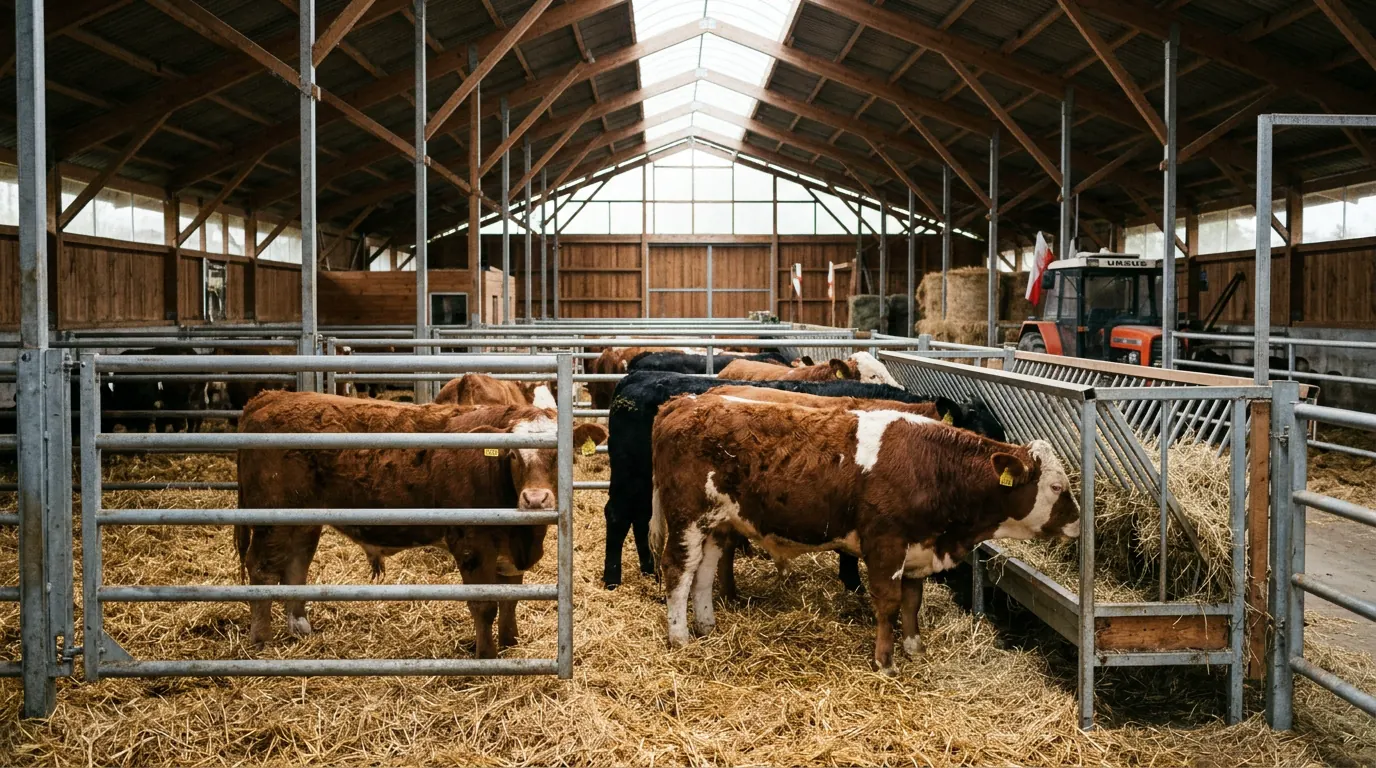
The buying price for cattle in West Pomerania is set in a talk or a contract between the farmer and a buyer or slaughterhouse. The basis is usually the chilled carcass weight or the live weight of the animal, and extra payments may be added to the price. We give no regional quotes in amounts, because they change every week. Below we explain how the price is calculated, what affects it and where to check current data before you sell.
What affects the price in practice
Most often it is the animal's weight, dressing percentage, carcass class, the settlement basis (carcass or live weight) and extra payments. The same bull at the same live weight can bring a different price if you are paid on carcass and the dressing percentage is lower. Before you sell, ask the buyer for the settlement basis and get it written in the document.
How the cattle buying price is calculated
Base price from the carcass
Under the methodology of Poland's Ministry of Agriculture and Rural Development (MRiRW) for recording market data on beef and veal, the buying price of slaughter cattle is first calculated as a base price. It is made up of the value of the cattle bought and the weight of chilled carcasses. The document also shows an example of calculating the base price as an average of three subclasses. This matters to you because, when you are paid on carcass, what counts is how much meat the animal yields after slaughter, not only its weight before slaughter.
Live weight price and adjustments
Some cattle are sold on live weight. The methodology describes separately how the price is calculated in that case, and how it is adjusted for extra payments. Before you sign a settlement, ask whether the price refers to chilled carcass or live weight, and whether it was raised or reduced by extra payments. Keep settlements and invoices in one place, for example in KSeF invoicing (KSeF is Poland's national e-invoicing system), so every sale has a full record.
Dressing percentage and body weight
Dressing percentage in research
According to research by IZ PIB (Poland's National Research Institute of Animal Production) published in 2011, the dressing percentage of bulls at 12 months was 57.54% in the control group of Black-and-White crossbreds, and 59.75% in crosses with Limousin. When fattened up to 15 months, meat output in the Limousin group was 118.7% of the control group. The data come from animal science trials, not from buyer quotes, but they show why carcass-based settlement rewards a better dressing percentage.
Gain and fattening system
IZ PIB results from organic farms show that extensive fattening based on grassland can give good-quality beef animals. Adding one or two grazing seasons lowers the rate of gain, but the cost per unit of gain is clearly lower. So the age at sale and the fattening system decide the weight and class of the animal, and these in turn decide the price the buyer pays.
The cattle market in West Pomerania
Scale of the market
According to IZ PIB, Poland's total beef livestock output grew in 1960–1990 and reached 1,428,000 t in 1990, which covered domestic demand and allowed significant exports. Historical data do not describe today's prices in the region, but they show Poland's long tradition of beef cattle production. Prices can differ between buyers and slaughterhouses in the voivodeship, because each plant has its own demand and its own supply base.
Where to check quotes
Official market data are recorded by the Ministry of Agriculture and Rural Development under the methodology mentioned above. For current regional prices, ask several buyers and slaughterhouses for a price on the same day and on the same basis: carcass or live weight. You can also compare with neighboring regions, for example cattle prices in Pomerania or in Greater Poland.
Withdrawal period and documents that affect settlement
Withdrawal period and treatment
An animal that has been treated cannot go to slaughter before the drug's withdrawal period ends. The withdrawal period and dose are set by a vet, not by the leaflet or a neighbor's experience. Record every treatment, its date and the end of the withdrawal period, so you are sure before loading. Keep these records in the treatment and withdrawal period module, and if in doubt ask your vet or the slaughterhouse.
Identification and herd data
Before you sell, check that the ear tags and the data in the animal register (IRZplus, ARiMR's online animal register) match the documents the buyer receives. Herd data kept in a system linked to IRZplus reduce manual copying of numbers. Current rules on identifying and moving cattle can be checked in the Internetowy System Aktów Prawnych (Poland's online legal acts database). The rules described here reflect the legal state as of 22.11.2026.
How to prepare cattle for sale
Before loading
If you can, weigh the animals on the day of sale and write down the result. Check whether the buyer settles on carcass or live weight, because that decides how to read the weight. The sale document should contain the identification numbers, date, weight, unit price and the buyer's details. If you make several sales a month, keep a summary so you know how many head and how many kilograms went to which buyer.
When to hold back transport
An animal in a withdrawal period, a sick animal or one with incomplete data in its documents should not go to slaughter until you settle the matter with a vet. A held-back transport costs time and money, so check documents the day before. List animals from different age groups separately, because they may be settled differently.
Frequently asked questions
What is the cattle buying price in West Pomerania?add
We give no amounts, because quotes change every week and depend on the animal's category, weight and settlement basis. To learn the current price, ask several buyers and slaughterhouses in the region for the same date and the same settlement basis.
Is the cattle price based on live weight or carcass weight?add
It depends on the contract, because settlement can use either basis. With carcass settlement, the weight of chilled carcasses counts; with live weight, the animal's weight before slaughter. Before you sell, ask which basis the price uses.
What is dressing percentage?add
Dressing percentage is the ratio of carcass weight to the live weight of the animal, given in percent. According to IZ PIB research from 2011, bulls at 12 months had a dressing percentage of 57.54% in the control group and 59.75% in crosses with Limousin.
Does a drug withdrawal period affect selling cattle?add
Yes. An animal in a withdrawal period cannot go to slaughter before it ends. The withdrawal period and dose are set by a vet, not by the leaflet or a fellow farmer.
Should I keep my own record of cattle sales?add
Yes. A summary with date, weight, price and buyer makes settlements and herd checks easier. You can keep it in DlaFerm and issue invoices in KSeF invoicing.
Where can I check current market data?add
Market data are recorded by the Ministry of Agriculture and Rural Development under its methodology for beef and veal. Also ask buyers and slaughterhouses for a price on a specific day and for the settlement basis. You can check the rules in the Internetowy System Aktów Prawnych.
Sources & resources
- linkMRiRW (ZSRIR) — Methodology for recording market data on beef and veal
- linkIZ PIB — WZ — 60 years of IZ work on beef cattle (J. Trela et al.), WZ XLIX(2011)4:11–56
- linkIZ PIB — WZ — Breed selection and breeding work in organic beef herds (P. Wójcik, A. Czubska)
- linkIZ PIB — WZ — Current state and prospects of beef cattle rearing and breeding in Poland (H. Grodzki et al.), WZ LIII(2015)2:77–87
- linkInternetowy System Aktów Prawnych — isap.sejm.gov.pl
Prepared by: DlaFerm Team based on data from the sources listed · Publisher: INSTA-TECH sp. z o.o.
Do you sell cattle every few weeks?
See how <a href="/integracje-irzplus-czujniki">IRZplus and sensor integrations</a> work in DlaFerm. Create a free farm account and try them in practice.
Phone
+48 796 258 151