Cattle prices and buyers in Pomorskie, Poland
The price paid for slaughter cattle in Pomorskie voivodeship depends on chilled carcass weight, the animal's class and subclass, and whether you sell on carcass weight or live weight. We show what makes up the price and which data to keep at hand. We give no actual quotes, because they change every week.
verifiedFrom the team that has organised work on poultry farms for years.
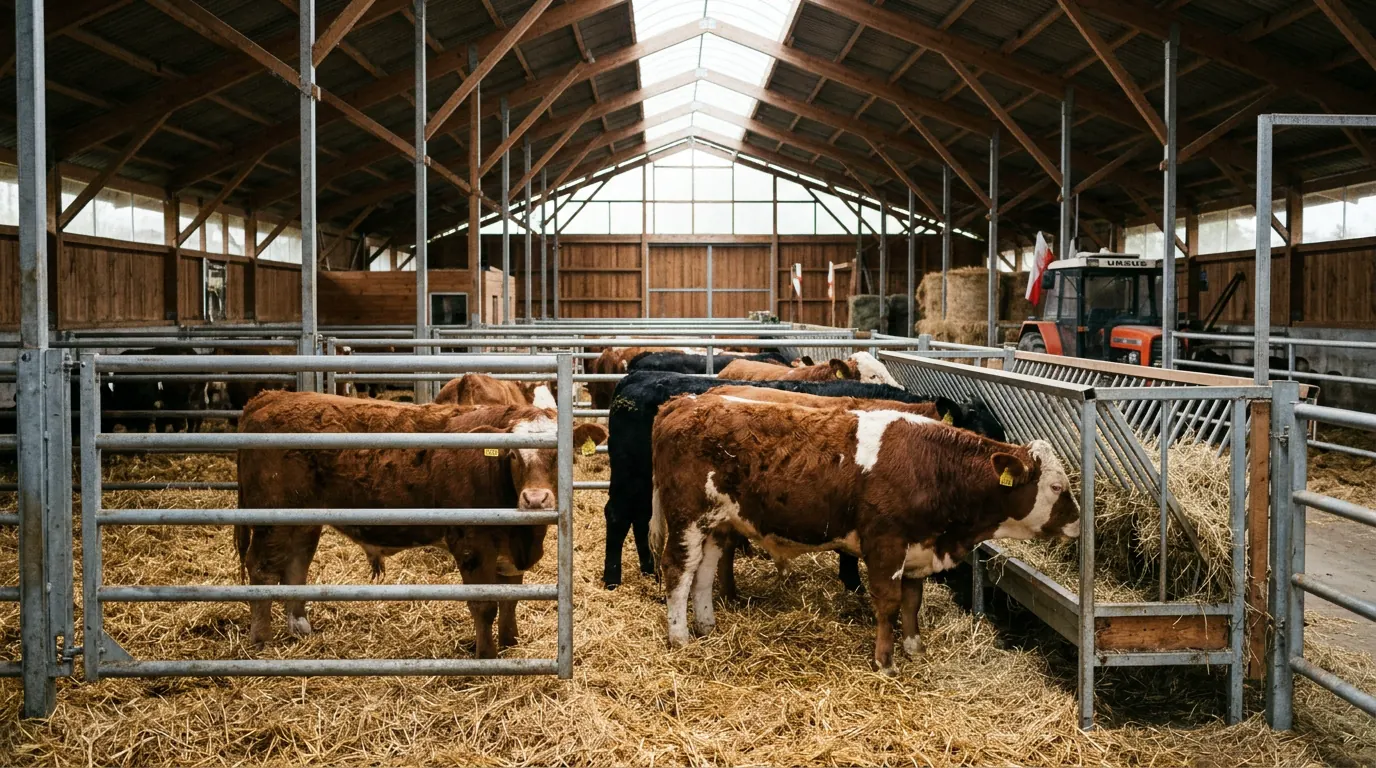
The price for slaughter cattle in Pomorskie voivodeship is set from chilled carcass weight and the animal's class. For live-weight sales, the price is converted to carcass weight. Rates are not fixed, so we do not list them here. To compare with another market, see poultry prices in Pomorskie.
Why there is no single rate
Two farms in the same county can get different prices for the same category of cattle. The difference comes from weight, dressing percentage, the way the animals are weighed and whether the buyer adds surcharges. So first learn the settlement rules, then compare quotes. Before you line up offers from several buyers, check how each one calculates the price, and write it down next to every batch of animals you sell.
What makes up the price of slaughter cattle
Base price from carcass weight
The MRiRW methodology defines the purchase price of slaughter cattle as the value of the cattle bought divided by the weight of chilled carcasses. The document also shows how to calculate the base price as an average of three subclasses. So a buyer does not pay one rate for the whole herd. It values each animal category separately. The practical point for you: carcass classification and weight after slaughter directly affect what you get per head. Before selling, ask the buyer which class and subclass it will use to value your cattle.
Selling on live weight
With live-weight sales, the price is converted to carcass weight, so dressing percentage matters. According to J. Trela et al. (Wiadomości Zootechniczne, 2011), 12-month-old bulls in the Black-and-White control group had a dressing percentage of 57.54%, and crossbreds sired by beef bulls reached as much as 60.18%. The same kilogram of live weight therefore gives a different carcass weight depending on breeding. When you compare live-weight offers, check that each buyer converts using the same carcass weight.
Surcharges and price adjustments
The MRiRW methodology provides for adjusting the purchase price for additional payments. This means a settlement can include items beyond the plain price per kilogram. Before you sign a contract, ask for a written breakdown: base price, any surcharges and how they are added. That makes it easier to compare two offers that look the same at first glance.
Where to find current data for Pomorskie
The MRiRW registration methodology
The Agricultural Markets Department of MRiRW prepared a methodology for registering market data from the beef and veal market. It covers the duty to register data, the scope of registration, how the purchase price is calculated, how trade volume is recorded and the requirements for software that calculates the price. Reading it shows which data go into the quotes. You will find the full text in the ministry's resources on gov.pl.
Prices by voivodeship in DlaFerm
The market module of DlaFerm.pl shows data by voivodeship, modeled on its poultry buyer-price tables. For Pomorskie you can check the same things as for neighboring Kuyavian-Pomeranian voivodeship, which has its own cattle prices page. When you compare, look at the quote date and whether the data are for carcass-weight price or live weight. Without these two details, figures from different weeks are not comparable.
Breed and rearing system versus the value of an animal
Crossbreds and meat output
In the fattening results table of Trela et al. (Wiadomości Zootechniczne, 2011), at 15 months of age Black-and-White bulls crossed with a beef breed gave clearly more meat than the control group. For example, crossbreds sired by Piedmontese bulls reached 133.7% of the control group's meat output. The result depends on the sire breed, feeding and age at slaughter. Before you plan a sale date, check at what age your batch gives the best ratio of weight to cost.
Extensive fattening on pasture
Wójcik and Czubska (Wiadomości Zootechniczne, 2014) describe how extensive fattening on grassland can produce good-quality beef cattle. Adding one or two grazing seasons lowers the intensity of gains, but the cost of each unit of gain is clearly lower. For you this means a different calculation: fewer kilograms a day, but lower feed costs. When you choose a system, compare the economic result over the whole period, not just the growth rate.
What to check before you sell cattle
Withdrawal period before sale
If an animal was treated with a medicine that has a withdrawal period, it must not go to slaughter before that period ends. The vet in charge of treatment chooses the medicine and sets the withdrawal period. Record every treatment with the date and the product name, and before loading check that the withdrawal period has passed. A treatment and withdrawal period record helps by reminding you of the dates before sale.
Invoice and settlement
Selling cattle requires a sales document, and the buyer usually sends a settlement showing weight and price. Before the deal, check with your accountant whether your sale goes into KSeF (Poland's national e-invoicing system) and in what form. Invoicing in KSeF makes this easier by linking sales data to your animal records. Keep the settlement for every batch, because you need it for inspections and for comparing prices over the following months.
How to record sales in your herd
A record for every animal
For each animal, record the sale date, live weight, carcass weight, class and the price you got. Over several batches, the summary shows which buyer pays more for the same category and how dressing percentage changes in your herd. The easiest way to keep these records is a farm management program, where herd and sales data sit in one place.
Requirements for software
The MRiRW methodology sets requirements for software that calculates the purchase price of cattle. If you use a settlement tool, ask the maker which methodology it uses to calculate the price and whether it records carcass weight and price changes over time. A program that does not show these items makes it harder to check settlements against your own records.
Frequently asked questions
What is the price of slaughter cattle in Pomorskie?add
We give no amounts here, because quotes change every week. You can check the current rate with the buyer or in the data by voivodeship on DlaFerm.pl, and work out the value of an animal from carcass weight and class.
What determines the price paid for slaughter cattle?add
It depends on chilled carcass weight, the animal's class and subclass, and how the sale is settled: on carcass weight or live weight. Additional payments can adjust the base price, so ask for the full breakdown.
What is the difference between live-weight and carcass-weight pricing?add
With live weight, the price is converted to carcass weight, so dressing percentage matters. According to J. Trela et al. (Wiadomości Zootechniczne, 2011), the dressing percentage of 12-month-old bulls in the control group was 57.54%, and in selected crossbreds it reached 60.18%.
Where can I find the official rules for registering beef market data?add
The methodology for registering market data from the beef and veal market was prepared by the Agricultural Markets Department of MRiRW. You will find it in the ministry's resources on gov.pl, with current agriculture information at gov.pl/web/rolnictwo.
Do I have to observe a withdrawal period before selling cattle?add
Yes. If an animal was treated with a medicine that has a withdrawal period, it must not go to slaughter before that period ends. The vet sets the medicine and the withdrawal period, and you record each treatment with the date and product name.
Can I compare cattle prices with poultry prices?add
You can compare how data are collected, but not the amounts, because cattle and poultry markets settle in different units. Poultry tables by voivodeship help you see how data are presented, while cattle settlement always rests on the animal's weight and class.
Sources & resources
- linkMRiRW (ZSRIR) — Methodology for registering market data from the beef and veal market
- linkIZ PIB — WZ — 60 years of beef cattle work at the Institute of Animal Production (J. Trela et al.), WZ XLIX(2011)4:11–56
- linkIZ PIB — WZ — Breed selection and breeding work in organic beef cattle herds (P. Wójcik, A. Czubska)
- linkIZ PIB — WZ — Current state and prospects of beef cattle rearing and breeding in Poland (H. Grodzki et al.), WZ LIII(2015)2:77–87
- linkMinistry of Agriculture and Rural Development — gov.pl/web/rolnictwo
Prepared by: DlaFerm Team based on data from the sources listed · Publisher: INSTA-TECH sp. z o.o.
Do you keep a beef herd and work out your sales?
The farm management program helps you record sales and herd data in one place. Create a free farm account in DlaFerm.pl or get in touch, and we will show you how it works in practice.
Phone
+48 796 258 151