Cattle prices and buying in Silesia (województwo śląskie), Poland
The price you get for cattle depends on how the buyer settles up, the animal's weight and age, and when you sell. This page shows how to read price quotes for Silesia, how the price is built under the methodology of Poland's Ministry of Agriculture and Rural Development (MRiRW), and what to check before you sign a contract.
verifiedFrom the team that has organised work on poultry farms for years.
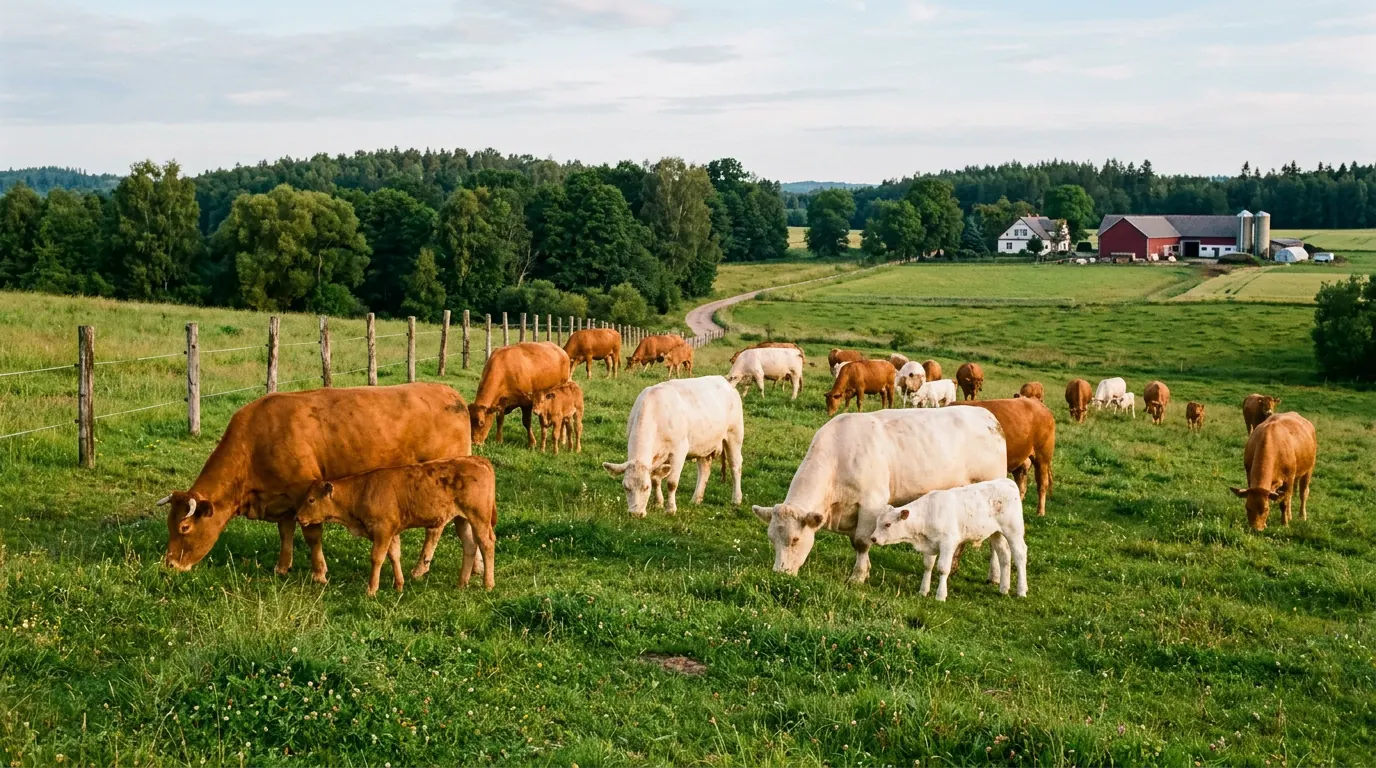
Cattle prices in Silesia have no single fixed rate. The price depends on the animal's category, the way you are paid (live weight or carcass weight), weight, age and sale date. DlaFerm.pl does not list specific amounts here, because quotes change every week. We show what drives the price, how the government methodology builds it, and how to prepare cattle so you sell without losses.
What affects the price at the buyer
Three things matter most to a farmer: dressing percentage, weight at sale and the animal's health. Dressing percentage is carcass weight as a share of live weight, in percent. In a study by J. Trela et al. (Wiadomości Zootechniczne, 2011), young bulls from Holstein-type black-and-white cows crossed with a Limousine sire reached a dressing percentage of 61.51% at 15 months, against 57.81% in the control group. The gap was clear, but it came from one trial, so do not assume it applies to every herd without checking.
Factors that decide the price of cattle
How you are paid
Cattle can be sold on live weight or on chilled carcass weight. With live weight, the price applies to the animal's weight on the scale. With carcass pricing, it applies to the weight after slaughter. The same price per kilogram gives a different final amount, because dressing percentage differs between animals. Before you sign, ask the buyer which basis they use and work out both versions for the specific animal.
Weight and age at sale
An animal sold at the right moment gives more meat for each day spent in the barn. In the same study, meat production from Limousine-cross young bulls at 15 months was 118.7% of the control group, while at 12 months it was lower (109.5%). Before you choose a date, work out the feed cost of each extra kilogram of gain and compare it with the price per kilogram.
Breed and daily gain
In a paper by P. Wójcik and A. Czubska (Wiadomości Zootechniczne, 2014), daily gains up to 15 months in different beef cattle groups ranged from 855 to 1060 g. Higher gain means a shorter finishing period, but breed alone does not decide the price. What counts is what actually lands on the scale.
How the purchase price is calculated
Base price
The methodology for recording beef and veal market data, prepared by the Agricultural Markets Department of MRiRW, describes how the purchase price of slaughter cattle is calculated. The base price comes from the value of the cattle bought (W) and the weight of chilled carcasses (I). The document also gives an example of a base price calculated as an average of three subclasses, so it is a result averaged over several groups, not from a single deal.
Live weight price and extra payments
The methodology separately describes how to calculate the price of cattle bought on live weight and how to adjust the price for additional payments. For you this means the amount in an advert is not always the full amount that reaches your account. Before selling, ask whether the buyer adds or deducts any extra payments and on what terms.
Recording trade
The document states that trade must be recorded and that software calculating the purchase price must meet set requirements. The practical lesson is simple: record every sale, meaning date, number of head, weight and price, and keep that data with your paperwork. You can issue the invoice in the KSeF invoicing module (KSeF is Poland's national e-invoicing system) and record the head count in your herd register.
Price quotes for Silesia
What to check before a deal
Before you accept an offer, compare it with quotes for Silesia and with the base price under the MRiRW methodology. Check the quote date, the animal category and the way you are paid. If the offer is on live weight and the quote is for carcass weight, convert both to the same basis.
Regional prices and other species
For other regions, see for example cattle prices in Opole or in Małopolska. The rule is the same everywhere: compare only data of the same category and the same pricing basis.
Herd health and sales
Withdrawal period before sale
After a medicine is given, a withdrawal period applies, during which the animal cannot go to slaughter. The length comes from the medicine's leaflet and your vet's advice; the vet chooses the medicine and dose. Record every treatment right away, with the date given and batch number, and check the date before animals leave. The Treatment and withdrawal period module tracks these dates in one place.
Diseases to report to your vet
Lumpy skin disease (LSD) is described in a leaflet from PODR Szepietowo (a regional agricultural advisory center in Poland). If you suspect symptoms, report them to your vet at once. Do not move or sell animals until the vet issues a decision.
Herd data in one place
Identification and register
Every animal must have an ID number, and its data goes into the cattle register. The IRZplus and sensor integrations module helps you avoid entering the same data twice (IRZplus is ARiMR's online animal register, run by Poland's Agency for Restructuring and Modernisation of Agriculture).
Sales plan
Line up planned sale dates with gains and withdrawal periods. With several batches a year it is easier to see when animals will reach target weight. In the farm management software you can save a schedule and compare it with the animals' real weights.
Frequently asked questions
What is the cattle price in Silesia?add
DlaFerm.pl does not list amounts here, because quotes change every week. Check the current rate in quotes for Silesia, matching the date, animal category and pricing basis. A number alone, without those details, says nothing about your sale result.
What is the difference between live weight price and carcass price?add
With live weight you are paid for the animal's weight before slaughter. With carcass price you are paid for the weight of the chilled carcass after slaughter. Dressing percentage, the carcass as a share of live weight, decides which gives the higher amount. Work out both before you agree a deal.
What determines the dressing percentage of cattle?add
It depends on breed, age and weight at slaughter. In a 2011 study by the Institute of Animal Production (IZ PIB), Limousine-cross young bulls at 15 months had a dressing percentage of 61.51% and the control group 57.81%. Results from one study do not automatically apply to every herd.
What is a withdrawal period and when does it block a sale?add
It is the time from giving a medicine until the animal can go to slaughter. The medicine leaflet and your vet set its length. While it runs, do not send the animal to the buyer.
How do I document a cattle sale?add
A sale is usually documented with an invoice or another document agreed with the buyer. Check what your buyer requires. The KSeF invoicing module helps keep invoices in order, and you keep head counts in the herd register.
Where can I check how the purchase price is calculated?add
MRiRW publishes the methodology for recording beef and veal market data. It describes the base price, the live weight price and adjustments for extra payments. Read it before you talk to the buyer.
Sources & resources
- linkMRiRW (ZSRIR) — Methodology for recording beef and veal market data
- linkIZ PIB — WZ — 60 years of IZ work on beef cattle (J. Trela et al.), WZ XLIX(2011)4:11–56
- linkIZ PIB — WZ — Breed selection and breeding work in organic beef herds (P. Wójcik, A. Czubska)
- linkPODR Szepietowo — Lumpy skin disease (LSD) leaflet (Z. Marciniak)
Prepared by: DlaFerm Team based on data from the sources listed · Publisher: INSTA-TECH sp. z o.o.
Want withdrawal dates and herd data at hand before you sell?
The Treatment and withdrawal period module records treatments and tracks dates before cattle leave for the buyer. Create a free farm account on DlaFerm.pl or get in touch, and we will show you how it works in practice.
Phone
+48 796 258 151