Cattle prices and buying in Małopolska
The price you get for cattle in Małopolska depends on the animal category, weight, dressing percentage and whether you sell live or by carcass. There is no single rate for the whole region. So we compare quotes with data recorded under the methodology of Poland's Ministry of Agriculture (MRiRW) and work out your own cost of production. Below, we show how to do it step by step.
verifiedFrom the team that has organised work on poultry farms for years.
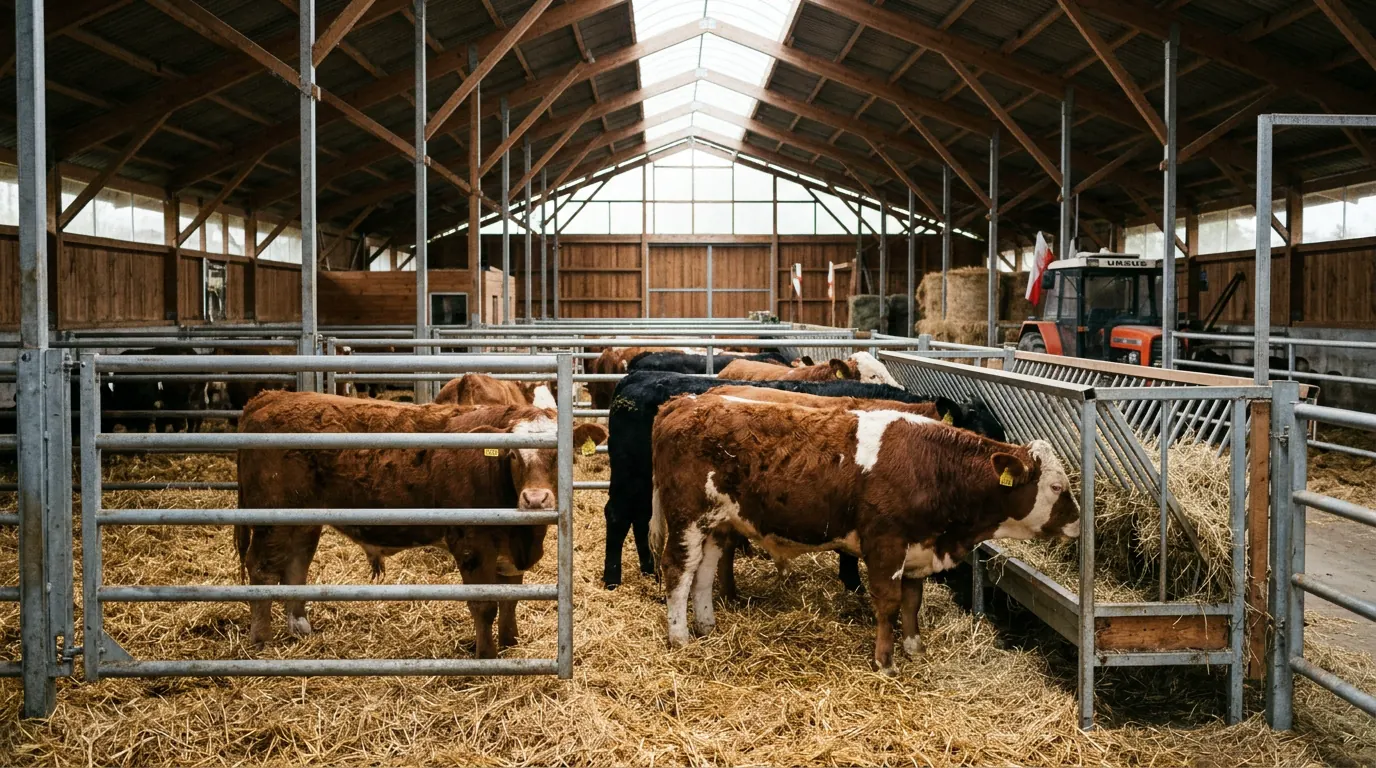
The market sets cattle prices in the Małopolska voivodeship (province). Buyers, slaughterhouses and farmers negotiate a price per kilogram of live weight or per kilogram of chilled carcass. The rate differs by animal category, weight and quality, so one offer from one buyer does not show the situation across the region. For comparisons, use data recorded under the uniform methodology of the Ministry of Agriculture and Rural Development (MRiRW), and only then set it against your own cost of production. Below we describe what drives the price, how to read quotes and how to turn them into a calculation for your farm.
What sets the buying price
Settlement is based on the weight and value of the cattle purchased. The MRiRW methodology explains that the base price is calculated from the value of the slaughter cattle bought and the weight of chilled carcasses, and it gives an example of the base price worked out as an average of three subclasses. Purchase by live weight is settled separately, and additional payments can adjust the final price. For you, this means the same animal can be worth a different amount sold live or by carcass, depending on dressing percentage. According to data from IZ PIB (Poland's National Research Institute of Animal Production), in a finishing trial of bulls from Black-and-White cows, dressing percentage at 12 months was 57.54% in the control group and 60.18% in crosses with Piedmontese.
How to read cattle price quotes
Live weight price vs carcass price
The price per kilogram of live weight is based on the animal's weight on the scale. The price per kilogram of carcass refers to the weight after slaughter and chilling. Dressing percentage links the two: you get carcass weight by multiplying live weight by dressing percentage. For example, at 57.54%, an animal with a live weight of 500 kg gives a carcass of about 288 kg. Before you compare two offers, check that both use the same settlement basis. The gap between live and carcass weight is often bigger than the gap between two rates, so comparing without converting leads to wrong conclusions.
What to check in a buyer's offer
Ask the buyer about the animal category (bull, young bull, cow, heifer), the weight range, the weighing date and whether the price includes subsidies. Write offers down with the date, because quotes change over short periods. Record every sale in your documents straight away, and you can issue invoices in the KSeF invoicing module (KSeF is Poland's national e-invoicing system). That makes it easier to compare results across transactions and see whether a buyer in a given month pays for weight or for dressing percentage.
Buying price vs cost of producing beef
Age and finishing system
IZ PIB research on extensive finishing shows that grassland can produce good-quality beef cattle. Including one or two grazing seasons in finishing lowers the rate of gain, but the cost of each unit of gain is clearly lower. Selling younger needs faster growth, while longer finishing raises feed use. So the same price can leave a different profit, depending on how long the animal stayed on the farm and what it was fed.
Dressing percentage and age at slaughter
The same IZ PIB table shows that dressing percentage rises with the animals' age. Bulls from Black-and-White cows reached 57.54% in the control group at 12 months and 57.81% at 15 months. Crosses with Piedmontese had a dressing percentage of 60.18% at 12 months and 61.98% at 15 months. Meat production relative to the control group at 15 months was 133.7% for these crosses. For you, this means the sale date and the breed affect carcass weight, and so the price, more than the rate per kilogram does.
Calculating income from finishing
Ready-made calculations of farm income from beef production, prepared by an ODR (agricultural advisory center), show the result at different intensity levels. Enter your own costs for feed, labor, veterinary care and bedding, then compare the result with the price you will actually get from the buyer. Treat market quotes as a reference point, not a ready price for your farm. For every comparison, note the date and the source of the data, so you know later what you based your decision on.
Cattle buying in Małopolska compared with the region
Distance to slaughter and transport cost
The farther you are from the slaughterhouse or buying point, the higher the transport cost, and that cost usually lowers your net price. When you compare offers, check who arranges transport, who pays for loading and how long the animals will be on the road. Transport arrangements also matter for welfare, and EFSA (the European Food Safety Authority) describes requirements for transporting cattle in its opinions. When you sell from your own farm, agree the weighing and collection rules with the buyer before the date.
Disease and movement restrictions
Lumpy skin disease (LSD) in cattle can restrict animal movements and affect your options for selling. The county veterinary officer and the Chief Veterinary Inspectorate set the rules and any restrictions, so check the current status in your county before you sell. Comparing neighboring livestock markets helps you judge whether selling animals pays in a given period or whether another line of production is better. Our other regional pages cover this too, such as current slaughter cattle price quotes.
Documents when selling cattle
Recording market data
The methodology for recording market data on the beef and veal market, prepared by the Agricultural Markets Department of MRiRW, sets out how to record purchase prices of slaughter cattle, calculate the base price and record trade volumes. Legal state as of 22.11.2026. For specific duties under statutory law, check the Internet System of Legal Acts (ISAP), because we do not give publication numbers we have not confirmed. The methodology helps you understand where quotes come from before you start comparing them.
Animal records
When you sell cattle, inspectors and buyers expect the data on the animals to match the herd register. Many farms keep entries in IRZplus, ARiMR's online animal register (ARiMR is Poland's Agency for Restructuring and Modernisation of Agriculture), and you can update some of the data in the IRZplus and sensor integrations module. Before you send animals off, check that identification data and dates match your documents. Mismatches usually come up at collection, so it is better to sort them out on the farm than on the ramp.
Herd health and the value of the sale
Withdrawal period after treatment
A vet always chooses the medicine and the dose. After a medicine is given, a withdrawal period applies: the time during which the animal cannot go to slaughter. Keep to this period without exceptions, because selling an animal still in withdrawal causes legal and health problems. Record every treatment with the date given, the product name and the date the withdrawal period ends. The Treatment and withdrawal module helps with this and lets you plan a sale so it does not clash with the withdrawal date.
Welfare during transport
EFSA describes the welfare risks for cattle during transport, including long journeys, stress and changing conditions. Animals in poor condition can also lower the slaughter result, which feeds through to price. For calves, minimum protection standards are set in Council Directive 2008/119/EC, published by the EU. Before the sale, give the animals rest, access to water and proper loading. Good condition on collection day is the simplest way to avoid losing weight and value.
Frequently asked questions
What is the current cattle price in Małopolska?add
We do not give specific amounts, because quotes change over short periods. Check current data in MRiRW publications and with several buyers near you. Compare offers from the same day and on the same settlement basis.
What is the difference between price per kg live weight and per kg carcass?add
The price per kg live weight is based on the animal's weight before slaughter. The price per kg carcass is based on weight after slaughter and chilling. The conversion uses dressing percentage. Bring offers to one basis before you compare them.
What affects the buying price of cattle?add
It depends on animal category, weight, dressing percentage, sale date and additional payments. Distance to the slaughterhouse also matters, because transport cost lowers the net price. The MRiRW methodology describes how the base price is calculated.
Where can I check cattle buying prices in Małopolska?add
The ministry publishes market data as part of recording data from the beef and veal market. Add to it by talking to buyers and keeping records of your own transactions. We cover poultry prices in the same region in a separate overview.
Does a medicine withdrawal period affect selling cattle?add
Yes. An animal in a withdrawal period after treatment cannot go to slaughter. A vet chooses the medicine and dose, and the withdrawal period follows the product's instructions and characteristics. Record every treatment so you can plan the sale date.
How do I check whether beef finishing pays?add
Add up the cost of feed, labor, veterinary care and bedding, then compare it with the price you will actually get for live weight or carcass. Take account of age at slaughter and dressing percentage. ODR calculations show the result at different intensity levels.
Sources & resources
- linkMRiRW (ZSRIR) — Methodology for recording market data from the beef and veal market
- linkIZ PIB — WZ — 60 years of IZ work on beef cattle (J. Trela et al.), WZ XLIX(2011)4:11–56
- linkIZ PIB — WZ — Breed selection and breeding work in organic beef cattle herds (P. Wójcik, A. Czubska)
- linkODR Lubań (PODR publication) — Sample calculation of farm income from beef production (different intensity levels)
- linkMinistry of Agriculture and Rural Development — gov.pl/web/rolnictwo
- linkInternet System of Legal Acts — isap.sejm.gov.pl
Prepared by: DlaFerm Team based on data from the sources listed · Publisher: INSTA-TECH sp. z o.o.
Do you finish beef cattle and want everything in one place?
The farm management program in DlaFerm.pl helps you keep documents and herd data in one place. Create a free farm account or get in touch, and we will show you how it works in practice.
Phone
+48 796 258 151