Cattle prices and buying in Opole Voivodeship
The price paid for cattle in Opole Voivodeship depends on weight, carcass class, animal category and contract terms, not on one fixed rate. We explain how the price is built and how to read market lists. We do not publish quotes, because they change within days.
verifiedFrom the team that has organised work on poultry farms for years.
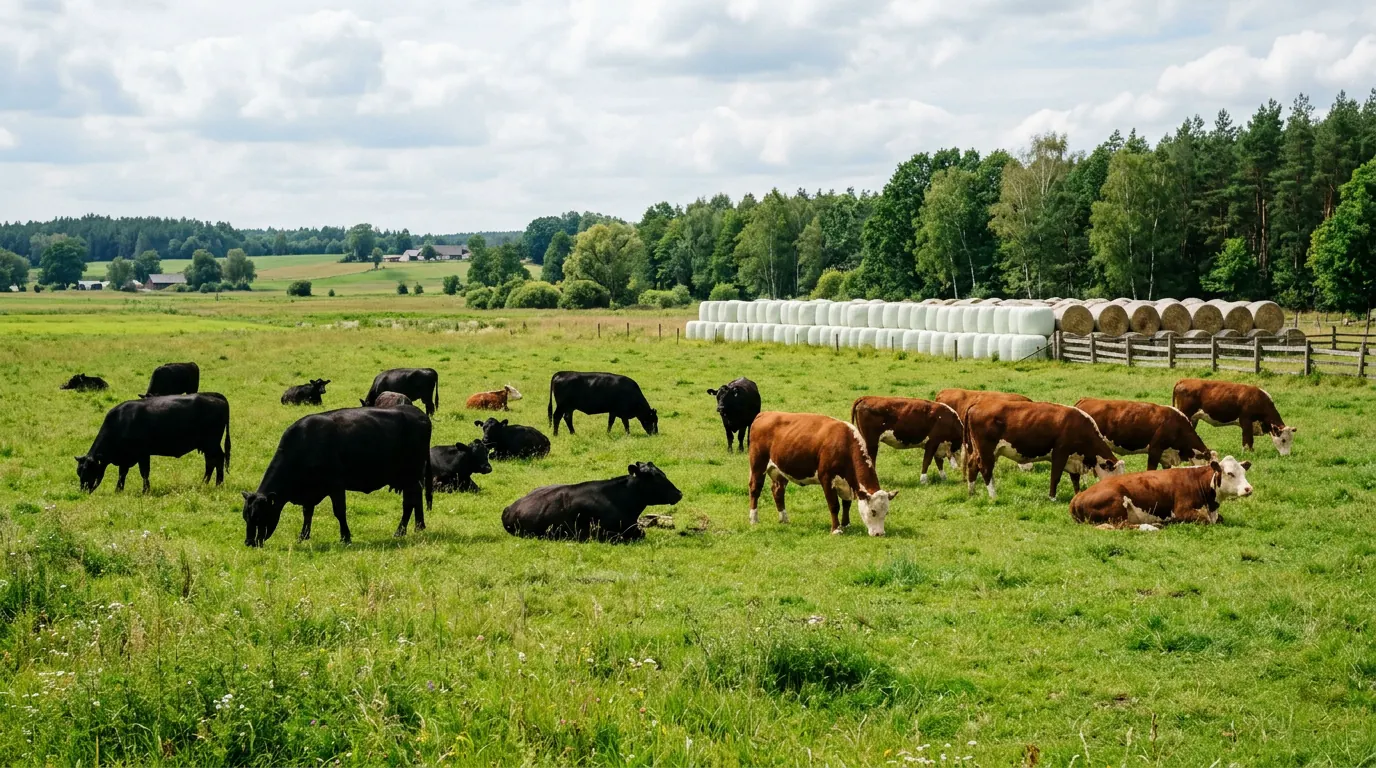
The buying price of cattle in Opole Voivodeship is not a single rate in a price list. The buyer pays for live weight or for the carcass, and the result depends on the animal's weight, carcass class, category and the terms of your contract with the buyer. We give no current quotes here, because they change within days. This text describes the situation as of 22.11.2026: what the price depends on, how to read market lists and how to work out what you will really get per animal. Regional lists work much like the poultry buying price lists for Opole Voivodeship: the data is local and only makes sense when you compare it over time.
Why the region matters
Cattle buying is local. Distance to the slaughterhouse, the number of animals in one lot and the pickup date all shape the offer a buyer makes. With a single animal you have less room to negotiate than with a larger lot, because the buyer counts transport and time for each head. A list for Opole Voivodeship is useful when you compare it with your own sales from the same period, not with a national figure. One offer from one buyer does not show the whole regional market, so collect several offers from different buyers.
What the cattle buying price depends on
Weight and carcass class
The methodology of Poland's Ministry of Agriculture and Rural Development (MRiRW), prepared by its Department of Agricultural Markets, describes how the base price is calculated. The price comes from the value of the slaughter cattle bought and the weight of chilled carcasses, and the methodology's example uses an average of three subclasses. Purchase by live weight uses a separate conversion. So the same rate per kilogram can give a different result depending on whether you sell live or the buyer pays for carcass yield. Before you sign, ask what basis the price will be calculated on.
Animal category and dressing percentage
According to data from IZ PIB (Poland's National Research Institute of Animal Production; Trela et al., WZ 2011), the dressing percentage of bulls fattened to 12 months of age was 57.54% in the control group and 60.18% in the cross with Piemontese. For heifers, the same study gave lower values than for bulls in the same groups. Dressing percentage affects carcass weight, and so the basis of payment. Animal category, sex and age at sale are three factors worth recording for every lot, because buyers look at them first.
Cattle prices in Opole Voivodeship: how to read the lists
What to check in a list
Before you compare a listed price with your own offer, check the quote date, animal category, weight range and settlement method. Read separately whether the amount is for live animals or chilled carcasses. The MRiRW methodology also mentions a price correction for additional payments, so some differences between buyers may come from extra payments or bonuses, not from the base rate. Note whether the list includes them. Without that, comparing two offers is incomplete and it is easy to draw the wrong conclusion.
How to use data across buyers
Read regional data as a time series, not as a single point. Record offers over several weeks and set them against your own sales. If the gap between buyers holds over several quotes, it is a signal to talk about pickup terms. If it shows up once, it usually comes from a chance pickup date or a particular lot. Remember that a list describes the market, not a guaranteed price for your herd.
Cost of gain and the cattle buying price
Pasture or intensive fattening
IZ PIB (Wójcik and Czubska, WZ 2014) describes that adding one or two grazing seasons to fattening lowers growth rate, but the cost of each unit of gain is clearly lower. In that institute's trials, daily gain up to 15 months ranged from 855 g to 1060 g across groups. For a farmer this means the highest intensity does not always give the best financial result. Before you decide how long to fatten, work out the cost of feed and pasture per kilogram of gain and compare it with the price the buyer will pay for the carcass.
Age at sale
In IZ PIB results (Trela et al., WZ 2011), crossbreds fattened to 15 months gave more meat than the same groups at 12 months. For example, bulls crossed with Piemontese gave 121.5% of the control group's output at 12 months and 133.7% at 15 months. A longer fattening period also raises feed cost and the time the barn is occupied. Decide the age at sale by comparing weight gain with the cost of a fattening day, not by the price per kilogram in a given week.
Paperwork and health when you sell cattle
Withdrawal period and treatment
Before you sell, check that the animals are not still in a withdrawal period after treatment. A vet always chooses the medicine and dose, and the farmer is responsible for keeping to the recommended withdrawal time. Keep a record of the medicines given, dates of administration and the dates when withdrawal ends, because the buyer and the inspector may ask for them. A good tool is a treatment and withdrawal period record, where you can see the dates animals clear withdrawal without paging through notes.
Invoice and settlement of the sale
Every cattle sale needs a correct document: seller and buyer details, animal category, number of head and price. The settlement also decides whether the lot is booked correctly on the farm. If you issue electronic invoices, check how invoicing in KSeF (Poland's national e-invoicing system) works before your first larger transaction. Always check the rules, obligations and deadlines in current law in ISAP (Poland's legal acts database), because the legal position can change.
Where to check current prices and rules
Official and industry sources
You will find the methodology for recording market data on beef and veal on the pages of the Ministry of Agriculture and Rural Development, in gov.pl materials. Information on animal health and veterinary requirements is published by the Chief Veterinary Inspectorate (Główny Inspektorat Weterynarii). Data on breeding and fattening results of beef cattle is prepared by the Institute of Animal Production (Instytut Zootechniki PIB), among others in the series Wiadomości Zootechniczne. For every list, check the publication date and the scope of the data before you use it.
Your own records as a benchmark
The best comparison for a regional list is your own sales history. Record pickup date, category, number of head, weight, settlement method and the price you got. After a few lots you will see what a sale at a given time and weight returns. A farm management program suits such records well, because it keeps herd, sales and treatment data in one place.
Frequently asked questions
How is the cattle buying price calculated?add
The MRiRW methodology describes the base price as coming from the value of the slaughter cattle bought and the weight of chilled carcasses. Purchase by live weight uses a separate conversion. Before you sign, ask the buyer what basis they use to calculate the amount.
Is the cattle price per kilogram of live weight or carcass?add
It depends on the contract and the way of purchase. Some buyers pay for live weight and others for chilled carcass weight. Always agree which one applies, because the same rate per kilogram gives a different result.
Where can I check cattle buying prices in Opole Voivodeship?add
Quotes are published by market operators and agricultural institutions, and you will find the methodology for market data on MRiRW pages. Check the quote date and the animal category before you compare a quote with your own offer.
Why do cattle prices differ between buyers?add
The result depends on weight and carcass class, animal category, pickup date, number of head in the lot and additional payments. A gap between buyers in a single week does not always mean a gap in the market.
Do I need to keep records of cattle sales?add
Records help you compare your own transactions with market lists and document the sale. Write down date, category, number of head, weight and price, plus treatment and withdrawal data before shipping.
How does the age of cattle affect the price?add
Age affects carcass weight and the cost of gain. In IZ PIB trials, longer fattening raised meat output but also feed cost and housing time. Base the decision on the cost per kilogram, not on the price alone.
Sources & resources
- linkMRiRW (ZSRIR) — Methodology for recording market data on beef and veal
- linkIZ PIB — WZ — 60 years of IZ work on beef cattle (J. Trela et al.), WZ XLIX(2011)4:11–56
- linkIZ PIB — WZ — Breed selection and breeding work in organic beef cattle herds (P. Wójcik, A. Czubska)
- linkIZ PIB — WZ — Current state and prospects of beef cattle rearing and breeding in Poland (H. Grodzki et al.), WZ LIII(2015)2:77–87
- linkChief Veterinary Inspectorate — gov.pl/web/wetgiw
Prepared by: DlaFerm Team based on data from the sources listed · Publisher: INSTA-TECH sp. z o.o.
Selling cattle to a buyer? Settle the sale in one place
The KSeF Invoicing module in DlaFerm.pl helps you prepare sales documents for animals. Create a free farm account and see how it works in practice.
Phone
+48 796 258 151