Soybean meal for chickens: how much in the feed
No single number fits every feed. The share of soybean meal depends on the type of bird, its age, what else is in the mix and how much protein and amino acids you want to supply. Below we show how to approach it and what to check on your farm.
verifiedFrom the team that has organised work on poultry farms for years.
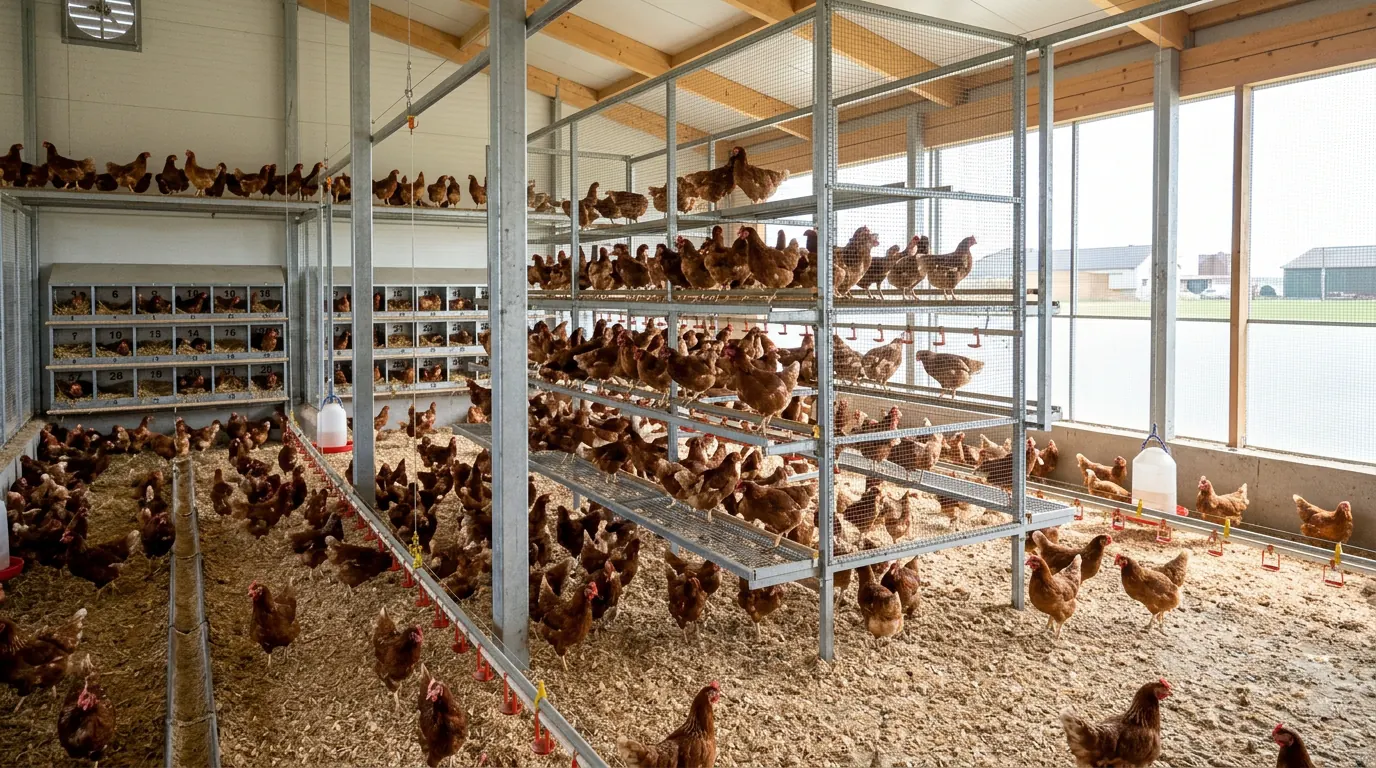
Soybean meal in chicken feed has no fixed dose. A nutritionist sets its share based on the age of the birds, the production goal and what is already in the mix, most often corn and wheat. Soy is the main source of protein and amino acids in feed, especially lysine. So you check the amount through the composition of the finished feed, not through a percentage picked by eye. For a comparison with other ingredients, see our page on corn for chickens.
What soy adds to the ration
Soybean meal supplies crude protein and the amino acids that cereals supply in small amounts. The Aviagen nutrition specification for broiler breeders (Ross 308 Parent Stock Nutrition Specifications 2021) shows that lysine and methionine are the amino acids planned first in the ration. For digestible lysine it gives 1036 mg per bird per day in one column of the table and 1050 mg in another. These figures are for broiler breeders, not laying hens, so treat them as an example of the principle, not a ready formula for your flock. Agree recommendations for laying hens with a nutritionist.
Where the protein requirement comes from
Concentration vs. daily intake
Nutrition specifications give values per ration, for example per kilogram of feed. But a bird eats a set amount per day, and that changes with age and temperature. According to the Ross Parent Stock Management Handbook 2023, it is worth calculating nutrient needs as daily intake per bird. In high temperatures feed intake drops, and a ration that looked fine on paper stops being enough. So changing the share of soybean meal without checking intake settles nothing.
Energy and bird age
The Ross 308 / 308 FF Broiler Nutrition Specifications 2022 give, for broilers with a target weight of 2.0–3.5 kg, feed energy that rises with each stage: 2975 kcal/kg in the starter (0–10 days), 3050 kcal/kg in the grower (11–24 days), 3100 kcal/kg in finisher 1 (25–39 days) and 3125 kcal/kg in finisher 2 (from 40 days to slaughter). This example shows that the dose of soy and the other ingredients changes with the stage of rearing. For laying hens, put together data from your own mix and agree them with an adviser.
Factors that shift the soybean meal share
The rest of the mix
The share of soybean meal depends on what the rest of the feed is made of. When the share of cereals is high, protein and amino acid sources matter more, because they have to make up the gap. When the feed already contains other plant proteins, such as rapeseed meal, you need to recalculate the whole balance rather than add soy on its own. We compare the two meals in our article on rapeseed meal for chickens.
Feed intake and weather
Feed intake is not constant. According to the Ross Broiler Management Handbook 2025, high temperature lowers intake, and that changes the amount of nutrients the bird actually gets. In hot weather, do not raise the soy dose just in case. First check whether the hens eat as much as the recipe assumes and whether water is available in full.
How to check how much feed the flock eats
An FCR calculation example
According to the Ross Broiler Management Handbook 2025, FCR is feed consumed divided by live weight gain. In the example, a sample of 10 birds ate 36 807 g of feed and reached a total live weight of 31 480 g, so FCR is 1.169. The same handbook gives an example of a 45-day-old bird weighing 3.295 kg with an FCR of 1.606. The lower the FCR, the better the bird turns feed into body weight. Run this calculation for your flock after every cycle, not only after changing the recipe. You can calculate the indicators in the FCR and EPEF online module.
Feed samples for the lab
According to the Ross Parent Stock Management Handbook 2023, it is key to take feed samples on the farm and test them in a lab regularly, to check whether the expected nutrient content is being met. Take the sample from several places in the bag or silo, mix it and send it to the lab. Compare the result with the recipe. A gap in protein or lysine is a reason to change the soy dose, so you do not have to guess.
What to do when results are disappointing
Order of action
When gains slow or hens lay less, start by checking the data: feed use, batch composition and house temperature. Only then consider changing the soy dose. Do not switch to a different feed in the middle of a cycle without advice. Feed additives such as vitamins for chickens also affect the result, so record any change to them along with the others.
Anti-nutritional factors
Raw soybean meal contains compounds that make protein harder to digest, so feed uses meal that has had suitable heat treatment. Some feed plants also contain tannins, which we cover in our article on tannins in poultry feed. If you suspect a problem with batch quality, ask the supplier for a quality document and a test result.
Frequently asked questions
How much soybean meal should I feed chickens?add
There is no universal dose. The share of meal depends on the type of bird, its age, the rest of the mix and feed intake. Set it with a nutritionist based on the composition of the feed.
Is soybean meal better than rapeseed meal for chickens?add
Each brings different protein and other components, and the choice depends on the recipe and availability. Always compare at the level of the whole mix, not a single meal.
Is soybean meal suitable for laying hens?add
Yes, soy is an ingredient in many layer feeds. But the specifications we cite here cover broilers and broiler breeders, so for laying hens you need data suited to their category.
How do I check that feed has the right amount of protein?add
Take samples from several places in the bag or silo and send them to a lab. Compare the result with the recipe. Regular tests show whether the expected nutrient content is being met.
Does soybean meal have a withdrawal period?add
Soybean meal itself is not a medicine, so it has no withdrawal period. If birds are treated, the withdrawal period applies to the drug, and a vet sets its length.
What should I do if my chickens eat poorly?add
First check house temperature, water access and feed quality. If the problem continues or signs of illness appear, contact a vet.
Sources & resources
- linkRoss 308 / 308 FF Broiler Nutrition Specifications 2022
- linkRoss Broiler Management Handbook 2025
- linkRoss 308 Parent Stock Nutrition Specifications 2021
- linkRoss Parent Stock Management Handbook 2023 (Interactive)
- linkRoss 308 / 308 FF Broiler Performance Objectives 2022
Prepared by: DlaFerm Team based on data from the sources listed · Publisher: INSTA-TECH sp. z o.o.
Tracking FCR and feed use on your farm?
The FCR and EPEF online module shows feed efficiency flock by flock. Create a free farm account at DlaFerm.pl and start recording feed use from day one.
Phone
+48 796 258 151