Sow Reproductive System: Anatomy and Heat Cycle
A sow's reproductive tract consists of the ovaries, oviducts, uterus, cervix and vagina. The heat cycle usually lasts about 21 days and gestation about 114 days. Knowing the anatomy and the cycle helps you time breeding better and spot problems sooner.
verifiedFrom the team that has organised work on poultry farms for years.
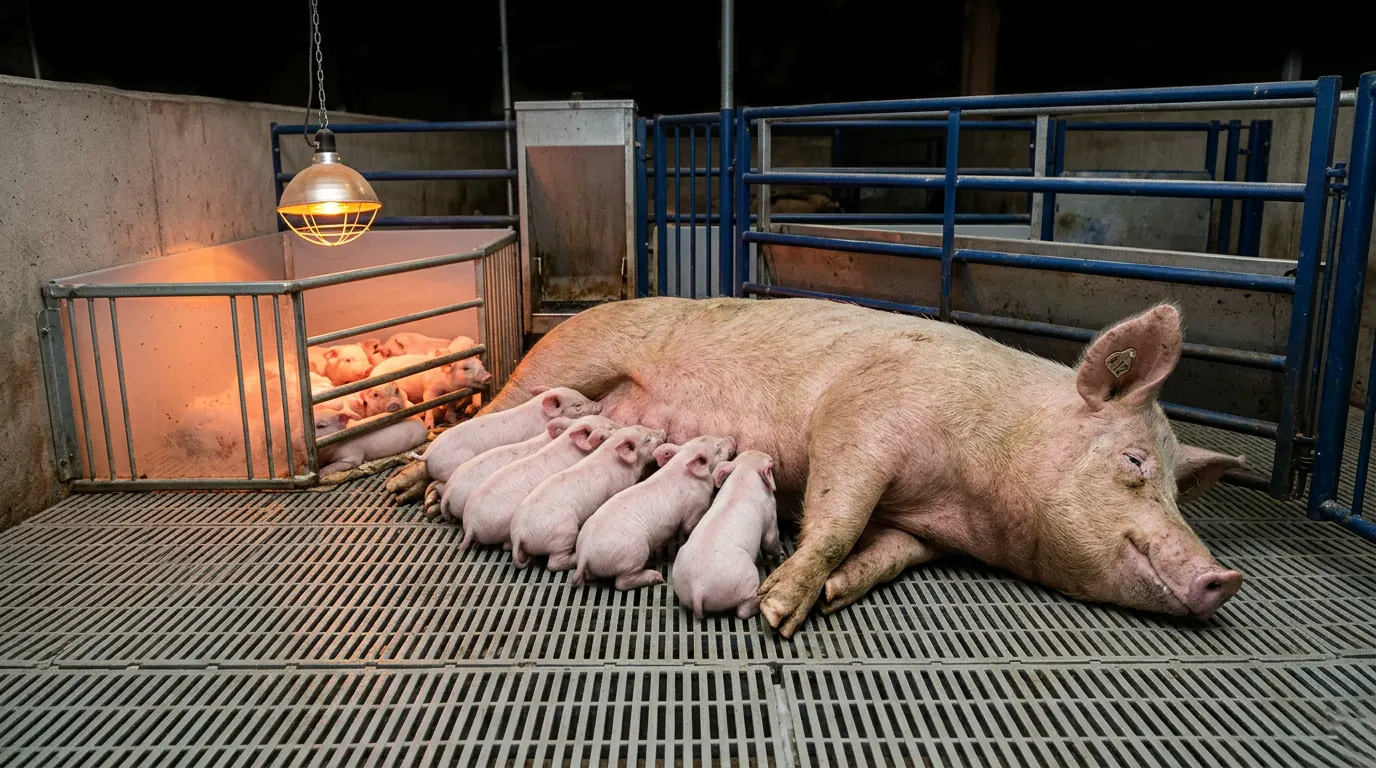
A sow's reproductive tract consists of the ovaries, oviducts, uterus, cervix, vagina and vulva. The ovaries produce egg cells and sex hormones, the oviducts are where fertilization happens, and the uterus gives the embryos room to develop through about 114 days of gestation. The heat cycle usually lasts about 21 days, and it decides when you can breed the sow. Here we describe these organs, the course of the cycle and the signs you will see in the pen. For breeding plans, see our guide to breeding and insemination of sows.
Why know the anatomy
Knowing the anatomy makes the signs easier to read. When you know the ovaries control heat through hormones, you understand why heat returns at regular intervals. When you know the path that semen and embryos take, it is easier to judge whether a problem lies in the breeding or in the sow's health. Record heat and breeding dates as they happen, for example in stocking and cycle planning.
Organs of the sow's reproductive tract
Ovaries and oviducts
The ovaries lie in the abdominal cavity, behind the kidneys. In each cycle a group of follicles develops in them, and egg cells are released from some of them. This is ovulation. The ovaries also produce estrogens, which control the signs of heat. The oviduct is a thin tube linking the ovary to the uterine horn. Its upper, widened section is where fertilization takes place. Fertilization usually happens close to ovulation, so you set the breeding time by heat, not by the calendar.
Uterus and cervix
The sow's uterus has two horns. Two long horns join a short body that leads to the cervix. Embryos develop in the uterine horns, spaced along them. The cervix has distinct folds and stays closed outside heat, while during heat it lets semen through more easily. This anatomy explains why breeding at the wrong point of the cycle often does not end in fertilization. Pregnancy is diagnosed by a veterinarian.
Vagina and vulva
The vagina runs from the cervix to the vulva. The vulva is the only external part of the tract that you see every day. During heat it becomes swollen and red, and a mucous discharge may flow from it. It is a handy indicator on your rounds, but the look of the vulva alone is not enough to set the breeding time. Combine it with the animal's behavior.
The sow's heat cycle step by step
Cycle length
A sow's heat cycle usually lasts about 21 days. Heat itself lasts a few days, and ovulation falls toward the end of that period. Outside heat, the corpus luteum in the ovary releases progesterone, which holds back the next follicles. When the corpus luteum regresses, hormones change and a new heat appears. Pregnancy, disease or strong stress can change the rhythm of the cycle. If a sow shows no heat after breeding or after weaning, a veterinarian should assess her.
Gilt maturity
Gilts reach sexual maturity at different ages, depending on development and feeding. The PIC manual (Nutrition and Feeding Guidelines, metric version, 2022) gives targets for breeding gilts: first heat before 195 days of age, age at breeding about 200–225 days and body weight 135–160 kg. The aim is to breed at the second heat, and the third is accepted only when weight is below 135 kg. These values are targets of the PIC program, not a general rule. Compare your own herd with them and talk to your adviser.
Signs of heat
In heat the sow is restless, readily approaches the boar and reacts to touch. The most reliable sign is the standing reflex: the sow freezes when someone presses on her back. Also watch for higher activity, pricked ears and a swollen vulva. Check several times a day, because heat is short. Write dates down at once, because after a few days it is hard to rebuild the course of the cycle. Records in the app for pig farmers let you compare dates with the same sow's earlier cycles.
From breeding to farrowing
Gestation
Gestation lasts about 114 days, that is 3 months, 3 weeks and 3 days. Heat not returning after breeding is the first sign to look for, but on its own it does not confirm pregnancy. A veterinarian makes the diagnosis, because cycle disorders can have different causes. Record the breeding date against the sow so you can work out the expected farrowing date and plan her stay in the pig house. Keep the stocking plan with room occupancy in mind.
Signs that farrowing is near
A few hours before farrowing the sow becomes restless and looks for a place away from the rest of the group. She starts building a nest from bedding material. The KPODR Minikowo publication "Behawior i dobrostan świń" (Pig Behavior and Welfare) confirms that these behaviors are typical. Watching for them lets you prepare for the piglets and not miss the start of farrowing.
Freedom and piglet care
According to KPODR Minikowo, the more freedom sows have during farrowing and the more time they spend building the nest, the stronger their maternal care. For the farmer this means the farrowing pen should allow movement and nest building, not just lying down. Restricting freedom is convenient in the short term, but it can cost you in piglet rearing.
Stress, feeding and handling
Stress and the cycle
According to IZ PIB (Dobrostan świń w zrównoważonym systemie produkcji zwierzęcej, 2026; pig welfare in a sustainable animal production system), long-term stress suppresses the hypothalamus–pituitary–ovary axis. The results can be no heat, weak signs of heat, low fertility and litter size, and poorer milk production. A single incident is rarely the cause. More often factors pile up: group changes, noise, overcrowding and heat. When reproduction looks off on your rounds, ask what changed in the pen over recent weeks.
Feeding gilts
PIC guidelines link gilt development to herd longevity. The aim is suitable growth, mineral reserves, bone development and good leg structure. PIC gives a target for daily gain over the whole productive life of 600–800 g/day. Feeding gilts differs from feeding finishing pigs, so build the development program separately. Set the feeding plan with an adviser or a veterinarian.
Handling
Calm handling of sows has measurable effects. A study cited by KPODR Minikowo (Babicz et al., 2016, Reproduction in Domestic Animals 51) showed that with calm handling sows were calmer, and on some measures piglet rearing was better. Record events and treatments in the treatment and withdrawal period records, so that when something changes in the herd you can see what changed.
How to measure reproductive results in your herd
What the performance evaluation covers
The 2025 evaluation of sow reproductive performance, published by IZ PIB (Poland's National Research Institute of Animal Production), covers the number of piglets born per litter, the number of piglets reared to day 21, the number of teats, the age of the gilt at first farrowing and the interval between litters. Values are broken down by sow breed, purebreds and crossbreds, and by voivodeship. This lets you set your own results against averages instead of relying on memory of last year.
How to collect data in the pen
Keep a record: breeding date, farrowing date, number of piglets born and reared, and the gap between litters. When heat does not return on time, note it together with the signs and the result of the examination. Data from several litters show a trend that a single farrowing will not reveal. The DlaFerm system makes herd-wide summaries easier, for example through the farm management program, when you keep other species too.
Frequently asked questions
How often does a sow come back into heat?add
A sow's heat cycle usually lasts about 21 days, so after an unsuccessful breeding the next heat appears roughly after that time. Departures from this rhythm usually need assessment. No heat after breeding does not automatically mean pregnancy, because only a veterinarian's examination confirms it.
How long is a sow's gestation?add
Gestation lasts about 114 days, that is 3 months, 3 weeks and 3 days. The expected farrowing date is worked out from the breeding date. The exact date depends on how the pregnancy goes and on conditions in the pen.
At what age does a gilt reach first heat?add
The PIC manual gives targets: first heat before 195 days of age, breeding at about 200–225 days and weight 135–160 kg. The aim is to breed at the second heat, not the first. Record the age and weight of your gilts to compare them with these values.
How do you tell when a sow is in heat?add
The most reliable sign is the standing reflex, when the sow freezes as you press on her back. It comes with a swollen, red vulva, restlessness and a wish to approach the boar. Check several times a day, because heat is short.
Can stress affect sow reproduction?add
Yes. In its 2026 publication IZ PIB describes how long-term stress can cause no heat, weak signs of heat, low fertility and litter size, and poorer milk production. First check changes in the herd, handling and conditions in the pig house. If problems continue, a veterinarian needs to assess the sows.
Where can I check average reproductive results in Poland?add
IZ PIB publishes sow reproductive performance results in yearly reports, for example for 2025, broken down by breed and voivodeship. Compare them with your own litter records. When comparing, check the year of the data and the sow breed.
Sources & resources
- linkIZ PIB — Pig welfare in a sustainable animal production system (eds. A. Rekiel, G. Żak)
- linkKPODR Minikowo — Pig behavior and welfare (P. Dorszewski et al.)
- linkPIC — PIC Nutrition and Feeding Guidelines (metric)
- linkIZ PIB (National Center for Animal Breeding / trzoda.izoo.krakow.pl) — Status of pig breeding and evaluation results in 2025
Prepared by: DlaFerm Team based on data from the sources listed · Publisher: INSTA-TECH sp. z o.o.
Do you run a sow herd and keep track of heat and breeding?
The stocking and cycle planning module in DlaFerm.pl helps you plan breedings and the herd cycle. Create a free farm account and see how it looks with your own herd's data.
Phone
+48 796 258 151