Slurry on a Poultry Farm: Storage, Tank and Spreading Dates
Slurry is a liquid fertilizer made of droppings and water. Poultry farms produce it less often than manure. We explain how to store it in a sealed tank, how to size the capacity and how to plan spreading dates under Poland's Nitrate Programme (Program azotanowy). We give the rules, not numbers you must never guess.
verifiedFrom the team that has organised work on poultry farms for years.
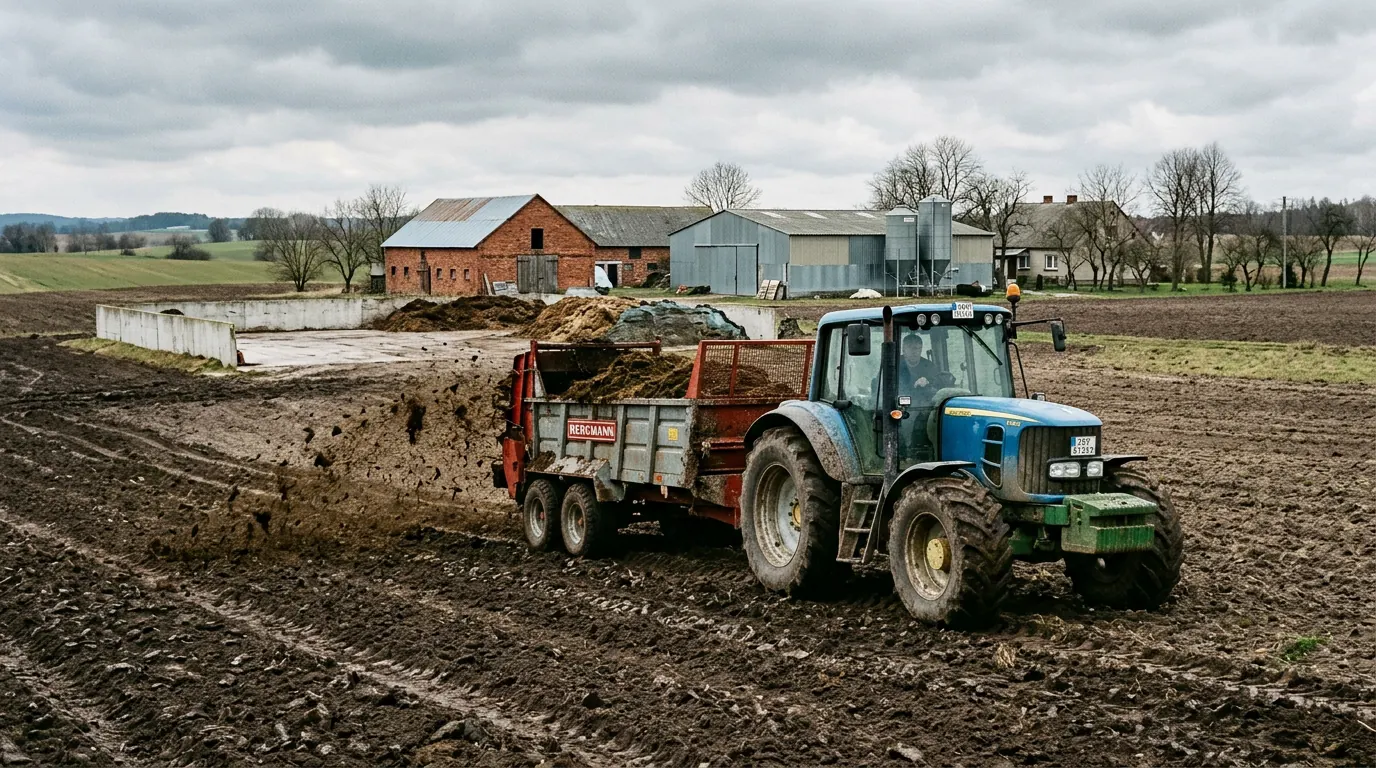
Slurry is a liquid organic fertilizer: a mix of droppings and water with no bedding. Poultry farms produce it less often than pig or cattle farms, because most flocks are kept on litter and the droppings leave the farm as manure. Slurry appears mainly in litter-free systems with manure channels, and where floors are flushed with water. Storing and spreading slurry is governed by Poland's Nitrate Programme (Program azotanowy), and the dates depend on soil type, weather and the closed periods for fertilizer use.
What to check before spreading
Before you set a date, check three things: how much slurry you produce in a year, how much tank capacity you have, and what the rules currently say. The legal position this text is based on is 22.11.2026. Rules change, so before each season read the current text in ISAP (Poland's online database of legal acts). If you are not sure which provisions apply to your farm, ask an agricultural adviser or the relevant office.
Where slurry on a poultry farm comes from
Droppings in litter-free systems
In litter-free systems, feces and urine fall from slats onto belts or into a channel under the grating. Some farms flush floors with water, which produces slurry. The more water enters the channel, the larger the volume and the lower the dry matter. You should know the outflow volume, because it decides tank capacity and spreading costs. Before you plan a tank, measure the outflow over several weeks and write the results in your records.
Manure with litter is a different matter
On straw, sawdust or shavings, droppings mix with the material and form manure, not liquid slurry. The Ross PS 2023 handbook recommends keeping litter in a separate, protected place away from the flock, to keep the flock free of pathogens. For the same reason, a manure heap should stand away from house entrances and from paths used by people and birds. We cover manure storage rules in a separate section below.
Storing slurry in a tank
Sealed tank and protection
The tank must be sealed and resistant to slurry. A leak into the ground threatens water, which is both an environmental problem and an inspection problem. Check walls, valves and overflow pipes after every spreading. Keep the tank away from the poultry house and protect it from birds, rodents and strangers. A cover or roof reduces rain, which adds volume you then have to haul.
Capacity from volume and storage period
Tank capacity depends on two figures: how much slurry enters it in a year, and how long you must keep it before you are allowed to spread. The second figure comes from the Nitrate Programme and depends on the closed periods. Do not size a tank by eye. Work out the inflow from your records, add a reserve for rainfall and check that some space remains if spreading is delayed. If you change stocking numbers, recalculate everything. See also our guide to manure pads and slurry tanks.
Spreading dates and closed periods
What the rules say about dates
The Nitrate Programme sets the periods when natural fertilizers must not be applied, and the conditions for spreading. In practice the periods differ by soil type and crop, among other things. We give no dates or numbers of days here, because they depend on the current text of the rules and may change. Check them in ISAP; guidance is published by Poland's Ministry of Agriculture and Rural Development. The legal position for this article is 22.11.2026. Read more about the Nitrate Programme and about manure and slurry contracts, fertilizing plans and spreading dates.
Plan spreading with a margin before the closed period
The most common mistake is planning spreading for the last week before the ban. Weather, wet soil and lack of machinery can push the job back. Set two windows, a main one and a backup, both within the permitted time. If you hire a contractor, put the date, quantity and area in the contract. You can handle the settlements for such services in the module for poultry service settlements, which makes it easier to check that jobs were done.
Manure: storage and dates are separate
Manure heap on a pad
Store manure on a hard, sealed pad, ideally covered from rain, with runoff led to a tank. The heap must not stand on bare ground or next to a watercourse. The amount of manure depends on the bird species, the length of the cycle and the housing system. Poultry manure has a higher nutrient content than many other fertilizers, so the dose must match the crop's needs. We describe one use in the text on chicken manure for tomatoes, and on doses in how much manure per hectare.
Manure dates may differ from slurry dates
The Nitrate Programme treats natural fertilizers by type, so the spreading date for manure and slurry is not always the same. Do not assume one calendar fits both. Before you spread manure, check the current text of the rules in ISAP and ask an adviser if you are unsure which provisions apply to your farm. Keep manure batch records separate from slurry, so data does not get mixed up at an inspection.
Records for every spreading
What to record at spreading
For each spreading, record the date, quantity or volume, field or plot, contractor and weather conditions. Attach the order number or a photo. The records feed next year's fertilizing plan and show how much tank capacity is left. Without them it is hard to say when and where the fertilizer went. If you keep a house register, add the amounts of litter and droppings from each cycle so you can work out the balance. See the poultry house register.
Records in DlaFerm
In DlaFerm.pl you keep farm data in one place, and you can compare cycle records with the placement plan and production indicators. The poultry farm management software holds information about houses, cycles and orders in one system, so spreading, quantities and settlements are not scattered across notebooks. The system does not replace an adviser or the rules. It is a tool for orderly documents, and the interpretation of bans stays with the keeper and the adviser.
Frequently asked questions
Do chickens produce slurry or manure?add
On most poultry farms the droppings end up as manure with litter, not as slurry. Slurry appears mainly in litter-free systems with channels and where floors are flushed with water. Check how your system works before you plan a tank.
What slurry tank capacity do I need?add
Capacity depends on the volume of liquid collected in a year and the period you must store slurry under the rules. We give no numbers here, because they depend on the farm and the current rules. Work out the volume from your records and add a reserve for rainfall.
When can I spread slurry on the field?add
Only outside the closed periods of the Nitrate Programme and with the spreading conditions met. Dates depend on soil type and crop, so check the current text in ISAP or ask an agricultural adviser. The legal position in this text is 22.11.2026.
Does chicken manure have the same spreading dates as slurry?add
Do not assume it does. The rules treat natural fertilizers by type, so check the provisions for manure before spreading. Keep separate records for each fertilizer.
Can I hire a contractor to spread slurry?add
Yes, hiring a contractor is common practice. The contract should state the date, quantity, area and who is responsible for meeting the rules. Record completed jobs so you have proof of spreading.
What if the tank is full and the closed period is close?add
Do not spread outside the permitted period. Contact your contractor as early as possible and, if you can, reduce the water entering the channel. Record the situation and agree a plan with your adviser.
Sources & resources
- linkRoss PS Management Handbook 2023 (Interactive)
- linkMinistry of Agriculture and Rural Development — gov.pl/web/rolnictwo
- linkInternet System of Legal Acts (ISAP) — isap.sejm.gov.pl
- linkChief Veterinary Inspectorate — gov.pl/web/wetgiw
- linkARiMR — gov.pl/web/arimr
Prepared by: DlaFerm Team based on data from the sources listed · Publisher: INSTA-TECH sp. z o.o.
Do you keep spreading records on your poultry farm?
DlaFerm.pl farm management software keeps your farm data in one place. Create a free farm account or get in touch, and we will show you how it works in practice.
Phone
+48 796 258 151