Slatted floors for cattle: dimensions, cost and when they pay off
A slatted floor lets manure and urine fall into a tank below the animals. It usually pays off with a large, steady herd and little time for cleaning. Below you find the minimum stall sizes from Polish rules, the cost components and a simple comparison calculation.
verifiedFrom the team that has organised work on poultry farms for years.
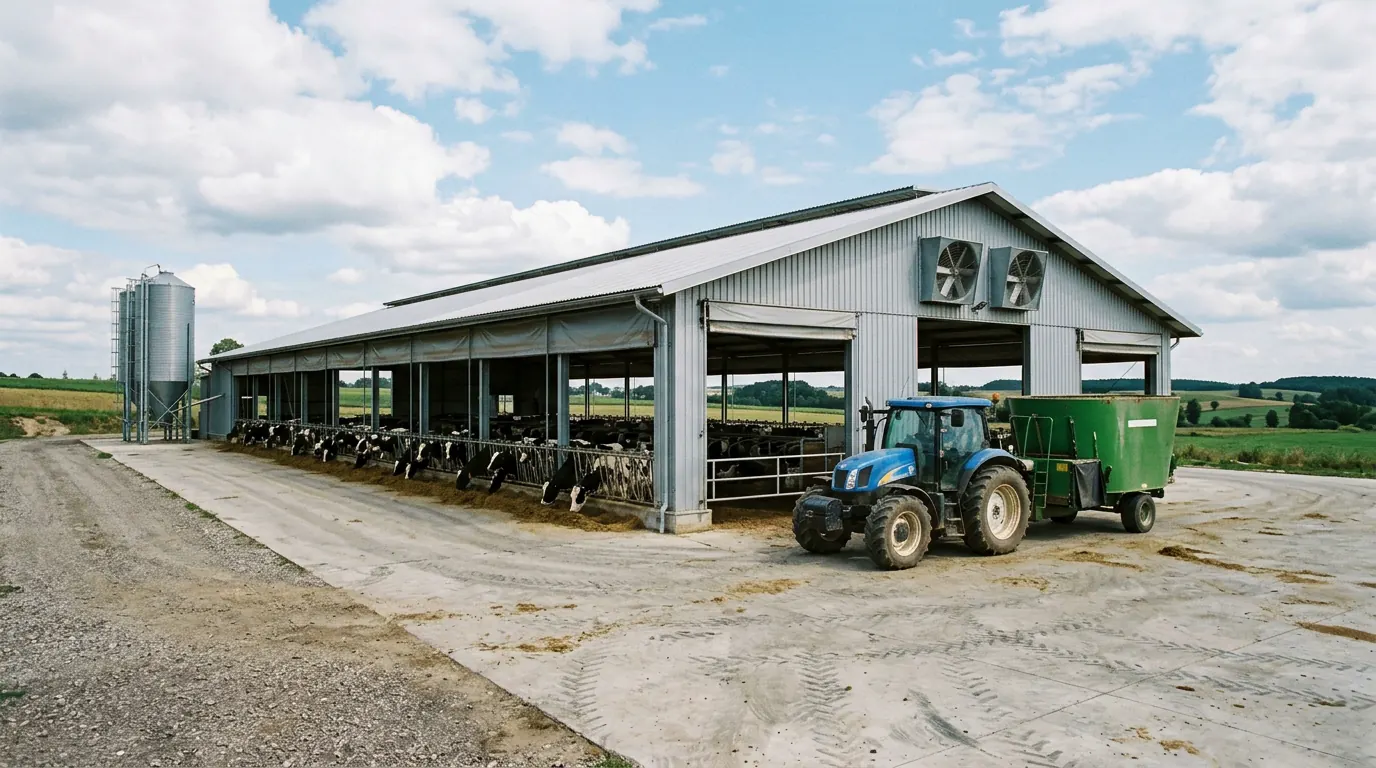
A slatted floor is made of bars, panels or beams. Manure and urine fall through it into a tank under the pen. The animal stands on a dry surface and the barn needs less manual cleaning. Slats usually pay off in herds with a steady, high stocking rate, where manure is collected continuously. With few animals and straw at hand, cheaper bedding more often wins. Below we describe stall dimensions under the rules, costs and a payback calculation.
Who this suits
In beef farming, slats are most common in fattening calves and young stock, where many animals share a small area. For a suckler herd that spends most of the time on pasture, slats usually make no sense. Before you choose a floor, describe your own system: number of animals, their weight, time spent in the barn and the amount of cleaning work. See also our guides to beef cattle barns and beef cattle farming.
Stall dimensions under the regulation
What the regulation sets
The minimum conditions for keeping farm animals are set by a regulation of Poland's Ministry of Agriculture and Rural Development (MRiRW), Dz.U. 2019 poz. 1966 (Poland's Journal of Laws), legal status as of 22.11.2026. It gives the size of the stall for cattle, not the size of the slats themselves. Design the slats so they fit a stall of the required size and do not restrict the animal's movement. Check the full text in the Internet System of Legal Acts, because the rules have several variants depending on the housing system.
Dimensions for fattening cattle and cows
For fattening cattle up to 300 kg, the stall must be at least 1.3 m long and 0.8 m wide. For cattle over 300 kg, the minimum rises to 1.45 m by 0.95 m. Cows and heifers over 7 months of pregnancy need at least 1.6 m by 1.1 m. Bulls need a stall of at least 2.4 m by 1.4 m. When you design, allow extra room for movement and the animal's height, not just the minimum values.
Area per animal
In the second housing system described in the regulation, what counts is the area per animal, not a single stall. For cows and heifers over 7 months of pregnancy, this is at least 4.5 m² per animal. If you plan several groups, calculate the area for each separately, because groups of different weight have different requirements.
Slats vs bedding: two basic systems
Slats and a tank under the floor
On slats, manure and urine fall through the gaps into a tank below the animals. You must empty the tank regularly, store the slurry in a sealed tank and spread it according to a plan. Slats give a dry, clean surface, but the animals stand on a hard floor, so gap width and the quality of the edges matter for their legs. Check that the contractor has chosen the material and gaps to suit the weight of your animals.
Deep litter
Deep litter is a different approach: manure builds up on the floor and you add a layer of straw or sawdust regularly. At the experimental farm of IZ PIB (the National Research Institute of Animal Production) in Kołbacz, beef herds were kept both on deep litter and on pasture, which shows that both systems are used in practice. Bedding needs straw and manure removal, but you do not have to build a tank under the floor.
Which one to choose
With a small herd, good straw supply and free floor space, bedding is usually cheaper to build. With a large herd and limited time for cleaning, slats cut the work. The decision depends on your straw balance, labor cost and options for hauling manure. Before you choose, calculate both options with your own data.
Slatted floor cost: what it depends on
Cost components
The price is made up of the load-bearing elements and surface (concrete panels, precast elements, bars or beams), installation and transport, building or enlarging the tank under the floor and preparing the foundation. Add the rebuilding of the barn and auxiliary equipment, for example a slurry pump or mixer. Price each item separately, because offers often cover only part of the work.
Prices and where to get them
Prices of building materials, steel and concrete change within short periods, so figures in a guide go out of date quickly. Ask at least several contractors for an offer split into materials and labor. Before you invest, also check whether you can get support from programs of Poland's ARiMR (Agency for Restructuring and Modernisation of Agriculture), because the agency sets the rules and deadlines.
Running costs
After construction, costs are electricity for the pump, time for emptying the tank, inspections and repairs of the gaps. Their size depends on the number of animals and how often you haul the slurry. If you track feed use as you go, records from feed silo monitoring make it easier to compare costs across cycles. Do not forget the saving on straw, which you buy less of with slats.
When slatted floors pay off
Break-even point
Slats most often win where there are many animals and work with straw and cleaning takes many hours. The longer the building is to serve and the more animals per floor, the easier it is to spread the investment over the years. With a small herd the investment often does not pay back, because bedding is cheaper than building.
A simple calculation
Put together three items: the yearly cost of straw and its transport, the labor time for cleaning, and the yearly installment for the slats and tank, spread over their service life. Compare these totals for both systems. It is also worth tracking feed indicators such as FCR, because animals in a clean, dry pen may use feed better. You can compare the results in the FCR and EPEF online module.
Ready-made calculations
Advisory publications show sample income calculations for beef production at different levels of intensity. Such material is a good starting point, but you must recalculate the figures with your own prices for feed, straw and live cattle. Repeat the analysis every year, because market prices change fast.
Health, hygiene and welfare on slats
Legs and hooves
Slats with gaps that are too wide, sharp edges or a slippery surface raise the risk of leg injuries and hoof problems. EFSA (European Food Safety Authority) opinions on beef cattle welfare point to floor quality and freedom of movement, so check these recommendations when you plan. Watch the herd after every floor change and report worrying signs to your vet.
Hygiene and disease
The tank under the slats and the slurry are a source of odor and pathogens, so clean and disinfect regularly. Records of entries to the barn help with biosecurity, and a ready plan makes it easier to repeat the same rules. At any suspicion of disease, for example lumpy skin disease, contact your vet. An electronic entry and exit log and a biosecurity plan generator will help.
Medicines and withdrawal periods
The vet always chooses the medicine and the dose. After each treatment, write down the date, the product and the withdrawal period, because it decides when the animal can go to slaughter. Keep treatment records up to date, not from memory, especially when the barn holds several groups. Treatment and withdrawal records make this easier.
Frequently asked questions
What size should slatted floors for cattle be?add
The MRiRW regulation (Dz.U. 2019 poz. 1966) gives minimum stall sizes, for example at least 1.3 m by 0.8 m for fattening cattle up to 300 kg. The slatted floor must fit the stall and not restrict movement. Agree the final design with a designer and your vet.
Are slatted floors required for beef cattle?add
The rules set requirements for stalls and floor area, but they do not prescribe one type of floor. The choice depends on the housing system and herd size. Before investing, talk to the county vet or an adviser, because inspectors assess the whole building.
How much do slatted floors for cattle cost?add
We give no amounts, because prices of materials and labor change within short periods and depend on the region. The price depends on the area, the tank under the floor and how much of the barn you rebuild. Ask for offers split into materials and labor and compare them with the cost of straw.
When do slatted floors pay off?add
Usually with a large herd and limited time for cleaning bedding. Add up the yearly cost of straw, labor and the investment installment, then compare the result with a bedding system. With a small herd, bedding more often wins.
Are slatted floors suitable for cattle on pasture?add
Cattle on pasture spend most of their time outdoors, so slats in the barn matter little there. A slatted floor concerns animals kept inside a building. If the herd is in the barn for only part of the day, calculate both situations separately.
How often should you empty the tank under the slats?add
It depends on the number of animals, the tank size and how you haul the slurry. Set a schedule with the contractor or an adviser and record every removal. The tank must be sealed so that no slurry leaks into the environment.
Sources & resources
- linkMRiRW / Journal of Laws — Regulation of the Minister of Agriculture on minimum conditions for keeping farm animal species — consolidated text (Dz.U. 2019 poz. 1966)
- linkIZ PIB — WZ — Beef cattle farming on the organic farm Glinna — IZ PIB Kołbacz experimental farm
- linkTeagasc — Teagasc Beef Manual — Section 3: Beef Systems
- linkODR Lubań (PODR publication) — Sample farm income calculation for beef production (different intensity levels)
- linkChief Veterinary Inspectorate — gov.pl/web/wetgiw
Prepared by: DlaFerm Team based on data from the sources listed · Publisher: INSTA-TECH sp. z o.o.
Do you keep a cattle herd and want treatment records under control?
The Treatment and withdrawal module helps you record treatments, products and withdrawal periods in one place. Create a free farm account and see how it works with your herd, or get in touch and we will show it to you live.
Phone
+48 796 258 151