Chicken vaccination schedule for a backyard flock
Your vet sets chicken vaccinations for your specific flock, not a ready-made calendar from a forum. The plan depends on diseases in your region, where the chicks came from and how the vaccine is given. Record every dose so you can track dates and withdrawal periods.
verifiedFrom the team that has organised work on poultry farms for years.
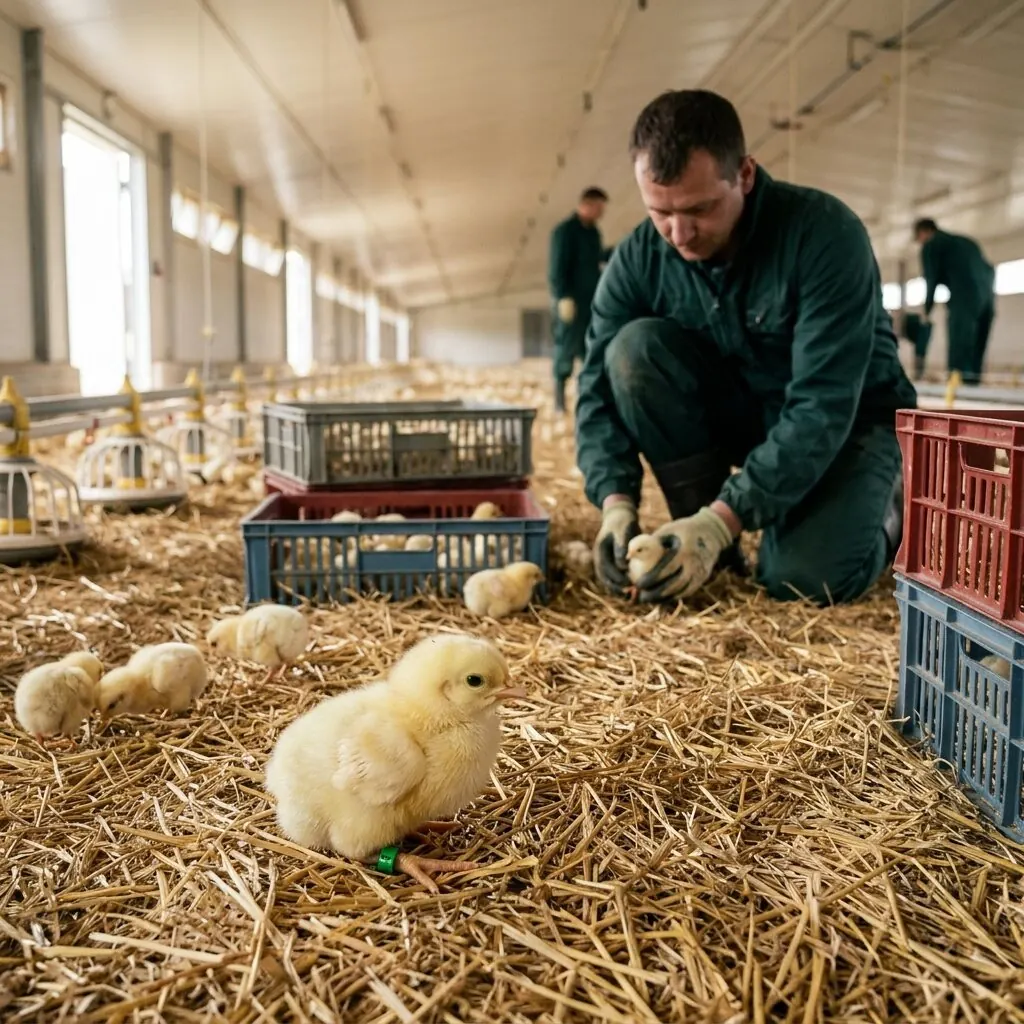
Your vet sets chicken vaccinations for your specific flock, not from a universal calendar copied from a forum. The plan depends on diseases in your region, where the chicks came from, contact with wild birds and other flocks, and which vaccines are available. Below we show what such a plan contains, how to record it, and what to watch when giving vaccines and counting withdrawal periods. Treat each point as a list of questions for your vet, not a ready schedule.
Why there is no single schedule
A commercial farm works to a protocol agreed with the hatchery and the vet, with a biosecurity program and a record of every dose. A backyard flock has fewer birds, but the risk is similar: a virus can arrive with a new bird, feed, boots or clothing. Vaccination advice changes with the disease situation, so before each season check current notices from Poland's Chief Veterinary Inspectorate (Główny Inspektorat Weterynarii, GIW) and talk to your vet. Also note which vaccinations were done last year, because that is the first thing a vet needs to set a plan.
How to build a chicken vaccination schedule
What each entry must contain
Each entry should have five items: the disease, the vaccine name with batch number, the age of the birds in days, the method of giving it, and the date of the next dose if one is needed. Add who gave the vaccine and how many birds were vaccinated. A year later such an entry lets you rebuild the flock's history without searching through scraps of paper. We describe vaccine types and availability in a separate article: Poultry vaccines: types and price.
Chicks from a hatchery
Chicks bought from a hatchery often arrive already vaccinated. Ask the seller for written confirmation of which vaccinations were done, when, and with which products. Enter this as the first item in your schedule. Do not repeat a vaccine without asking your vet, because a double dose is not always harmless for the bird, and mistakes in records are easy to make. If you buy chicks from several sources, keep a separate schedule for each batch.
Diseases to vaccinate the flock against
Newcastle disease
Newcastle disease is a viral poultry disease of very high virulence, controlled officially. On many farms vaccination against it is the base of the plan, and your vet sets its timing and type. Signs such as breathing difficulty, nervous signs or a drop in laying call for contacting your vet at once, not waiting. We describe the vaccination in Vaccination against Newcastle disease (ND).
Avian influenza
Avian influenza (HPAI) is a viral disease whose outbreaks in Europe appear especially during bird migration seasons. Vaccination rules for it are not the same as for Newcastle disease and depend on official decisions. In practice the most important measures are keeping the flock away from wild birds and strict hygiene, and you discuss vaccination with your vet. Current information is in GIW notices. More on the disease and vaccines: Avian influenza (HPAI) vaccines.
Marek's disease
Marek's disease is a viral, tumor-forming disease of chickens. Vaccination against it is standard in hatcheries, usually done on the first day of life. If you buy chicks from a hatchery, check that this was done and enter it in your schedule. If you raise chicks from eggs hatched in your own coop, ask your vet whether and when to vaccinate.
Storing and giving the vaccine
Storage
Every vaccine has temperature requirements in its leaflet. Many products are kept cold, so the fridge for vaccines should be separate from food. Do not freeze products if the leaflet forbids it, and do not use a product past its expiry date. Use an opened vial within the time the manufacturer gives. Write down the batch number and expiry date before you throw away the packaging, because you need these for any complaint and in an inspection.
Giving through drinking water
When a vaccine is given in drinking water, the water must be clean and free of disinfectants, which can neutralize the virus. Empty and rinse the drinkers before adding the product, and the birds should be thirsty to the degree the manufacturer recommends. The leaflet sets the exact time and amount of water. If you are unsure, ask your vet to show the technique on your own flock. For eye-drop vaccination, work with a second person so you do not mix up the birds.
Recording vaccinations and withdrawal periods
Why recording matters
A recorded vaccination is proof for your vet, a reference point for planning later doses and information in an inspection. If you sell eggs or birds, a buyer may ask about the flock's health history. Keep entries in one place, not in a notebook that is easy to lose. In the Treatment and withdrawal period module of DlaFerm.pl you record vaccinations together with medicines, dates and batch numbers, and the system shows when the withdrawal period ends.
Withdrawal period after vaccination
For many vaccines the withdrawal period is zero or not specified, but do not assume it. Check the leaflet and ask your vet. It is different if your vet prescribes an antibiotic or another medicine at the same time, because for it a withdrawal period is usually set and counted from the last dose. If two products are used in the flock, count the withdrawal period for each separately and apply the longer one. The rules on medicinal products are set out in law, and you can check the current text in ISAP (Poland's online legal database).
Vaccination does not replace flock protection
New birds
Keep every new bird separate for an observation period before you join it to the flock. Watch behavior, appetite and the look of droppings. Do not bring in birds from a show or market without prior testing. We describe flock protection rules for small farms in the generator: Biosecurity plan generator.
Water, feed and people
Clean water, dry litter and mold-free feed limit disease risk as much as vaccination does. Change shoes and clothes before entering the run, and send visitors to an entry zone. If you keep a larger number of birds, planning everything in one program simplifies control: Poultry farm management software.
Frequently asked questions
Do I need to vaccinate chickens if I only have a few?add
A small number of birds does not remove the need to think about flock health. Viral diseases spread between birds and from wild birds, and in a small flock signs are easy to miss. Agree with your vet which vaccinations are recommended in your region, and write the plan down.
Who should set the chicken vaccination schedule?add
The schedule is set by a vet who knows the region and the health situation of the flock. A guide can show what to ask, but cannot replace an examination of the birds. Before the visit, write down where the chicks came from, earlier vaccinations and any signs you have seen.
Can I buy chicken vaccines without a prescription?add
Availability depends on the type of product and the rules in force on the day of purchase. Some products may need a vet's order, so confirm this with your vet before buying. You can check the current legal position in ISAP, Poland's online legal database.
How long after vaccination can I eat the eggs and meat?add
For many vaccines the withdrawal period is not specified or is zero, but you always find the answer in the product leaflet. If a medicine was given in the same period, its withdrawal period counts, and the longer one applies. Record the dates of each dose so you do not have to guess.
What should I do if I miss the date of the next dose?add
Do not dose on your own and do not make up two doses at once. Contact your vet and say when the last dose was. The vet will decide whether the vaccination has to be repeated.
Is vaccination enough to protect the flock?add
No. Vaccination is one element of protection, alongside isolating new birds, clean water, entry hygiene and limiting contact with wild birds. Without these, even well-planned vaccinations give less protection.
Sources & resources
- linkChief Veterinary Inspectorate (GIW) — gov.pl/web/wetgiw
- linkISAP, Poland's online legal database — isap.sejm.gov.pl
- linkEFSA — efsa.europa.eu
- linkNational Research Institute of Animal Production (Instytut Zootechniki PIB) — izoo.krakow.pl
Prepared by: DlaFerm Team based on data from the sources listed · Publisher: INSTA-TECH sp. z o.o.
Still keeping vaccinations in a notebook?
The Treatment and withdrawal period module in DlaFerm.pl records vaccinations and medicines with dates, batch numbers and withdrawal deadlines. Create a free farm account and enter your first batch of birds.
Phone
+48 796 258 151