Cattle weight by chest girth: how to measure and judge it
No universal chart turns chest girth into kilograms, and we found none. The measurement still has value: Poland's IZ PIB (National Research Institute of Animal Production) uses chest girth as one of the traits for assessing beef cattle. Here is how to measure, what the data say and how to build your own girth-to-weight relation in your herd.
verifiedFrom the team that has organised work on poultry farms for years.
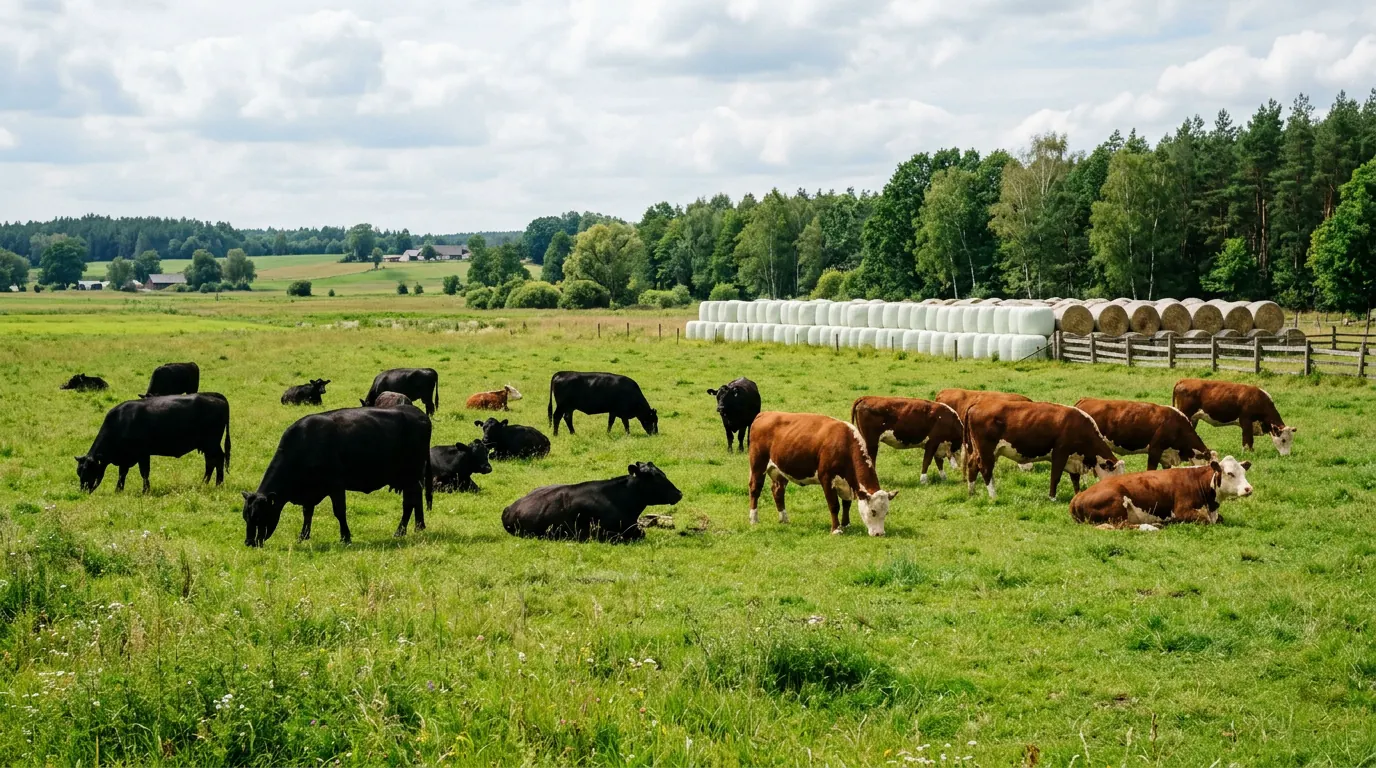
There is no universal chart that gives cattle weight in kilograms from chest girth alone. Studies by the Instytut Zootechniki PIB (IZ PIB) treat chest girth as one of the live measurements, next to body weight standardized to 210 and 420 days of age and height at withers. It is used to assess performance and breeding value, meaning the choice of animals for breeding, not to convert weight on the farm. If you need a quick estimate before sale, use the biomass-at-pickup calculator, and find our other tools in the calculators for farmers section. For more on the topic, see our beef cattle guide.
Why a measurement does not replace a scale
Girth changes with breed, sex, age, body condition and how the animal stands at the moment of measuring. The same bull measured in two different states of feeding gives different results. The IZ PIB formula was derived to assess bulls and rests on standardized weights, not on a single girth. So for a beef herd the scale remains the most reliable source of weight, and girth serves as a supporting trait for tracking gain.
How to measure chest girth
Where to place the tape and how the animal stands
Place the tape behind the shoulder blades, at a right angle to the spine, so it wraps the chest without squeezing the skin. The animal stands straight on level ground, does not lean on a wall and does not back up. Record the result in centimeters. Have the same person measure every animal, with the same tape, and with a similar rumen fill, for example always before feeding. Differences between measurements by one person are usually smaller than between two people.
Height at withers
Besides girth, IZ PIB also measures height at withers: the distance from the ground to the highest point of the back between the shoulder blades. Measure vertically, from the ground to the withers, with the animal standing on a level surface. Record both values together, because girth alone cannot tell you whether an animal is short and broad or taller and narrower. The same girth at a different height means a different body build.
Repeat the measurements
Measure at every weighing, not just once a year. Note the date, ear tag number, age in days and weight next to the girth. After several measurements of the same group you will see whether girth gain goes together with weight. Without a date and age, even good data cannot answer the question about growth.
What the Institute of Animal Production studies say
Live measurements in bull assessment
According to IZ PIB studies, the assessment of beef bulls uses body weight standardized to 210 days, weight at 420 days, chest girth, height at withers and an ultrasound measurement of the longissimus dorsi muscle thickness. The assessments have run since 2007 jointly with the Polish Association of Beef Cattle Breeders and Producers. So girth is collected as an input to the indexes, not as a stand-alone measure of weight.
Development Index
The Development Index (WR) is calculated with the formula given in IZ PIB publications: WR = 100 + (24.99 × M210 + 0.51 × M420 − 1.73 × WKL + 4.89 × OKLP) / 1000. The symbols are: M210 and M420, weights standardized to 210 and 420 days (kg); WKL, height at withers (cm); OKLP, chest girth (cm). The result is not a weight in kilograms but a relative index, so do not put your own weight into the formula without age standardization.
Standardized Muscularity Index
The Standardized Muscularity Index (SWM) presents a bull's muscularity as a value averaging 100 with a standard deviation of 10, and values usually fall between about 70 and 130. The Combined Assessment Index (WOZ) joins muscularity and development: WOZ = 0.6 × SWM + 0.4 × WR. In 2017, across two assessment seasons (2017/1 and 2017/2), 607 beef bulls were assessed. These indexes rank breeding sires; they do not price a single animal for sale.
What this means for you
The studies show one thing: development and muscularity are assessed together, from several measurements and with age standardization. If you want to use IZ PIB indexes in your herd, you need weight at a defined age, not girth alone. Check the details in the IZ PIB publications listed in the sources below.
Why we give no weight chart, and what to use instead
What is not known
None of the studies this article rests on contains a chart converting chest girth into body weight of beef cattle. Giving such values would be guessing. An overstated weight means the buyer pays less than you expected, and an understated one means you lose money at weighing. So you will not find kilogram values for particular centimeters here.
Your own relation in your herd
Pick a dozen or so animals of the same age group and breed. Measure girth, weigh them on the same day and write down both values. After collecting the pairs you will see how weight rises with girth in your herd. The relation will not carry over unchanged to another farm, because it depends on breed, feeding and age. With more data you can fit a simple relation in a spreadsheet.
Where to keep the records
Measurements, weights and dates are easiest to keep in one place, not in a notebook by the barn door. The farm management program lets you assign a result to a given animal and compare it with earlier measurements, and our beef cattle herd management software is built for the same job. For feed planning a feed calculator helps, and for the weight of a group, the biomass calculator before pickup.
Weight, price and selling live cattle
What the price depends on
The price per kilogram of live weight depends on current quotes, the animal's category, its sex and whether you sell by live weight or after slaughter. We give no amounts because they change. Check current quotes with the buyer and in market publications. Before pickup it is worth working out the cost of one kilogram of live weight, which a cost-per-kg calculator makes easier.
Weighing before pickup
Lead the animals to the scale calmly, without unnecessary stress and under steady conditions. Write down the weight and the time of weighing, because the buyer may have their own settlement rules. A girth measurement before pickup will not replace the scale, but it shows whether the group is growing evenly, and outliers are worth checking before shipping.
Withdrawal period and treatment
If an animal was treated, check the withdrawal period before shipping, because it decides the pickup date, not weight. The medicine and dose are always chosen by a vet. Record the date of administration and the end of the withdrawal period in the treatment and withdrawal records so you do not sell the animal too early.
What weight and girth depend on
Age and breed
Weight and girth grow with age, but the pace depends on breed. IZ PIB studies base the assessment on weight standardized to 210 and 420 days, because this lets you compare animals of the same age. So at every measurement record the exact age in days or months.
Feeding
The diet of cows and of rearing calves affects their development. The OODR Łosiów (an agricultural advisory center) leaflet on feeding beef cattle describes feeding rules in this production system, and Teagasc materials discuss feeding in beef systems. Work out detailed rations with a specialist, because they depend on age, weight and the feed on your farm.
Condition at the time of measuring
An animal after a long trip or stress can look different than when calm. Always measure under the same conditions and do not compare results from different days without a note. If the animal is sick or clearly weak, do not treat the result as representative, and report the case to a vet.
Frequently asked questions
Is there a cattle weight chart by chest girth?add
The IZ PIB studies we use contain no universal chart converting girth into weight. Girth is one of the measured traits in bull assessment. The safest approach is to build your own relation on animals from your own herd.
How do you measure the chest girth of cattle?add
Place the tape behind the shoulder blades, at a right angle to the spine, with the animal standing straight on level ground. Record the result in centimeters. Always have the same person measure with the same tape.
Is chest girth enough to sell cattle?add
No. Settlement is usually based on weight, so weigh the animals before pickup. Girth only gives you a feel for how fast the group is growing.
What is the IZ PIB Development Index?add
It is an index calculated from weights standardized to 210 and 420 days, height at withers and chest girth. Its result is not a weight in kilograms. The formula is given in the section on IZ PIB data.
How much does a bovine of a given girth weigh?add
We give no such values, because no reliable values are published, and weight depends on breed, age and condition. To learn the weight of your animals, weigh several head and build a relation in your herd.
Where can I check current live beef cattle prices?add
Quotes change weekly, so we do not publish them. Check with the buyer and in market publications. You can work out the cost of one kilogram of live weight in a DlaFerm.pl calculator.
Sources & resources
- linkIZ PIB — Wiadomości Zootechniczne — Breeding work in a beef cattle herd (Z. Choroszy et al.), WZ L(2012)1:11–20
- linkIZ PIB — WZ — New methods of assessing performance and breeding value of beef cattle (Z. Choroszy et al.), WZ LVI(2018)3:17–23
- linkIZ PIB — WZ — The role of IZ PIB in developing methods to assess performance and breeding value of beef cattle (G. Skrzyński et al.), WZ LVII(2019)1:114–119
- linkIZ PIB — Livestock keeping and breeding over 70 years. Cattle Breeding Department, Sheep and Goat Breeding Department
- linkOODR Łosiów (gov.pl) — Feeding beef cattle (leaflet)
Prepared by: DlaFerm Team based on data from the sources listed · Publisher: INSTA-TECH sp. z o.o.
Do you keep a beef herd and want all weights in one place?
Create a free farm account and see how the DlaFerm.pl farm management program keeps records of weighings and measurements for your herd, or get in touch with us.
Phone
+48 796 258 151