Cattle Prices and Buying in Lubelskie Province, Poland
The buying price for cattle in Lubelskie is not one fixed figure. It changes week to week and depends on carcass weight, the animal's class and how the buyer settles the sale. We show how the price is calculated under the method of Poland's Ministry of Agriculture and Rural Development (MRiRW) and where to check current data.
verifiedFrom the team that has organised work on poultry farms for years.
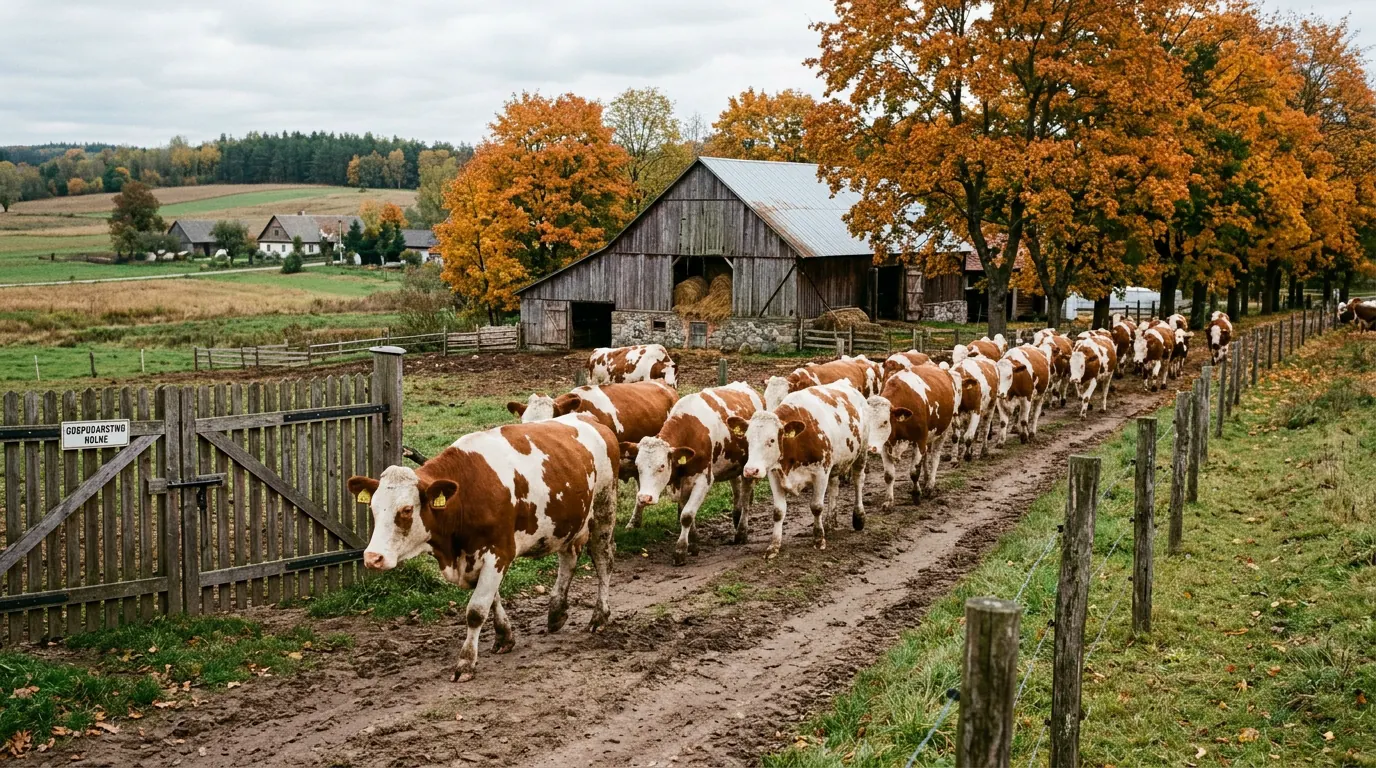
We do not give cattle buying prices for Lubelskie in PLN, because quotes change every week. You can check them in the market data from MRiRW. The price itself depends on carcass weight, class and additional payments. Cattle settlement has its own rules, so below we explain how the price is built and what to look at in an offer.
What to check before you sell
Before you offer animals to a buyer, check three things: body weight, the date of the last treatment and the sale documents. Each one affects the settlement. Skipping a withdrawal period can stop the sale, and a wrong weight changes the price. Record weight and treatments as you go, not only at loading.
What the cattle buying price depends on
Price based on chilled carcasses
The methodology for recording market data on beef and veal, developed by MRiRW, describes how the buying price of slaughter cattle is calculated. The base price comes from the value of the cattle bought and the weight of chilled carcasses. Two animals with the same live weight can give different results if their dressing yield differs. For every offer, ask which weight it is based on.
Average of subclasses and live-weight pricing
The methodology gives an example where the base price is an average of three subclasses. It describes separately how to calculate the price of cattle bought on live weight. The difference between the two methods is significant, so when you compare offers, check that both sides calculate the same way. Buying prices are also adjusted for additional payments, which you should note in the settlement.
Why weight and sale timing matter
Weight and age
According to an IZ PIB (Poland's Institute of Animal Production) data set on beef crossbreds on an organic farm, an animal at 19 months weighed 497 kg and at 25 months 591 kg. Height at the withers in the same data rose from 127 to 135.5 cm. Weight clearly rises with age, so the sale date affects the carcass. Before you set a sale date, weigh the group and compare the results with earlier batches.
Breed and daily gain
IZ PIB research on breed selection on organic farms shows that breed affects daily gain. In comparisons up to 15 months, differences between genetic groups were clear. Breed does not set the price by itself, but it affects when an animal reaches selling weight. So when you plan finishing, aim for a target weight, not just an age.
Cost of gain and finishing intensity
Extensive finishing on pasture
IZ PIB research on extensive finishing shows that grassland can produce good-quality beef cattle. Adding one or two grazing seasons lowers the intensity of gain, but the cost per unit of gain is clearly lower. For the farmer this means a longer rearing time with lower feed spending.
Calculating income from beef cattle
A publication from ODR Lubań (an agricultural advisory center) gives a sample calculation of farm income from beef cattle at different intensity levels. Work out your own cost per kilogram of gain: feed, pasture, vet and labor. Compare it with the buying price from the same period. The figures in the publication show a method, not a forecast for any given year.
Where to check prices and how to compare buyers' offers
Sources of market data
MRiRW collects and publishes market data on beef and veal. General information on agricultural policy is on gov.pl/web/rolnictwo. Check the date of the quote, because last month's price may no longer match the market. It is worth comparing Lubelskie data with neighboring regions, for example Mazowieckie or Podkarpackie, and with the national slaughter cattle quotes.
Comparing buyers' offers
Use the same week, the same settlement basis and the same class. Ask for a written settlement showing carcass weight, class and additional payments. Record the result of each offer in your own records, so after the season you can see which buyer paid best for your animals.
Withdrawal period and invoice before selling cattle
Withdrawal period before slaughter
A vet sets the withdrawal period after a medicine, and it must always pass before an animal goes to slaughter. The vet chooses medicines and doses, not the farmer. Enter every treatment in your records with the date and the animal group, so you know the withdrawal date before you sign a contract with the buyer. If in doubt, ask the vet before the animal goes to slaughter.
Invoice and settlement
You issue the invoice for cattle sold under the rules of KSeF, Poland's national e-invoicing system. Weight, number of head and buyer details should match the transport documents and your herd records. The KSeF invoicing module helps you carry this data over without retyping it.
Frequently asked questions
How much does cattle cost in Lubelskie?add
We do not give figures, because quotes change every week. You can find current data in MRiRW market materials and from the buyer. Compare offers from the same period and for the same class.
Are cattle priced per kilogram of live weight or carcass weight?add
The MRiRW method describes the buying price of slaughter cattle based on the weight of chilled carcasses. A live-weight price is calculated separately, under different rules. Always ask what basis the buyer uses.
What affects the buying price of cattle?add
The most important factors are carcass weight, the animal's class, the settlement basis and additional payments that adjust the price. The sale date also matters, because weight changes with age. Record these details for every batch.
Can I sell cattle during the withdrawal period?add
No. A vet sets the withdrawal period and it must pass before slaughter. Enter every treatment in your treatment and withdrawal records, so you know the date before you sign a contract.
How do I compare cattle buyers' offers?add
Ask for a written settlement with carcass weight, class and additional payments. Compare prices from the same week and on the same basis. Record the result of each offer, so after the season you can see which buyer paid best.
Is selling worthwhile when finishing cattle on pasture?add
It depends on the cost of gain and the rearing time. IZ PIB research shows that pasture lowers the intensity of gain but also the cost per unit of gain. Work out your own cost per kilogram and compare it with the buying price from the same period.
Sources & resources
- linkMRiRW (ZSRIR) — Methodology for recording market data on beef and veal
- linkIZ PIB — WZ — Breed selection and breeding work in organic beef cattle herds (P. Wójcik, A. Czubska)
- linkIZ PIB — WZ — Slaughter characteristics of beef from organic farms (P. Wójcik, J. Walczak)
- linkODR Lubań (PODR publication) — Sample calculation of farm income from beef cattle (different intensity levels)
- linkMinistry of Agriculture and Rural Development — gov.pl/web/rolnictwo
Prepared by: DlaFerm Team based on data from the sources listed · Publisher: INSTA-TECH sp. z o.o.
Want withdrawal periods under control before the buyer arrives?
The DlaFerm Treatment and withdrawal module tracks dates for each animal group and shows when cattle can go to slaughter. Create a free farm account and enter your first treatment, or get in touch with us.
Phone
+48 796 258 151