Wild boar vs domestic pig: differences, hybrids and ASF risk
Wild boar and domestic pigs are the same species, but they differ in build, behavior and role in spreading disease. Today the wild boar is an important carrier of the ASF virus in Europe. We show how to tell a wild boar, a young boar and a pig-boar hybrid apart, and which steps reduce the risk in your pig house.
verifiedFrom the team that has organised work on poultry farms for years.
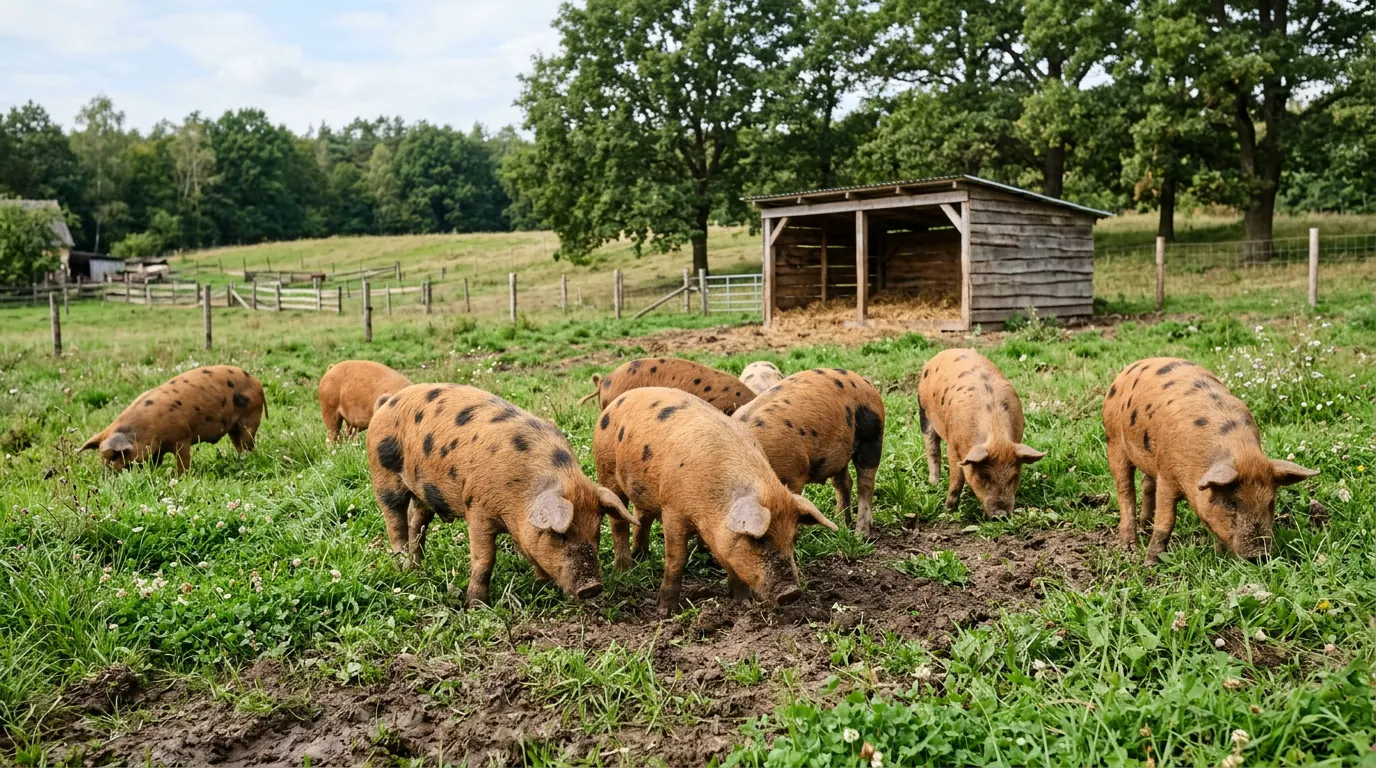
Wild boar and domestic pigs belong to the same species (Sus scrofa), and the domestic pig descends from domesticated wild boar. After many generations of selection they differ in looks, behavior and ability to cope with life in the wild. For a farmer the most important difference is another one: a wild boar can bring African swine fever (ASF) to your herd, and a domestic pig infected with the virus has no effective treatment.
The short answer: wild boar and domestic pigs differ in build, behavior and role in epidemiology, and pig-boar hybrids (Polish: świniodziki) are crosses of the two. Contact with a wild boar can be direct or indirect, through feed, equipment, footwear and people. Below we list the traits that help you tell the animals apart and judge the risk on your own farm. You report any suspected disease to a vet. You do not diagnose it yourself.
Wild boar and domestic pigs: how they differ
Build and looks
A wild boar has a long, narrow head, a long tapered snout and bristles over the whole body. Its trunk is slim and its legs are long and strong, so it can run fast and jump obstacles. The domestic pig was selected for growth and carcass. It has a shorter snout, erect or drooping ears, much thinner hair and a broader trunk. Skin and bristle colors in domestic breeds vary widely, from white to black, so color alone is not enough to identify an animal.
Behavior and senses
Wild boar live in family groups called sounders, and adult males usually keep away from the group. They have a very good sense of smell and use it to find food, often rooting through litter and soil. Domestic pigs on a farm are tame and used to handling. A wild boar runs from noise and people, but when wounded or surprised it can attack. Do not approach a wild boar or try to catch it without a trained crew.
Pig-boar hybrids and young wild boar on farms
What pig-boar hybrids are
Pig-boar hybrids (świniodziki) are crosses of wild boar and domestic pigs. You find them on hobby farms, in hunting enclosures and on farms that want to keep wild boar traits. Their looks vary a lot, depending on how much wild boar blood is in the line. They have no breed standard and no production data comparable to pig breeds. As far as disease is concerned, treat them like any pig: origin, health status and contact with wild boar affect the risk in the same way. Before buying, ask your vet which requirements apply to such animals in your county (powiat). Record the animals in your herd register, for example in the app for pig farmers.
Young wild boar: how to recognize them
Young wild boar (warchlaki) carry light lengthwise stripes on a darker coat, and the stripes fade and disappear with age. They are sometimes mistaken for piglets with similar coloring, especially when an animal reaches a farm from the forest or from a casual seller. When you buy, ask for origin documents and the place of birth. Bringing in an animal of unknown origin is one of the ways disease can reach a farm. Log every new animal in your records straight away.
Why wild boar are a danger to your herd
Wild boar as a reservoir of the virus
African swine fever is caused by a virus that is deadly for pigs and poses no threat to humans. In Europe wild boar are an important carrier of the virus in the environment. An infected carcass, contact with a live boar and its secretions can infect other animals. The virus is very hardy and can survive in feed, litter, on clothing and footwear. There is no approved drug or vaccine for ASF in the EU, so the effective defense is to keep the infection out. That is why limiting contact with wild boar is the base of every pig farm plan.
What the EFSA data for 2025 show
According to EFSA, in 2025 the number of EU countries affected by ASF rose from 13 to 14, after outbreaks in wild boar were reported in Spain, the first since the virus was eliminated there in 1995. EFSA recorded no new EU countries with outbreaks in domestic pigs this year, but Estonia reported outbreaks again after a year without them. The lesson for a farmer is simple: risk does not depend on whether your region already has outbreaks, but on how fast the virus can come from the forest. Read the EFSA analysis together with the zone map for your county. Recording every entry and procedure in the pig house helps in the first day of a suspicion, which we describe in ASF in the pig house: a record of every pen and data ready for the first day of suspicion.
Protecting your farm from contact with wild boar
Fencing and the area around buildings
The fence should make it hard for wild boar to enter the farm and the outdoor runs. Check it regularly for digging and holes, especially after rain and in winter, when tracks are visible. Around buildings, clear away litter, waste and any spots where wild boar could look for food. Store feed and litter in tight, closed rooms. Write wild boar tracks, carcasses by the fence and visits by free-living animals in your log. You can prepare a ready scheme of control points in the biosecurity plan generator.
People, equipment and feed
Work footwear and clothing should be changed at the pig house entrance, and footwear cleaned and disinfected according to your plan. Wash and disinfect vehicles, trailers and equipment brought from outside before they enter the farm. Register visitors in the farm entry and exit book, with date, time and purpose of the visit. Feed from an unknown source is an extra risk, so keep delivery documents. Workers who had contact with wild boar or carcasses should not enter the pig house without changing clothing and footwear.
The law and what to do when ASF is suspected
Legal state as of 22.11.2026
ASF control in Poland is set by the regulation of the Minister of Agriculture and Rural Development of 12.03.2026 on measures to control African swine fever (Dz.U. 2026 poz. 344, Poland's Journal of Laws). We give the legal state as of 22.11.2026, and before you decide, check the current version in ISAP (Poland's online legal acts database). Commission Implementing Regulation (EU) 2023/594, which lays down special ASF control measures, applies alongside it. Restriction zones can change, so check them regularly with your county vet (powiatowy lekarz weterynarii).
Reporting deaths and suspicions
Report a dead wild boar near the farm and any unusual signs in pigs to your vet straight away. Do not touch a carcass with bare hands and do not move it around the farm. Secure the spot, limit the entry of people and equipment, and write the event in your log. The rules for handling an ASF suspicion are set by the Chief Veterinary Inspectorate (Główny Inspektorat Weterynarii) and the county vet. Also record deaths and treatments in the Treatment and withdrawal period module, so the data is ready for an inspection.
Frequently asked questions
Can a domestic pig breed with a wild boar?add
Yes, crossing a wild boar with a domestic pig is possible and gave rise to pig-boar hybrids. Their traits depend on how much wild boar blood is in the line. Do not assume such a hybrid is safer from disease than a domestic pig.
How do you tell a young wild boar from a piglet?add
The surest sign is the lengthwise stripes on the back, which are clear in young wild boar and fade with age, plus the build: a slimmer body and a narrow head. If in doubt, do not buy the animal without origin documents. Leave the health assessment to your vet.
Can wild boar pass ASF to domestic pigs?add
Yes. Wild boar are an important carrier of the ASF virus in the environment. Domestic pigs get infected through contact with a live boar, its secretions, a carcass, or contaminated feed, litter and equipment. The virus does not pass to humans, but it threatens the whole herd.
Is there a cure for ASF?add
There is no approved drug or vaccine for ASF in the EU. Protection means keeping infection out: fencing, hygiene, control of entries and quick reporting of suspicions. Treatment of other diseases and withdrawal periods are set by a vet.
Do you have to register pig-boar hybrids?add
Every holding of pigs needs registration, and hybrids are no exception. Ask your county vet which duties apply to your situation. You can check the current rules in ISAP, Poland's online legal acts database.
What should I do if a dead wild boar lies by my fence?add
Do not touch it or move it. Secure the area, limit the entry of people and animals, and report it to your vet at once. Write down the date, time and place in your farm log.
Sources & resources
- linkEFSA — Epidemiological analysis of African swine fever in the European Union during 2025
- linkEuropean Commission / EU Publications Office — Commission Implementing Regulation (EU) 2023/594 laying down special ASF control measures (original version, PL)
- linkMinistry of Agriculture / Journal of Laws — Regulation of the Minister of Agriculture of 12.03.2026 on measures to control African swine fever (Dz.U. 2026 poz. 344)
- linkChief Veterinary Inspectorate — gov.pl/web/wetgiw
- linkOnline System of Legal Acts (ISAP) — isap.sejm.gov.pl
Prepared by: DlaFerm Team based on data from the sources listed · Publisher: INSTA-TECH sp. z o.o.
Want to plan ASF biosecurity for your pig house?
The Biosecurity plan generator in DlaFerm.pl walks you through a checklist of control points for your farm. Create a free farm account in DlaFerm.pl and start with your own plan.
Phone
+48 796 258 151