Turkey eggs: laying and incubation
A turkey hen lays during the season. The number of eggs and the hatch rate depend on the line, the age of the bird, lighting, feeding and how you store eggs before they go into the incubator. We explain what to watch at each stage. Take laying data from the breeder's line documentation, and always check incubation settings against the manual of your machine.
verifiedFrom the team that has organised work on poultry farms for years.
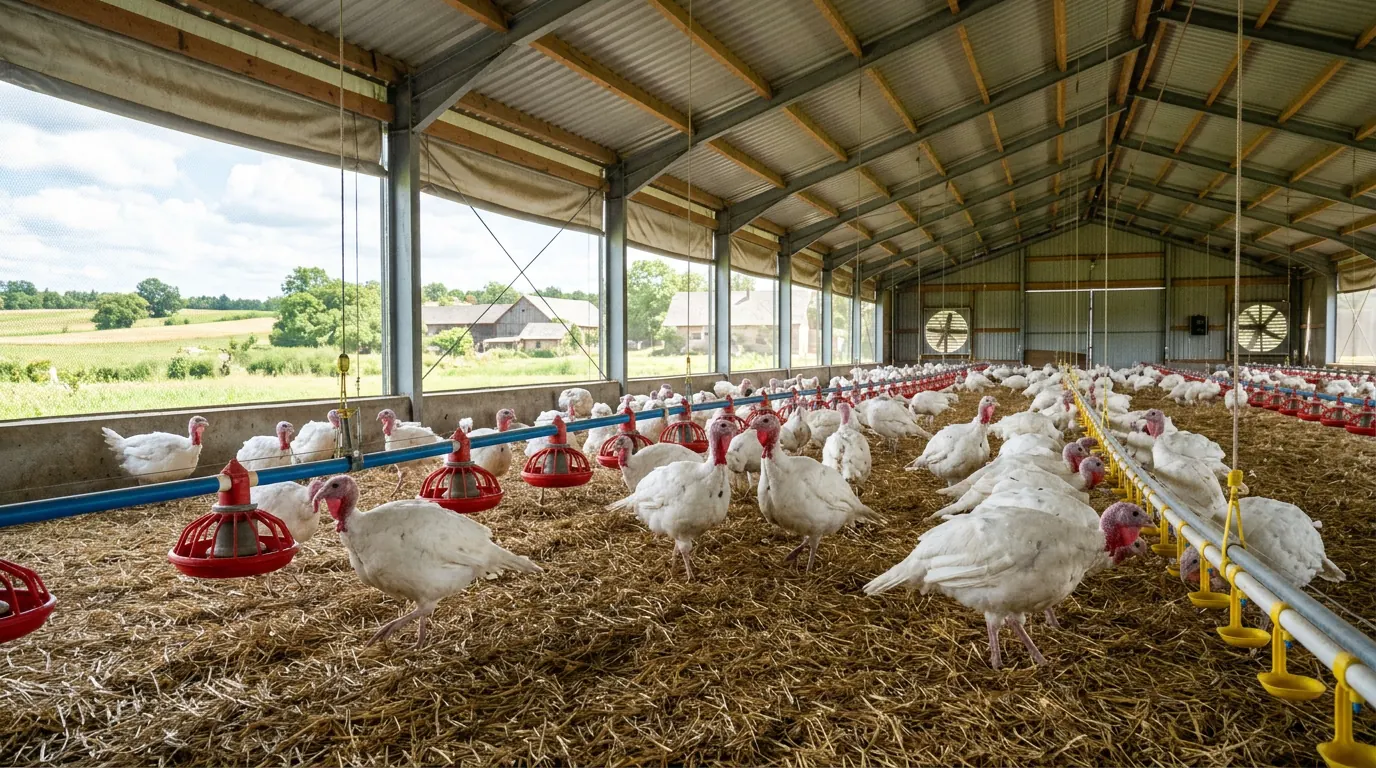
Turkey eggs are clearly larger than hen eggs and need different handling at every stage: from flock laying, through storage, to incubation. A turkey hen lays during the breeding season. The number of eggs depends mainly on the breeding line, the age of the bird, lighting and feeding. In incubation, humidity, temperature and regular egg turning count, and the hatch time for turkeys is about 28 days under the common industry norm. Below we describe what affects laying and how to prepare hatching eggs for the highest possible hatch rate. Agree recommendations for your own flock with a vet or a poultry adviser.
How turkey eggs differ from hen eggs
A turkey egg is much heavier than a hen egg, and its size and weight also vary between batches from the same week. So do not treat them like hen eggs when you plan storage, trays and setting time. Labeling batches separately lets you compare hatch results across weeks and flocks. If you keep hens and turkeys together, keep separate records so you do not mix up laying and hatch data. Differences in egg size show at collection, so record them from the first day of laying.
Turkey hen laying: what it depends on
Breeding line and age of the bird
The breeding line sets the laying potential, and the age of the bird decides when the flock starts to lay and how long it keeps high output. Young hens start later than adult birds, and eggs from the first weeks are often smaller and less useful for incubation. Before you plan hatches, check in the line documentation from which week to expect hatching eggs and what the typical laying curve looks like. Compare your results with that curve, not with a general average, because differences between lines are large. You can run the numbers in the flock laying calculator, and keep weekly records from the start of laying.
Lighting and season
Day length and light intensity stimulate reproductive hormones, so changing the lighting is one of the most common ways to regulate laying. A sudden shorter day or a break in light stops laying, while gradually lengthening the day stimulates it. In practice, make changes slowly, following the program prepared for your line, and write them in the flock log. Light changes and other triggers, such as moving or catching birds, cause stress, which also lowers laying. If output drops suddenly, first check flock health and water access, and only then change the lighting program.
Feeding and hatching egg quality
Energy and nutrients in the ration
The nutrition specifications for Ross parent stock give values for a base energy density of 2800 kcal/kg and note that they must be adjusted proportionally when the feed energy is different. The same handbook says portion size is set from body weight and laying performance, not fixed. This rule is universal, so you can carry it over to turkey hens: match the ration to weight and output, not to the calendar. Look for specific turkey norms in the line's feeding recommendations or ask an adviser. Change the diet gradually and watch weight and laying. We cover the general rules in our guide to feeding laying hens.
Assessing egg quality
Egg quality is judged, among other things, by albumen height, which helps catch problems with diet, bird age or storage. In practice, keepers more often check size, shape, shell cleanliness and how even egg weight is within a batch. To learn more about the indicators, see our explanation of Haugh units. Record check results with the date and batch number, because only a comparison over time shows a trend. Do not treat a single check as grounds to change the diet.
Storing eggs before incubation
Storage room temperature
According to the Ross Parent Stock Management Handbook 2023, which covers parent-stock hens, after laying the embryo stops growing normally once the egg cools to about 26–29 °C, and below 26 °C growth is clearly slower. All development stops at 15 °C. For you this means a stable, cool store without sudden temperature swings. The data concern hens, so treat them as a starting point for turkeys and check conditions with your hatchery or the line's recommendations. The handbook also notes that the more the embryos' stages of development differ at the start, the wider the hatch window, so collect eggs often.
Collecting and handling eggs
Collect eggs several times a day, especially in heat and frost, and discard cracked or dirty ones. Do not wash hatching eggs without a clear need, because you can damage the protective layer of the shell. Place eggs as the hatchery advises, usually pointed end down, and store them in a separate, clean room. Mark each batch with the laying date, because it decides the order of setting in the incubator. If eggs wait longer, note it in the log, because long storage raises the risk of a weaker hatch.
Incubating turkey eggs step by step
Humidity and temperature
Hatchery handbooks list wrong relative humidity and temperature among the most common causes of a poor hatch. The Ross Broiler Management Handbook 2025 states that too much moisture loss during incubation and wrong temperature lead to dehydrated chicks and poorer condition after hatch. Set the parameters according to the incubator manual and turkey recommendations, then check them daily with an independent thermometer and hygrometer, not only the machine's own sensors. We describe the settings in our guide to humidity in the incubator.
Hatch time
Under the commonly used industry norm, turkey eggs in an incubator hatch after about 28 days. The timing depends on temperature and storage, so do not book poult delivery for a specific day without a buffer. In the last days of the hatch, limit opening the incubator, because each opening changes the microclimate. You can compare with the hen cycle in our guide on how long a hen sits on eggs, but for turkeys your own schedule and hatchery data count.
Batch records and flock health
Hatching batch records
Record every batch: laying date, number of eggs, setting date, candling result and number of hatched poults. This lets you compare results across weeks and flocks and find the cause of a drop faster. In DlaFerm.pl you keep a poultry house record and plan hatch dates in the stocking and cycle planning module, so the dates are visible in one place. Also add notes on weather and feeding changes, as they often explain swings in results.
Treatment and withdrawal period
If the flock needs treatment, a vet chooses the medicine and dose. After a drug is given, a withdrawal period applies, and you must record it before eggs go to sale or to hatching. Keep a treatment log with dates of administration and the end of withdrawal, so you do not mix up dates. Check the rules on flock registration and movements on the websites of the Chief Veterinary Inspectorate (Główny Inspektorat Weterynarii) and ARiMR (Poland's Agency for Restructuring and Modernisation of Agriculture), as they can change. You keep treatment and withdrawal records in the treatment and withdrawal module.
Frequently asked questions
How many eggs does a turkey hen lay?add
The number depends on the breeding line, the age of the bird, lighting and feeding, so there is no single universal value. The most reliable way is to compare your results with the laying curve given by the line's producer. Keep your own weekly records to see the trend.
How many days does turkey egg incubation take?add
Under the commonly used industry norm, turkey eggs incubate for about 28 days. The exact timing depends on incubator temperature and how the eggs were stored before setting. Build a time buffer into your hatch schedule.
How long can you store turkey eggs before incubating?add
We do not give a universal limit, because it depends on storage temperature, humidity and shell condition. The shorter eggs wait, the better, and the store must be stable and cool. Ask your hatchery for its rules and record the laying date of each batch.
Can turkey eggs be hatched under a hen?add
Turkey eggs can be hatched under a broody hen, but it needs a suitable hen and a quiet place, and results are often less predictable than in an incubator. For hatching on a larger scale, rely on an incubator and a proven procedure. Discuss the decision with an adviser.
What mistakes most often lower hatchability?add
Most often these are wrong humidity and temperature in the incubator, storing eggs too long, and dirty or cracked eggs. The Ross Broiler Management Handbook 2025 also lists improper storage conditions and too much moisture loss during incubation among the problems. Record parameters and results to find the cause faster.
Do you have to document treatment of turkeys?add
Yes, after a drug is given a withdrawal period applies, and you must record it. A vet chooses the medicine and dose. Check the rules on flock registration and movements on the websites of the Chief Veterinary Inspectorate and ARiMR, as they can change.
Sources & resources
- linkRoss Parent Stock Management Handbook 2023 (Interactive)
- linkRoss 308 Parent Stock Nutrition Specifications 2021
- linkRoss Broiler Management Handbook 2025
- linkChief Veterinary Inspectorate (Główny Inspektorat Weterynarii) — gov.pl/web/wetgiw
- linkARiMR — gov.pl/web/arimr
Prepared by: DlaFerm Team based on data from the sources listed · Publisher: INSTA-TECH sp. z o.o.
Do you keep a turkey flock and plan hatches?
The stocking and cycle planning module in DlaFerm.pl helps you plan batches and hatch dates in one place. Create a free farm account and see how it works on your own farm.
Phone
+48 796 258 151