Sow vs gilt: differences, gestation, litter size
In practice a sow and a gilt are both breeding females. The difference is whether the female has already farrowed. Sow gestation lasts about 114 days, and you assess a litter with two separate counts: piglets born alive and piglets raised to day 21. Below we show how to tell the categories apart in the herd and in your records.
verifiedFrom the team that has organised work on poultry farms for years.
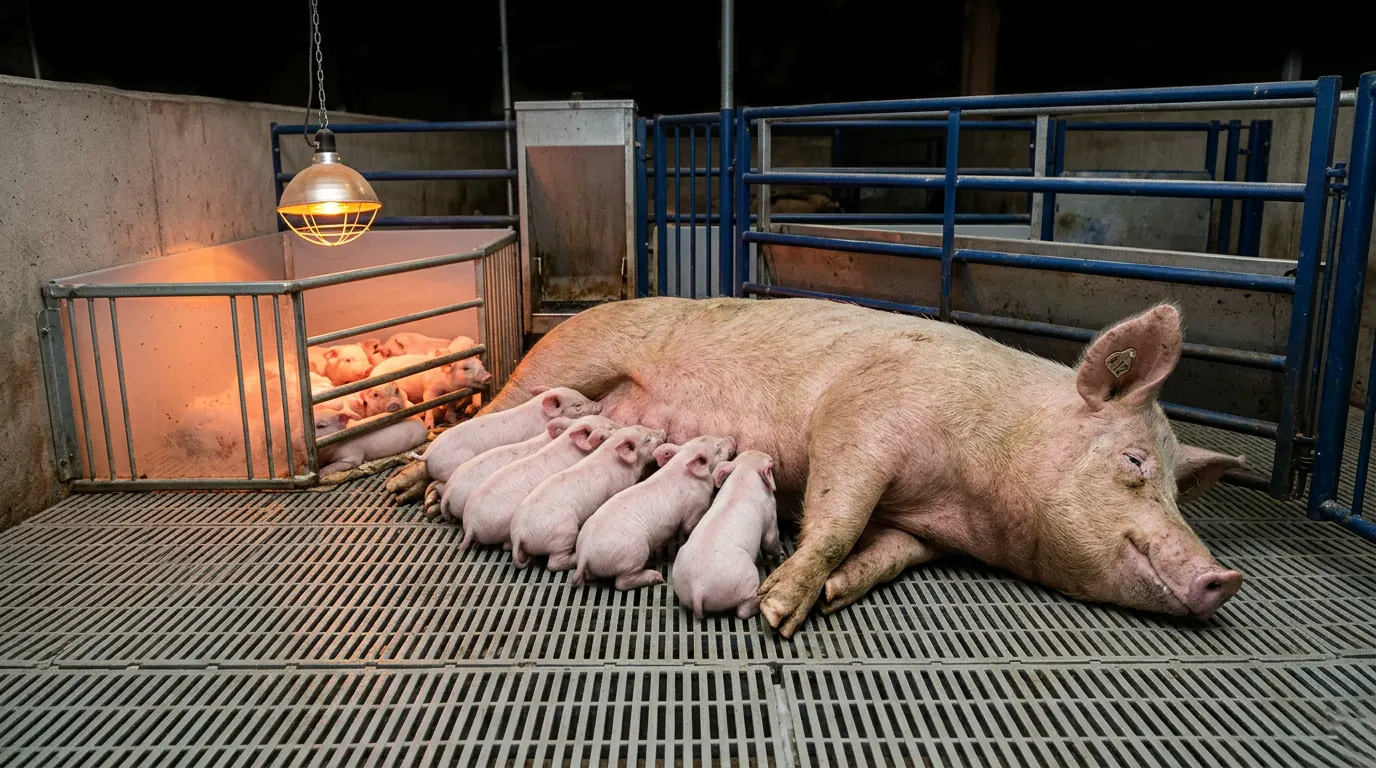
A sow and a gilt are not two breeds or two groups of animals. Usually they are the same adult breeding female at different stages of life, and the difference is in how the herd names her. According to the EFSA definitions in its opinion on pig welfare on farm, a gilt is a female past puberty that has not yet farrowed, and a sow is a female after her first farrowing. In Polish herds the everyday word "maciora" simply means an adult breeding sow. In your records, stick to one name and clear categories. The app for pig farmers makes keeping such records easier.
Gestation, farrowing and litter size: three questions
When people ask about a sow, they usually want to know three things: how long gestation lasts, what happens at farrowing, and how many piglets are left at weaning. Sow gestation averages about 114 days, a little over three months. You assess a litter with two figures: piglets born alive and piglets raised to day 21. IZ PIB (Poland's National Research Institute of Animal Production) lists them as separate traits, so keep them separate in your records too. The sections below go through each stage in turn.
Gilt, sow and maciora: categories in the herd
Gilt before the first farrowing
A gilt is a young female after puberty that has not yet farrowed. Directive 2008/120/EC and the EFSA opinion treat her separately, because housing and pen requirements cover females at different stages of reproduction. IZ PIB breeding summaries include the gilt's age at first farrowing, one of the traits used to assess a herd. Before a gilt goes to the farrowing house, record the date of first service and her age on the day she farrows.
Sow after the first farrowing
A sow is a female after her first farrowing. From then on every litter counts: record the number of piglets, the date of the previous farrowing and the interval to the next litter. EFSA also distinguishes dry pregnant sows, meaning the period from weaning to the next peri-farrowing period, and cull sows, meaning females sent for slaughter. This split helps you plan stocking and decide which females to remove from breeding.
Sow gestation: course and care in the herd
Length of gestation
Sow gestation lasts about 114 days: roughly three months, three weeks and three days. This is the standard figure used in the industry, but you calculate the farrowing date from the service date for each sow separately. That tells you when to move her to the farrowing house and when to prepare the room. Planning these dates in the batch and cycle planning module shows which sows are close to farrowing in the same week.
Preparing for farrowing
Under Directive 2008/120/EC (legal status as of 22.11.2026), pregnant sows and gilts are treated against external and internal parasites where necessary, and those moved to farrowing pens must be thoroughly cleaned of parasites. In the week before the expected farrowing, give the female enough nesting material, as long as the slurry system on the farm allows it. There must also be free space behind the sow so that farrowing can happen naturally or with assistance. A vet chooses the medicine and timing. Record the withdrawal period in the treatment and withdrawal records.
Farrowing and the first weeks of piglets
Piglet crushing
According to a study by KPODR Minikowo (a regional agricultural advisory center in Poland) on pig behavior and welfare, sows are usually very caring and can raise piglets well. Crushing still happens most often right after farrowing, and it becomes less frequent over time. Free-range sows check for piglets nearby before lying down. In a farrowing crate the sow's movement is limited, which raises the risk to piglets when she changes from sitting to lying. Note crushing for every litter. It shows whether the problem lies in the housing or in a particular sow.
Weaning no earlier than day 28
Directive 2008/120/EC states that piglets under 28 days old must not be weaned from the sow, unless the welfare or health of the dam or the piglets would otherwise be at risk. EFSA defines a piglet as an animal from birth to weaning, and a weaner as a pig from weaning to 10 weeks of age. In the litter card, record the age and number of piglets at weaning. You will use these data to assess the sow and plan finishing.
How many piglets does a sow have: what to count and how
Born alive and raised to day 21
In its assessment of reproductive performance, IZ PIB counts two basic traits: the number of piglets born alive in a litter and the number of piglets raised to day 21. The breeding value of each sow is calculated from the average of her litters. If a sow has had one litter, only that litter counts. For multiparous sows, litters from two, three or more farrowings are taken into account. A single good litter does not decide a sow's rating. At every farrowing, record both values separately.
Age at first farrowing and interval between litters
The IZ PIB summary for 2025 includes, among others, the number of piglets raised to day 21, the number of teats, the gilt's age at first farrowing and the interval between litters. The interval between litters is the time from one farrowing to the next, so it shows how quickly a sow returns to the cycle after weaning. Compare these values with your own results from recent years, not with another farm. You calculate production indicators such as FCR and EPEF in the FCR and EPEF online module.
Keeping sows in your records: what to write down
Sow card
A sow card should include the ID number, date of birth, age at first farrowing, service and farrowing dates, piglets born alive and raised to day 21, crushing losses and weaning dates. This set lets you assess a female before you choose her for further breeding. In DlaFerm you keep this card in one place, split into gilts and sows. If you keep your register in IRZplus (ARiMR's online animal register, run by Poland's Agency for Restructuring and Modernisation of Agriculture), check how to link the data in integrations with IRZplus and sensors.
Biosecurity when bringing in gilts
Every new gilt is a risk of bringing disease into the herd. Before she arrives, record her origin and quarantine dates, and agree a plan with your vet. You can prepare the farm's biosecurity rules in the biosecurity plan generator. Check current requirements with the Chief Veterinary Inspectorate (Główny Inspektorat Weterynarii), because the rules change and depend on the disease situation.
Frequently asked questions
What is the difference between a sow and a gilt?add
A sow is a female after her first farrowing, and a gilt is a female before her first farrowing. EFSA and Directive 2008/120/EC use these categories. In Polish herds "maciora" is the everyday name for an adult breeding female. In your records, stick to one name and clear categories.
How long is a sow pregnant?add
Sow gestation lasts about 114 days, a little over three months. Calculate the due date from the service date for each female separately. Report deviations from the norm to your vet.
How many piglets does a sow have in a litter?add
Record two values: piglets born alive and piglets raised to day 21. The exact average depends on breed, line and herd conditions, so compare it with your own results and with IZ PIB data.
When can piglets be weaned?add
Directive 2008/120/EC does not allow weaning piglets younger than 28 days, unless the health of the dam or piglets is at risk. Record such a decision in the litter card together with the reason.
Does a pregnant sow need worming?add
The directive provides for treatment against parasites where needed. A vet chooses the medicine, dose and timing. After treatment, record the withdrawal period in your treatment records so you do not mix up dates.
What should go on a sow card?add
The ID number, service and farrowing dates, piglets born alive and raised to day 21, crushing losses and weaning dates. These data are enough to assess a female when you choose breeding stock again.
Sources & resources
- linkKPODR Minikowo — Pig behavior and welfare (P. Dorszewski et al.)
- linkEU Publications Office — Council Directive 2008/120/EC laying down minimum standards for the protection of pigs (PL)
- linkEFSA AHAW Panel — Welfare of pigs on farm (EFSA Journal 20(8):7421)
- linkIZ PIB — BLUP breeding evaluation results, reproductive performance, 2026 issue 1
- linkIZ PIB (National Animal Breeding Center / trzoda.izoo.krakow.pl) — State of pig breeding and evaluation results in 2025
Prepared by: DlaFerm Team based on data from the sources listed · Publisher: INSTA-TECH sp. z o.o.
Want your sow cycle under control in one place?
Create a free farm account in DlaFerm.pl, choose the app for pig farmers and start with a batch plan for your first group of sows.
Phone
+48 796 258 151