Simmental: a dual-purpose breed
Simmental is a dual-purpose breed kept in Poland for both milk and beef. In a beef herd we value it for fast calf gain and good carcass yield, and its cows stand out for how long they stay in production. We show figures from IZ PIB research (Poland's National Research Institute of Animal Production) and what to record so you can compare your own results.
verifiedFrom the team that has organised work on poultry farms for years.
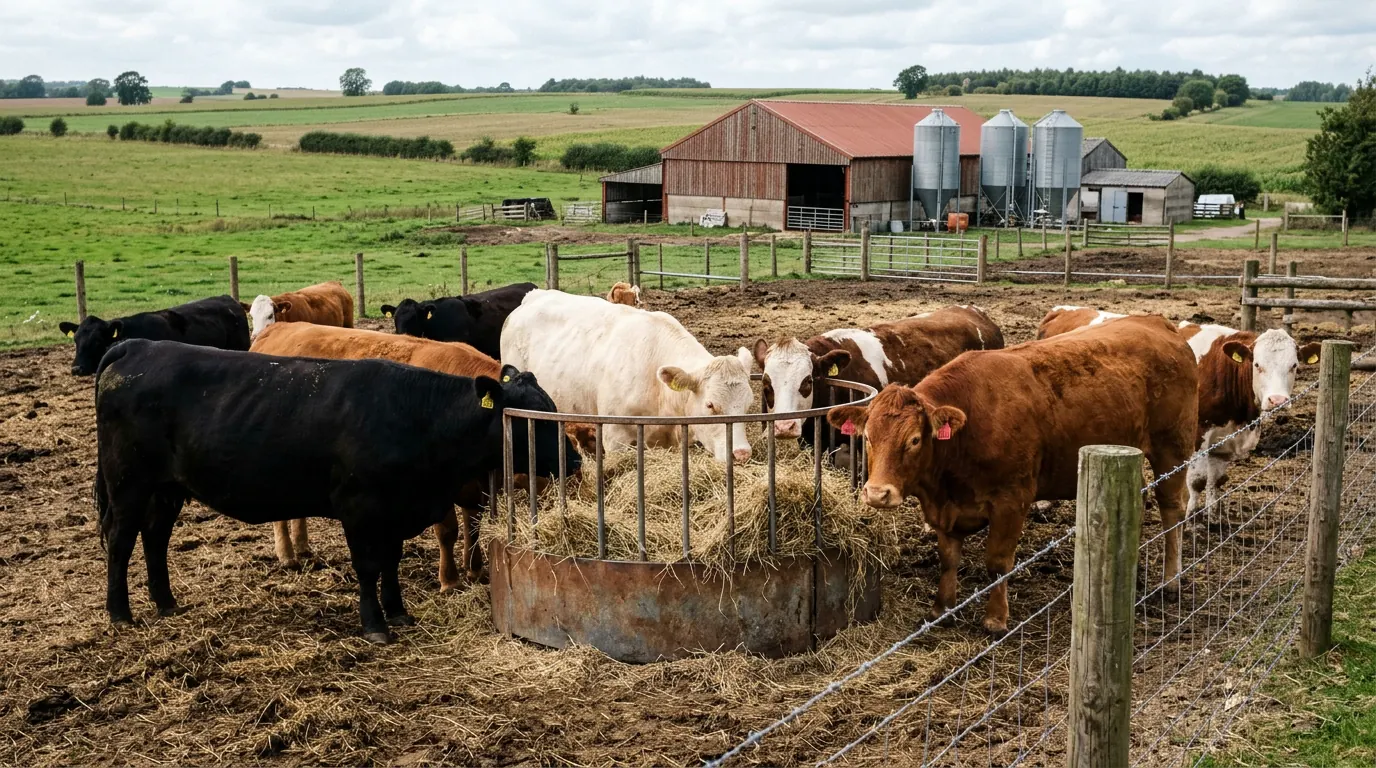
Simmental is a dual-purpose breed. In a beef herd it is used mainly as a sire for fattening and as a breed for crossbreeding. According to IZ PIB data (Grodzki et al., WZ 2015), the average weight of Simmental bull calves standardized to 210 days is 296.1 kg, with a daily gain of 1229 g. The data come from studies of the population in Poland, so use them as a reference for your own weighings, not as a guaranteed result.
Where the dual purpose comes from
According to IZ PIB, Simmental cattle from the dual-purpose population grow fast, have good carcass yield and carcasses that are not too fatty (Choroszy and Choroszy, cited in an IZ PIB monograph). The same population also gives milk, so in a beef herd you need to set a clear goal: suckler cows to raise calves, or bulls for fattening. That choice decides which bulls you pick and which results you record.
Growth and carcass yield of Simmentals
Calf gain
According to IZ PIB data (Grodzki et al., WZ 2015), Simmental heifers standardized to 210 days weigh 251.8 kg on average, gaining 1015 g a day. For comparison, Limousin bull calves reach 274.7 kg and 1095 g. Results depend on feeding and conditions, so record the weight at every weighing and compare it with these values. The staff app helps here: a farm hand enters the result straight from the scale.
Carcass yield
Research described by IZ PIB (Trela et al., WZ 2011) covered crossbreds from Polish Red (PR) cows and Simmental bulls. At 12 months the carcass yield was 56.87% against 57.54% in the control group, and at 15 months 59.04% against 59.01%. The differences are small, so your own slaughterhouse data decide profitability, not the breed alone. Record live weight before slaughter and carcass weight to calculate yield in your own herd. You can keep all indicators in one place with production indicators.
Simmental cows in a beef herd
Productive life
In the IZ PIB summary for the Simmental population (506 cows), cows at first calving make up 14.6% and cows beyond ten calvings 3.4%. For Limousin (11,186 cows) the values are 19.2% and 1.0%. Simmental cows more often reach higher calving numbers, which spreads the purchase cost of a suckler cow over more calves. Record the calving number for each cow to check this in your own herd.
Planning calvings
Even batches of calves make selling and rearing easier. Before you plan the next mating, set the calving dates and the date when each cow is ready to be bred again. Records show which cows come back into heat late, and you can base selection decisions on that. Keep the schedule in stocking and cycle planning. A vet assesses the cows' health before mating.
Breeding work with Simmental
Simmental in crossbreeding
According to IZ PIB, Simmental cattle crossed with dairy-breed cows give good-quality beef animals that meet the requirements of the meat industry. When you choose a bull for crossbreeding, check his pedigree and evaluation results. Record the bull's number against each calf crop so that after rearing you can compare the gain of his offspring.
Bull evaluation and identification
Performance and breeding value evaluation of beef bulls is run by IZ PIB centers and breeders' associations, and the result helps you pick a sire for the herd. Enter animal ID numbers as registered in the IRZ system (Poland's animal identification and registration system). You can sync the data with the IRZplus integration, which cuts down retyping the same numbers in two places.
Fattening and health of Simmentals on the farm
Feeding
The Teagasc Beef Manual (Ireland) describes feeding of beef cattle and ration planning for suckler cows and calves. Set the exact ration with a nutrition adviser and watch gain over time. Fast-growing animals should not be overfed on energy, because the risk of excess fat rises, and that lowers carcass value.
Treatment and withdrawal period
A vet always chooses the medicine and dose. Your job is to record every treatment and keep to the withdrawal period before slaughter or sale. Entries in the treatment and withdrawal records show which animal received a treatment and when it can be sold.
Running a Simmental herd step by step
What to record
For each calf record the birth date, birth weight and check weights. For each cow record the calving number and calving date. At sale record the live weight and the buyer. After a year, these data show whether the herd is moving in the right direction and help you spot weaker animals sooner.
Billing and invoices
Issue invoices for calves and services in a module that handles KSeF invoicing (KSeF is Poland's national e-invoicing system), so sales data do not live in a separate spreadsheet. We describe the formalities as of the legal state on 22.11.2026. Before you file anything, check the current text of the rules in the Internetowy System Aktów Prawnych (Poland's online legal database).
Frequently asked questions
How much does a Simmental bull calf weigh at 210 days?add
According to IZ PIB (Grodzki et al., WZ 2015), the average weight of Simmental bull calves standardized to 210 days is 296.1 kg, with a daily gain of 1229 g. The data come from studies of the population in Poland. Compare your own weighings with these values, because the result depends on feeding.
Is Simmental good for beef fattening?add
According to IZ PIB, Simmental cattle from the dual-purpose population give good-quality beef animals, and so do crossbreds from dairy cows and Simmentals. The breed grows well, but the result depends on feeding and housing. Before you decide, check your own gain and carcass yield.
How long do Simmental cows stay productive?add
IZ PIB data show that some Simmental cows reach higher calving numbers, though the spread depends on the herd. Record the number of calvings for each cow. That lets you work out how many calves each suckler cow rears and when to replace her.
How much does a Simmental bull or calf cost?add
We do not give prices, because they change and depend on pedigree, age and evaluation results. Ask the breeder for the pedigree and performance evaluation results. Check the current price on your local market or with a beef cattle breeders' association.
Do Simmentals need special care in winter?add
Housing rules depend on your farm's conditions, the age of the animals and how you feed them. Work out the details with an agricultural adviser (ODR) or a vet. Keep bedding dry, give constant access to water, and check the cows' body condition before calving.
Sources & resources
- linkIZ PIB — WZ — Current state and prospects of beef cattle rearing and breeding in Poland (H. Grodzki et al.), WZ LIII(2015)2:77–87
- linkIZ PIB — WZ — 60 years of IZ work on beef cattle (J. Trela et al.), WZ XLIX(2011)4:11–56
- linkIZ PIB — Farm animal rearing and breeding over 70 years. Cattle Breeding Department, Sheep and Goat Breeding Department
- linkTeagasc (Ireland) — Teagasc Beef Manual — Section 3: Beef Systems
- linkInternetowy System Aktów Prawnych (Poland's online legal database) — isap.sejm.gov.pl
Prepared by: DlaFerm Team based on data from the sources listed · Publisher: INSTA-TECH sp. z o.o.
Do you keep Simmentals or beef crossbreds?
The planning module helps you set the rhythm of calvings and sales, and the IRZplus integration keeps your animal data in order. Create a free farm account in DlaFerm.pl and see how it works for your herd.
Phone
+48 796 258 151