Silage for beef cattle: corn, grass and beet
Corn, grass and beet silage are bulk feeds for beef cattle. The amount you feed depends on animal weight, herd category and silage quality. Below we set out figures from IZ PIB, EFSA and Teagasc and show how to calculate the silage you have in store.
verifiedFrom the team that has organised work on poultry farms for years.
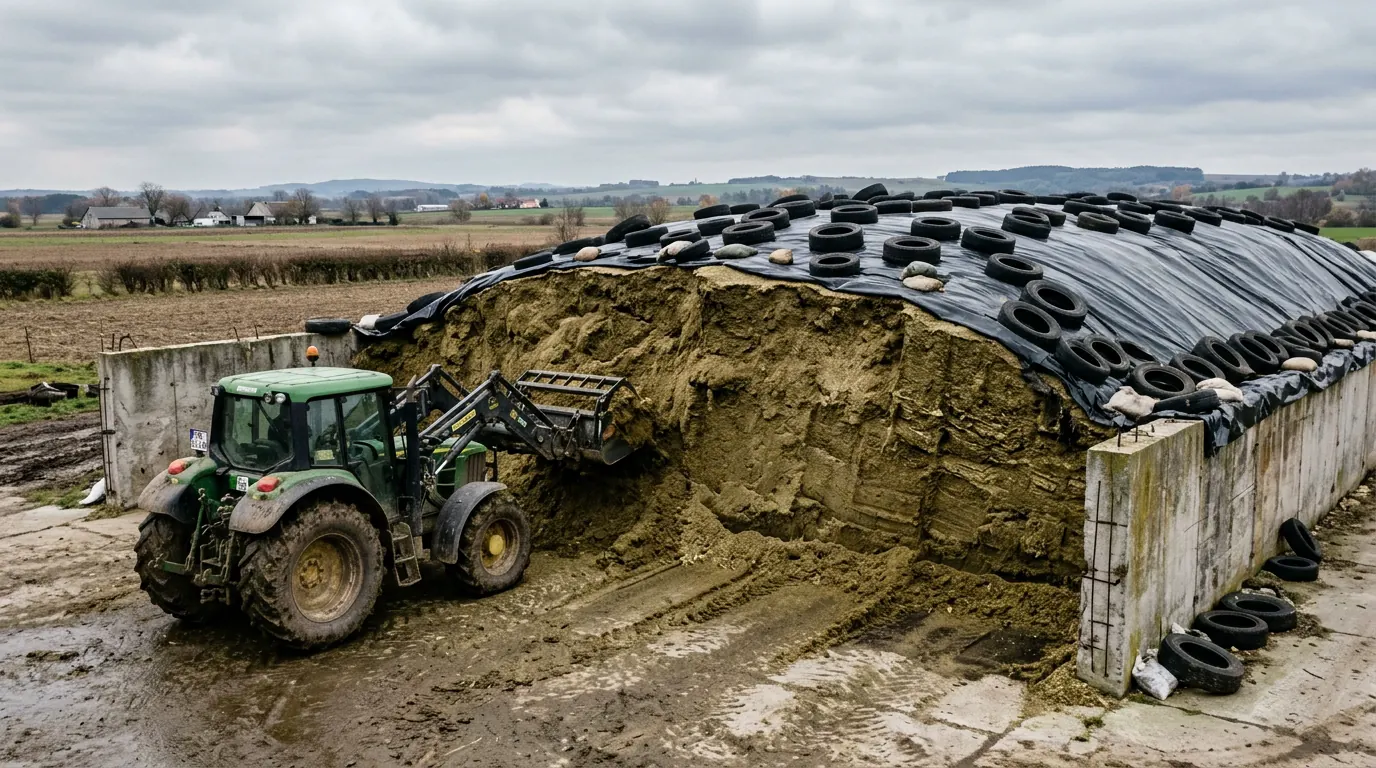
Corn, grass and beet silage are the bulk feeds that many beef farms build the diet on. You set the ration by body weight, category (suckler cows, calves, finishers) and silage quality, not with one norm for the whole herd. We give figures only from IZ PIB (Poland's Institute of Zootechnics), ODR (agricultural advisory centers), Teagasc and EFSA. Where the sources give no number, we describe the principle. Legal and knowledge state as of 22.11.2026.
The ration depends on the animal category
Cows rearing calves are fed mainly bulk feed. A leaflet from OODR Łosiów (an agricultural advisory center) says the feed should contain 4.1 MJ net energy and more than 18% crude fiber per 1 kg of dry matter. Weaned calves for fattening need feed with more energy and protein. Calves running with their dams get green forage, concentrate and hay on top of their mother's milk. That is why one ration for all cattle rarely works. Keep stocks and animals in one place, for example in the silo monitoring module.
Corn silage: ration by body weight
Approximate rations by body weight
In a table by Bilik et al. (IZ PIB, Wiadomości Zootechniczne 2014), corn silage at 30% dry matter is fed at 4 kg a day for cattle weighing 200 kg, 5 kg for 300 kg, 6 kg for 400 kg and 7 kg for 500 kg. Dry matter intake is then about 5.5, 7.2, 8.5 and 9.5 kg a day. The authors note that silage is fed ad libitum, so the rations are approximate. When you use two silages, mix them before feeding and give them as one mixture. The table covers organic production, so adjust the ration on your farm to weight gain and body condition, ideally with an advisor.
Corn grain and whole cobs
The OODR Łosiów leaflet points out that corn grain is high in fat, so adjust how much you give to the corn silage fed as bulk feed. Calves can be fed whole ensiled corn cobs. Rye is used only in limited amounts and only for older animals, because it contains non-starch polysaccharides with an anti-nutritional effect. Before you change the ration, check what is already in the silo and how much is left.
Grass and legume silage: the base for suckler cows
EFSA's opinion on beef cattle welfare (EFSA Journal 23:9518) describes the suckler cow diet as based mainly on bulk feed and lower in energy than the finisher diet. Before calving, energy is limited by feeding grass silage of moderate digestibility, about 660 g digestible dry matter per kilogram, in unlimited amounts. When the silage is high quality, part of it is replaced with straw. For grass-based feeding, EFSA says the average calving date is usually mid-March, at the start of the grazing season.
Wilted grass and mixtures
In the same IZ PIB table, wilted grass silage (30% dry matter) is given at 13 kg for cattle of 200 kg, 16 kg for 300 kg, 19 kg for 400 kg and 21 kg for 500 kg. Wilted grass and legume silage is 10–18 kg, and wilted meadow grass silage 9–16 kg. Grain and legume silage is 5–8 kg. The figures are approximate and apply to a specific composition. Check your own silage analysis, because quality changes with every cut. To keep stocks and rations together, the IRZplus integration (IRZplus is ARiMR's online animal register) links animal data with your records.
Beet silage: an addition to the ration
Our sources contain no ration table for beet silage, so we do not give a number you would have to guess. The principle is the same as for other bulk feeds: introduce the addition gradually over several days and watch feed intake and the animals' droppings. With every change, write down the date, composition and amount, so that after a few weeks you know what worked.
What to do before changing the ration
Before you add beet to the ration, discuss the composition with a vet or a nutrition advisor from the ODR, who will set the proportions and check the protein and energy balance. Do not swap one ingredient for another 1:1 without recalculating dry matter and energy. Changing one ingredient changes the whole diet.
How to estimate silage stocks in a silo
Volume and tonnes
The Teagasc Beef Manual (Section 6: Nutrition) shows a simple calculation. Multiply the silage volume (length times width times height) by a conversion factor to tonnes of fresh weight, which depends on dry matter. For silage at 25% dry matter the factor is 0.68, for 30% it is 0.60 and for 35% it is 0.53. The manual's example: a silo of 28 m × 10 m × 2.4 m holds 672 m³, which at 25% dry matter gives about 457 t of fresh weight. The authors stress that estimating stocks in a clamp can be very imprecise, so leave a margin when you plan stock to last until spring.
Feed share in costs
A sample calculation from ODR Lubań for beef production shows how large a share of direct costs goes on feed. Feed costs make up 71.0% in the crossbred variant and 65.1% in the purebred beef variant. Corn silage accounts for about 25% of costs in both, and wilted grass silage for 11–12%. Feed prices change from season to season, so work out costs from your own data, not someone else's figures. Track stocks in silo monitoring and complete herd records with data from IRZplus.
Diet changes and animal health
Silage of random composition, quality that differs between silos and a sudden switch to a new batch are risks for the digestive system. Make every change gradually and check the animals every day. Only a vet chooses a drug and its dose. In your records, note when a product was given and what the withdrawal period is, because it affects when you can sell animals. Keeping these entries in the treatment and withdrawal module makes inspections easier.
When to call a vet
If feed intake drops clearly for several days after a ration change, or the animals have diarrhea, do not wait to call a vet. Give the vet the ration composition and the date of the change, which helps find the cause. Adjust the ration only after the vet's advice.
Frequently asked questions
What silage is best for suckler cows?add
For suckler cows the base is grass silage of moderate digestibility, according to EFSA about 660 g digestible dry matter per kilogram, fed in unlimited amounts before calving. Better silage can be partly replaced with straw. Set the composition with an advisor based on a feed analysis.
How much corn silage should I feed cattle weighing 300 kg?add
According to the IZ PIB table the approximate ration is 5 kg of corn silage at 30% dry matter a day. Silage is fed ad libitum, so adjust the amount to weight gain and body condition. A vet or nutrition advisor makes the final decision.
Can I mix grass silage and corn silage?add
Yes. According to IZ PIB, when you use two types of silage, mix them before feeding and give them as a mixture. Try to feed the mixture in the same proportions every day so the composition does not change from day to day.
How do I calculate how much silage is in the silo?add
Measure the length, width and height of the clamp, then calculate the volume in m³. Multiply it by the conversion factor to tonnes of fresh weight, which depends on dry matter, for example 0.68 for 25% dry matter according to Teagasc. The result is approximate, so keep a safety margin.
Can beet silage replace corn silage?add
We give no conversion because our sources have none. Introduce changes gradually and do not swap ingredients 1:1 without recalculating dry matter and energy. Discuss the change with a vet or an ODR advisor.
Sources & resources
- linkTeagasc (Ireland) — Teagasc Beef Manual — Section 6: Nutrition
- linkIZ PIB — Wiadomości Zootechniczne — Feeding beef cattle in organic production (K. Bilik et al.)
- linkOODR Łosiów (gov.pl) — Feeding beef cattle (leaflet)
- linkODR Lubań (PODR publication) — Sample farm income calculation for beef production (different intensity levels)
- linkEFSA AHAW Panel — Welfare of beef cattle (EFSA Journal 23:9518)
Prepared by: DlaFerm Team based on data from the sources listed · Publisher: INSTA-TECH sp. z o.o.
Running a beef herd and counting your feed stocks?
With DlaFerm.pl you track silage stocks in the silo monitoring module and link animal data with IRZplus. Create a free farm account or get in touch, and we will show you how it works in practice.
Phone
+48 796 258 151