Red free-range broiler: reviews, weight, rearing
The red free-range broiler is a slower-growing meat bird kept in a system close to free-range, with a longer fattening period than fast-growing hybrids. We explain how to track flock weight, how to read breeder reviews and what drives rearing. We give numbers only with a source, and for this breed we recommend your own records from earlier batches.
verifiedFrom the team that has organised work on poultry farms for years.
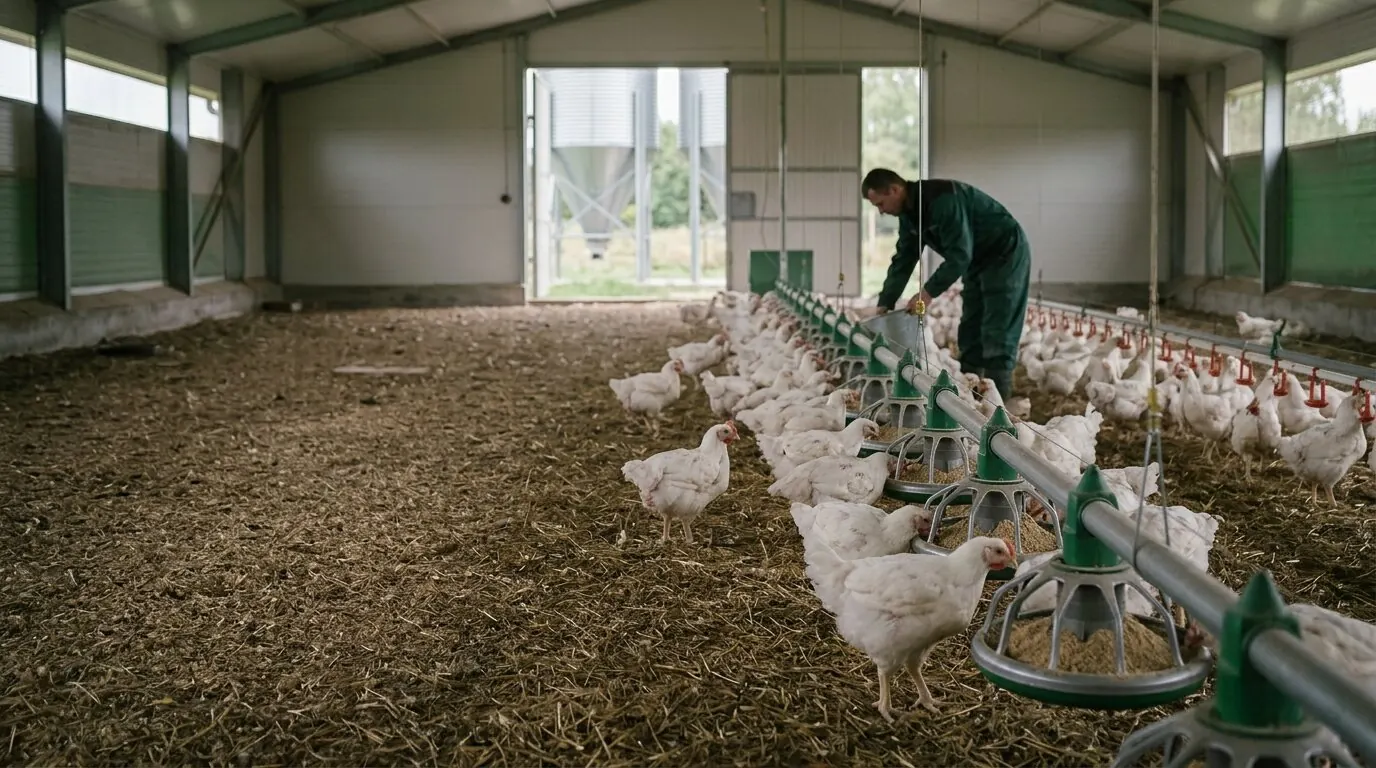
The red free-range broiler (brojler czerwony zagrodowy) is a meat bird from the group of slow-growing colored breeds, not a fast-growing commercial hybrid. Its slaughter weight comes more slowly, so you fatten it longer, and feed use per kilogram of gain is usually higher. In a free-range system the birds have access to a run, which affects movement, condition and growth rate. There are no reliable weight standards for this breed, so always compare weight with your own records and with the plan agreed with your chick supplier.
Breeder reviews: how to read them
Reviews of the red free-range broiler vary. Some breeders praise the taste of the meat and the birds' resilience in run conditions; others complain about slow gain and higher feed cost per kilogram. Before you trust a review, check whether the author gives slaughter weight, bird age, housing system and feeding method. A review without these data cannot be compared with your farm. The best reference is a flock record kept over several batches in the same system. Reviews are accounts from individual breeders, not comparative studies, so treat them as a lead to check.
Red free-range broiler weight: how to track it
Weigh from day one
The Ross Broiler Management Handbook 2025 recommends weighing birds often, from the first day of life, always with the same standardized, repeatable method. The rule is written for fast-growing hybrids, but it helps with any breed: only an identical procedure gives results you can compare. Pick the sample from different places in the house, not only near the feeder. Write the result down at once, with the date and the number of birds in the sample. After a few weeks you see a trend, not a single case. We describe weighing and sampling methods in a separate text on weighing broilers without catching the birds. Rules for rearing the whole flock are in our broiler rearing guide.
What to do when a result does not fit
The Ross Broiler Management Handbook 2025 recommends that when a result differs from earlier weighings or from the expected gain, you weigh a second sample straight away. This confirms whether the problem is real and helps you find the cause: wrong sampling, a feed change, drinker failure, temperature swings or disease. Do not change the feed ration on the basis of one weighing. First check drinkers, temperature and water use, because these are the most common sources of trouble. We cover water use in water consumption in broilers. If you suspect disease, call your vet, who decides what to do next.
Longer growth than hybrids
The red free-range broiler is fattened longer than standard commercial hybrids, so target weight tables for fast-growing breeds are not the right yardstick for it. Ross 308 Nutrition Specifications from 2022 sets feeding by target live weight: up to 2.0 kg, from 2.0 to 3.5 kg and above 3.5 kg (as-hatched). This split shows that feeding changes with the bird's weight, not only with age, and you can carry the principle over when planning other breeds. Still, set rations from your own weighings. Feeding details are in broiler feeding standards.
Rearing the red free-range broiler step by step
First week
The first days decide how even the flock will be. Chicks must find water and feed quickly, and the temperature under the heat source should match their behavior, not only the thermometer reading. Watch whether the birds spread out evenly or huddle in corners, which signals a draught or too low a temperature. Check drinkers several times a day. Record feed and water use, because deviations in the first week foretell later problems. We describe the first-week plan in rearing broiler chicks: the first week.
Run and environmental enrichment
Free-range birds have a run, and its quality affects movement and condition. Keep litter dry and move feeding spots so you do not foul one patch of ground. Enrichment means, for example, shrubs, beams or scratching areas that encourage the birds to move. Remember ventilation: damp litter in the house raises the risk of leg problems, even when the birds spend a lot of time on the run. We expand on enrichment and ventilation in environmental enrichment for broilers and our text on poultry house ventilation.
Lighting and calm in the flock
The lighting program affects how fast birds eat and whether they overexert themselves. Bright light at night adds stress. Set a fixed light plan and do not change it during a batch without a clear reason. Calm entries into the house, less noise and gentle moving of birds during weighing reduce stress.
Feeding and gut health: what to watch
Ration matched to weight
Set the amount of feed by the weight and growth rate of the flock, not by the calendar. A slow-growing bird eats differently from a hybrid, so a rigid table from a fast-growing breed's manual can overstate or understate the ration. Record feed use per house and compare it with the gain from weighings. The feed conversion ratio (FCR) shows how many kilograms of feed you used per kilogram of gain. It is the best indicator of whether your feeding plan works. DlaFerm.pl lets you calculate production indicators such as FCR and EPEF online.
Gut and prevention
Gut health affects feed use and resistance to disease. Changes in feed composition, sudden switches between mixes and wet litter raise the risk of gut problems. Programs that support gut flora are set by a vet or a nutrition adviser. Do not pick products yourself. Worms and salmonella need testing and a plan with your vet; an entry in the flock record is not enough. You will find more in our guide to broiler gut health.
Medicines and withdrawal periods
Treatment is set by a vet, who chooses the medicine and dose. You record the date given, the dose, the withdrawal period and the date after which selling the meat is allowed. The vet and the product documentation give the withdrawal period. A record in the system prevents a mistake at dispatch, because all dates are in one place. DlaFerm.pl has a treatment and withdrawal records module for this.
How to choose the red free-range broiler for your farm
Comparison with a hybrid
Choosing between a slow-growing and a fast-growing breed is a decision about what you want to sell and where. Fast-growing commercial hybrids have detailed performance tables but need intensive feeding and a well-controlled house. The red free-range grows more slowly but suits local sales and a system with a run. Before you buy chicks, ask the supplier for data from earlier batches and compare it with your own results.
Selection for robustness
Selection for robustness is a direction in which breeders choose birds that stay healthy in run conditions, not only birds that grow fast. For a farm it means you should judge the flock over several batches: losses, weight and leg problems. Such records are your best argument in talks with a supplier. Read more in selecting broilers for robustness.
Your own indicators instead of other people's opinions
Before you decide on the basis of other people's accounts, work out your own indicators: weight in successive weeks, feed use, losses and time on the farm. Comparing two batches calculated the same way gives a reliable answer that no internet review can. If you keep records in one system, the comparison takes a few minutes, not a whole evening with sheets of paper.
Biosecurity and duties when keeping poultry
Biosecurity on the run
Birds on a run can come into contact with wild birds. Limit visits by strangers, keep a log of entries and exits, change footwear and disinfect equipment at the house entrance. You can build a biosecurity plan in the DlaFerm.pl biosecurity plan generator. Record people's entries and movements in the QR entry and exit log module, so you have a register ready in case of an inspection.
Avian influenza zones
Duties in HPAI (avian influenza) protection and surveillance zones are set by Poland's Chief Veterinary Inspectorate (Główny Inspektorat Weterynarii, GIW) in the current rules. The legal status in this guide is dated 22.11.2026, so before you act, check the current text in ISAP (Poland's online database of legal acts) and on the GIW website. In practice the inspectorates may require more than the general rules do, so ask your county veterinarian before you decide. We describe the zone rules in HPAI zone duties.
Documents and settlements
When you sell birds and poultry catching services, every document counts. Invoicing in KSeF (Poland's national e-invoicing system) and settlements with poultry catching crews are best kept in one place, so house data matches the invoice. You can check farm support with ARiMR (Poland's Agency for Restructuring and Modernisation of Agriculture). DlaFerm.pl has KSeF invoicing and poultry catching crew modules to support your paperwork.
Frequently asked questions
Is a red free-range broiler the same as a fast-growing broiler?add
No. The red free-range broiler is a slow-growing meat bird that is fattened longer than a fast-growing commercial hybrid. It has a different growth rate, different feed use and different run requirements. Hybrid performance tables are not suitable for judging it.
How much does a red free-range broiler weigh?add
There are no reliable weight standards for this breed. Weight depends on age, feeding and housing conditions. Compare results with your own weighings from earlier batches and with the plan agreed with your chick supplier.
Are breeder reviews of this breed reliable?add
Reviews are accounts from individual breeders, not comparative studies. Check whether the author gives slaughter weight, bird age, housing system and feeding method. Without these data it is hard to compare the result with your own farm.
How often should I weigh a broiler flock?add
Weigh often, from the first day, always with the same repeatable method. The Ross Broiler Management Handbook 2025 says a result that does not match expectations should be checked at once with a second sample. Record every result in the flock record.
Can I choose a medicine or dose for sick birds myself?add
No. A vet always chooses the medicine and dose. You record the date given, the dose and the withdrawal period, and you set the date for selling the meat after that period ends. Call the vet without delay at any worrying sign.
Sources & resources
- linkRoss Broiler Management Handbook 2025
- linkRoss 308 / 308 FF Broiler Nutrition Specifications 2022
- linkRoss 308 / 308 FF Broiler Performance Objectives 2022
- linkChief Veterinary Inspectorate (Główny Inspektorat Weterynarii): gov.pl/web/wetgiw
- linkInternet System of Legal Acts (ISAP): isap.sejm.gov.pl
Prepared by: DlaFerm Team based on data from the sources listed · Publisher: INSTA-TECH sp. z o.o.
Want to compare weights and losses from earlier batches?
The DlaFerm.pl digital flock record stores weighings, feed use and losses in one place, so you can compare your next batch with your own data. Create a free farm account and enter your first weighing.
Phone
+48 796 258 151