Raising piglets: from birth to weaning
Raising piglets means managing three critical periods: the first days after birth, the fast growth phase with the sow, and weaning. Piglets must not be weaned before 28 days of age, unless the health of the sow or the piglets is at risk. We describe what to check in each period and how to record rearing data.
verifiedFrom the team that has organised work on poultry farms for years.
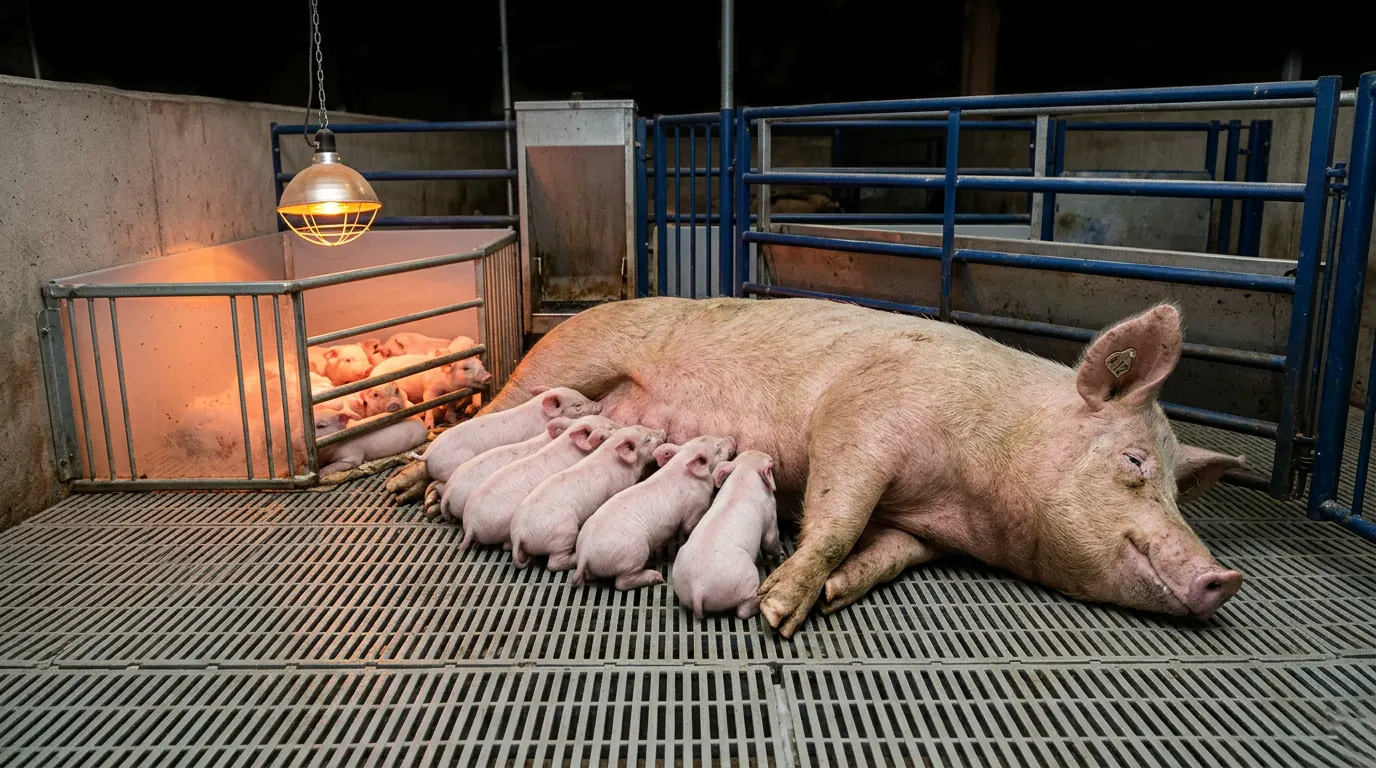
Raising piglets starts at farrowing and ends at weaning from the sow. Piglets must not be weaned before 28 days of age, unless the health of the sow or the piglets is at risk. When the conditions are met, you may move them at day 21, which is 7 days earlier, but only to a separate room that has been emptied, cleaned and disinfected and is isolated from the sow area. The 28-day rule is repeated in the brochure "ABC w odchowie prosiąt" (ABC of piglet rearing) from KPODR Minikowo, a Polish agricultural advisory center, which refers to a European Union directive.
Why the first weeks decide the result
In the first weeks piglets depend on the sow's milk and on a warm, dry bed. According to IZ PIB (Poland's National Research Institute of Animal Production) in its organic pig farming guide, piglets double their birth weight within 7–10 days, so the demand for iron rises very fast. Weaning changes feed, surroundings and social group all at once. So record litter weight and the number of piglets raised right away, because these data decide how the herd is assessed.
Farrowing and the first days after birth
The nest and space for piglets
The piglet nest should have an area of at least 0.7 m² and be within the sow's line of sight, no closer than 30 cm from her bed. According to the KPODR Minikowo manual "Behawior i dobrostan świń" (Pig behavior and welfare), a sow kept alone around farrowing and while nursing needs at least 3.5 m² of space. Piglets need room so the sow can feed them easily, and guard rails protect them from being crushed. Provide a dry, clean floor, because damp and cold raise the risk of deaths. Record the condition of the nest and the temperature in the app for pig farmers.
Iron and anemia
Pale skin on a piglet can be a sign of developing anemia. IZ PIB points out that piglets born in a building have no access to soil, where they could pick up iron naturally. Anemia lowers resistance, so check skin color on every round. Your vet decides on iron supplementation and names the product and dose. Record the products given and the dates in the treatment and withdrawal period records, because they affect later withdrawal periods.
Care up to day 21
Growth and litter checks
Check every day that all piglets are suckling and that no piglet in the litter is clearly weaker. Since piglets double their weight in 7–10 days, weight differences within a litter deepen quickly, and weaker piglets are more often pushed away from the teats. The Institute of Animal Production (IZ PIB), when assessing breeding performance, analyzes piglet and litter weight on the day of birth and on the day of weaning. Keeping the same records on your own farm lets you compare litters of the same sow and spot a problem early.
Disease and unusual feces
Diarrhea in a litter calls for a quick response. Describe the signs, note how many piglets are sick and tell your vet, who chooses the medicine and dose. If the feces look abnormal, the procedure from photo to sample for the vet can help. The biosecurity plan generator helps you set hygiene rules and farm entry rules and organize daily routines.
Weaning piglets: timing and preparation
Age and body weight
Piglets must not be weaned before 28 days of age, unless the health of the sow or the piglets is at risk. Weaning at day 21 is possible when the piglets move to a separate room that was emptied, cleaned and disinfected beforehand. The KPODR Minikowo brochure reminds you that when setting the date you must consider not only age but also body weight. Older piglets handle weaning more gently and cope better without their mother's milk.
Stress and feed change
Weaning is the third critical period. According to KPODR Minikowo, stress comes mainly from the change to solid feed and often from poorer temperature conditions. IZ PIB adds that in the new surroundings piglets meet unfamiliar pathogens, a new hierarchy forms in the group, and weaned piglets lose maternal antibodies. Before weaning, check the temperature and access to water, and change feed gradually, following the advice of your feed supplier and vet. Keep an eye on feed stocks with feed silo monitoring.
Floors and space
On a slatted floor, the slot width for piglets must not exceed 11 mm, and the slat width must not be less than 50 mm. These requirements come from the KPODR Minikowo manual "Behawior i dobrostan świń". Note the date of the move, the number of piglets and the condition of the floor in each group. At the next weaning you will then know what to check before the piglets enter the room.
How to keep rearing records
What to record for every litter
For every litter, record the farrowing date, the number of piglets born and raised, and the litter weight on the day of birth and on the day of weaning. IZ PIB analyzes the same traits when assessing breeding performance, so your records match what goes into breeding evaluations. Record medicines separately, with the date given, the product named by your vet and the withdrawal period. A missing treatment entry means a risk of error when you sell finishers.
Indicators and planning
When you know the weights and numbers, it is easier to plan the next batches and weanings. The FCR (feed conversion ratio) shows whether rearing and finishing follow the feed plan. Plan weaning dates ahead so the room is ready and free of the previous group. The batch and cycle planning module helps with the cycle schedule, and you can see the indicators in FCR and EPEF online.
Welfare requirements in rearing
Minimum standards
Minimum standards for the protection of pigs in the EU are set by Council Directive 2008/120/EC. It requires that the part of the floor where animals rest together is solid, covered with a mat, or bedded with straw or another suitable material. Piglets must also have enough room for the sow to feed them. Check the current text of national rules in the Internetowy System Aktów Prawnych (ISAP, Poland's online legal acts database), legal state as of 22.11.2026.
Piglet behavior as an indicator
According to KPODR Minikowo, piglet behavior shows whether rearing is going calmly. Piglets lying together on the bed, not huddled in one corner, usually point to thermal comfort. Piglets that eat and drink willingly need intervention less often. Record your observations from rounds in the app for pig farmers, so after a few weeks you can see a trend and not just a single day.
Frequently asked questions
When can you wean piglets?add
Piglets must not be weaned before 28 days of age, unless the health of the sow or the piglets is at risk. Weaning at day 21 is allowed when you move them to a separate room that is emptied, cleaned and disinfected. Make the decision together with your vet.
How big should a piglet nest be?add
The nest should be at least 0.7 m² and within the sow's line of sight, no closer than 30 cm from her bed. According to KPODR Minikowo, a sow kept alone around farrowing and while nursing needs at least 3.5 m² of space. Plan the pen layout for your building together with an advisor.
Why do piglets need iron?add
Piglets double their birth weight within 7–10 days, and in a building they have no access to soil, where they could pick up iron. Pale skin can signal anemia. Your vet decides on supplementation and names the product and dose.
What should you do if piglets have diarrhea?add
Note how many piglets are sick, the signs and when they appeared, then tell your vet. Do not pick a medicine yourself based on a description of the signs. If the feces look unclear, taking a sample as your vet advises can help.
How do you record piglet rearing?add
Record the farrowing date, the number of piglets raised, litter weight on the day of birth and weaning, and every medicine given with its withdrawal period. This lets you compare litters of the same sow and rebuild the herd history without digging through notes.
Sources & resources
- linkKPODR Minikowo — Behavior and welfare of pigs (P. Dorszewski et al.)
- linkKPODR Minikowo — ABC of piglet rearing
- linkIZ PIB — Organic pig farming guide (ed. E.R. Grela)
- linkIZ PIB — Farming and breeding of livestock over 70 years. Pig Breeding Department, Horse Breeding Department
- linkEU / Publications Office of the EU — Council Directive 2008/120/EC laying down minimum standards for the protection of pigs (PL)
- linkInternetowy System Aktów Prawnych (Poland's online legal acts database) — isap.sejm.gov.pl
Prepared by: DlaFerm Team based on data from the sources listed · Publisher: INSTA-TECH sp. z o.o.
Raising piglets in a sow herd?
The pig farmer app in DlaFerm.pl helps you record litters, weanings and treatments in one place. Create a free farm account and see how it works in your herd.
Phone
+48 796 258 151