Quail Cage Size and How Many Birds Fit
Quail cage size follows from the floor space the birds need and the number of birds you want to keep on it. You set the bird count from usable floor area and your chosen stocking density, not from the overall size of the cage. Below we show the order of the calculation and where to check the current requirements.
verifiedFrom the team that has organised work on poultry farms for years.
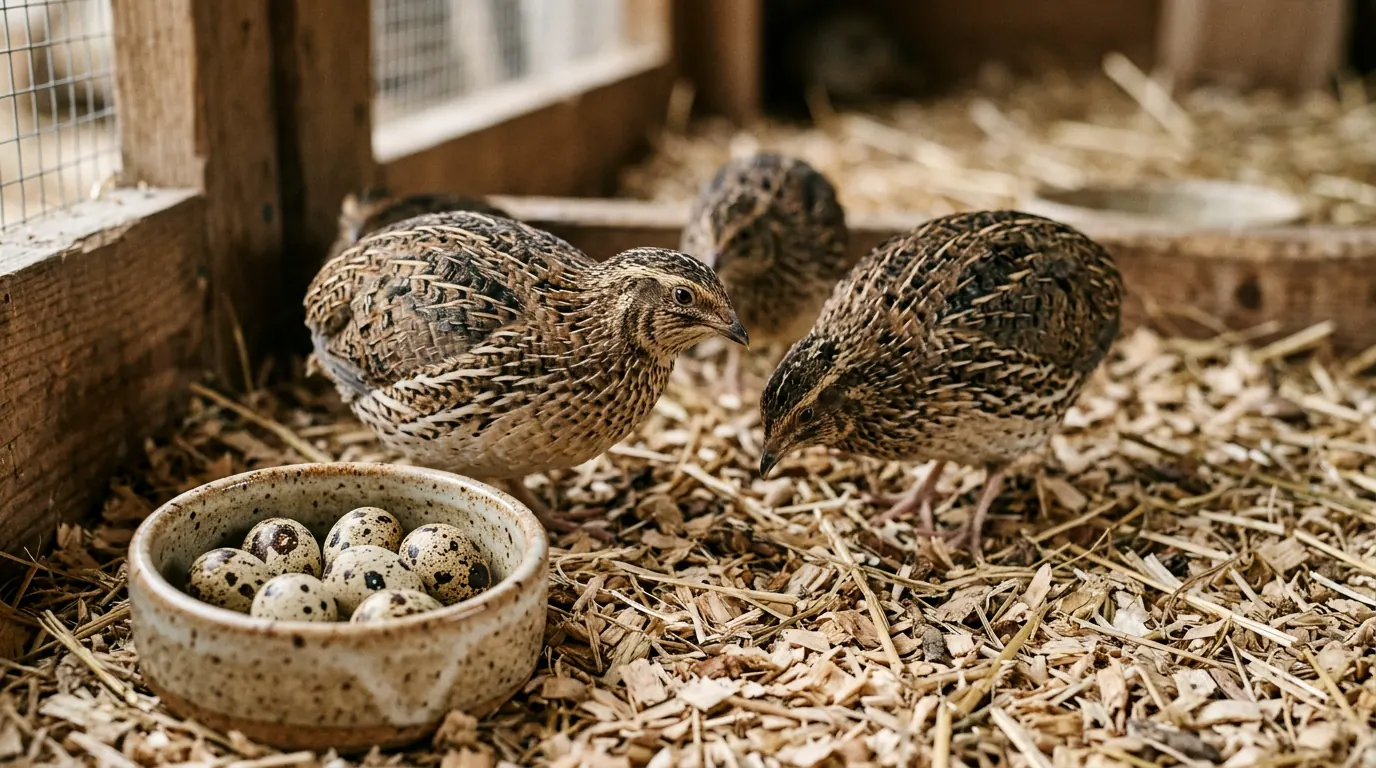
Quail cage size comes down to two things: the floor space a bird needs to move, and the number of birds you want to keep on that space. There is no universal length or width you can copy from another farm. It depends on the purpose of your flock, the cage design and the drinker and feeder system. Quail are small, so they need less room than hens, but too many birds soon shows in their feathers, health and laying. So you calculate floor area and stocking density first, and design the dimensions after that. We describe construction details in our guide to <a href='/wymagania-kurnika-dla-przepiorek'>housing requirements for quail</a>.
Keeping quail for eggs or for meat
Laying quail are usually kept in cages with access to feeders and drinkers and a system for collecting eggs. Meat quail need a different layout, because the birds grow and need more room as the cycle goes on. In both cases the same mistake repeats: the cage size was chosen for convenience of setting it up, not for the number of birds. Before you buy a ready-made cage, work out how many birds you want in one cage and how many cages you need in the whole building. Then it is easier to judge whether the design fits in the building at all.
How to calculate how many birds fit in a cage
Step 1: usable floor area of the cage
Measure the inside length and width of the cage floor and multiply them to get the area in square meters. Subtract the space taken by the feeder, drinker, any nest area or egg collection belt, because birds cannot stand or walk there. What is left is the usable area. Measure the inside, not the outside dimension with frame and mesh. A difference of a few centimeters on each side, repeated across many cages, leaves clearly less room than the plan assumed.
Step 2: stocking density and bird count
Stocking density is the number of birds per unit of area. With a known usable area, you divide it by your chosen density and get the maximum number of birds in the cage. Set the density according to welfare requirements, not according to how many cages fit in the building. Write the result in your records so you have a clear count balance at an inspection. We explain how to keep a bird count balance in a poultry house and check it with a camera in our <a href='/badania/liczenie-i-wykrywanie-ptakow-z-kamery'>article on bird counting</a>.
Cage dimensions: what they depend on
Depth and access
Cage depth must let you reach the birds, drinkers and eggs without climbing inside. A cage that is too deep makes health checks harder, because weaker birds at the back are easy to miss. A cage that is too shallow means more cages for the same area and more parts to clean. Set up the cage front so you can look at every bird without moving the whole unit. Access from the front also makes it easier to catch sick birds and remove dead ones quickly.
Height and arrangement in rows
Cage height decides whether a bird can stand normally and stretch its wings. When cages are stacked in tiers, make sure droppings and water from the upper rows do not fall on the lower ones. The distance between rows should give easy access to drinkers and feeders at the front. Agree the exact height with the cage maker and confirm it with your vet, because it depends on the design and the type of bird.
Too many birds in the cage: how to tell
Signs in behavior and feathers
You usually see changes in the feathers first: worn patches, bald spots and dirty backs. Birds peck each other, and at higher density injuries rise and more birds stand in the corners. Check whether all birds can reach the feeder at the same time. If some stand to the side all day, the density is too high or the drinkers are poorly placed. Uneven body weight in a cage is another sign that some birds eat too little. We describe feeding and feed distribution in our <a href='/zywienie-przepiorek'>article on feeding quail</a>.
What to do when density is too high
Start by measuring the area and counting the birds in each cage. If the result is above your chosen density, split the birds across more cages or reduce the number in the same cage. Before you make a change, talk to your vet, who can assess the health of the flock. Record every change with a date in your <a href='/program-do-ewidencji-kurnika'>poultry house records</a>, so you later know what changed and when. The record also helps at an inspection and when you judge results after the density change.
Rules on keeping poultry in cages
Where to find the current requirements
Requirements for keeping poultry come from legislation that changes over time. You can check the legal state as of 22.11.2026 in ISAP (Internetowy System Aktów Prawnych, Poland's online database of legal acts), which publishes current texts of acts and regulations. Search for the species and the words "dobrostan" (welfare) or "utrzymanie drobiu" (keeping poultry), then check the date of the last change. Do not rely on an old printout or a forum opinion, because differences between versions can affect dimensions and stocking density.
What inspectors check
Inspectors look at whether the stocking density meets the requirements, whether flock records are kept and whether birds have access to feed and water. In practice, inspectorates ask the keeper to show the bird count balance and how it is kept. Confirm the detailed requirements for your species with the Chief Veterinary Inspectorate (Główny Inspektorat Weterynarii) or with the vet who looks after your farm. Do not present your own calculations as a legal requirement until you have checked them in the current act.
Bird counts in cages: how to keep them
A record for every cage
Keep a separate card for each cage: number, date of placing, number of birds at the start and current count. Record deaths, sales and moves to other cages. That way you always know how many birds are actually in the cage, not how many should be. Software for <a href='/program-do-zarzadzania-ferma-drobiu'>poultry farm management</a> keeps this data in one place, with no retyping from a notebook to a computer.
Recalculating after losses
Losses change the density, so after every change recalculate the area per bird. Record the cause of death if you know it, because repeated causes often point to a problem with density or water. With many cages, compare counts between them. A cage with more losses than its neighbors needs checking. Do the recalculation on the day you notice the change, so you do not lose continuity in your data.
Frequently asked questions
What size should a quail cage be?add
There is no single size that suits every farm. The dimensions follow from the number of birds, your chosen stocking density per square meter and the design of drinkers and feeders. Calculate usable floor area and density first, then choose length, width and height to match the result.
How many quail fit in one cage?add
The number comes from usable floor area and your chosen stocking density, not from the overall capacity of the cage. Measure the inside, subtract the space taken by the feeder and drinker, and divide the result by the density. If you are unsure about the value, check it with your vet.
How do I know if my quail cage is too crowded?add
Watch the feathers, pecking, and whether all birds can reach feed and water at the same time. Uneven body weight and birds standing to the side all day are warning signs. Note your observations in your records and tell your vet.
Where can I check the current rules for poultry cages in Poland?add
Current legal acts are in ISAP (Internetowy System Aktów Prawnych), and explanations on inspections are on the Chief Veterinary Inspectorate (Główny Inspektorat Weterynarii) website. Check the legal state as of 22.11.2026 before any investment in cages. For a specific farm, ask your vet.
Who sets the final stocking density in a cage?add
The keeper chooses it within the welfare requirements, after talking to the vet who looks after the flock. Species, purpose of the flock and bird health all affect the choice. Write the chosen value in your documents so it is available at an inspection.
Sources & resources
- linkChief Veterinary Inspectorate (Główny Inspektorat Weterynarii) — gov.pl/web/wetgiw
- linkInternetowy System Aktów Prawnych (online database of Polish legal acts) — isap.sejm.gov.pl
- linkNational Research Institute of Animal Production (Instytut Zootechniki PIB) — izoo.krakow.pl
- linkEFSA — efsa.europa.eu
Prepared by: DlaFerm Team based on data from the sources listed · Publisher: INSTA-TECH sp. z o.o.
Counting birds in several cages at once?
The DlaFerm poultry house records module stores the stocking density of each cage and every change in bird numbers in one place. Create a free farm account or get in touch, and we will show you how it works in practice.
Phone
+48 796 258 151