Poultry transport crates: sizes and how to choose
Choose a poultry transport crate by the weight and number of birds it has to hold. A crate that is too small squeezes and injures birds. One that is too big lets them slide around on the road. Below we show how to work out the size and what to check before loading.
verifiedFrom the team that has organised work on poultry farms for years.
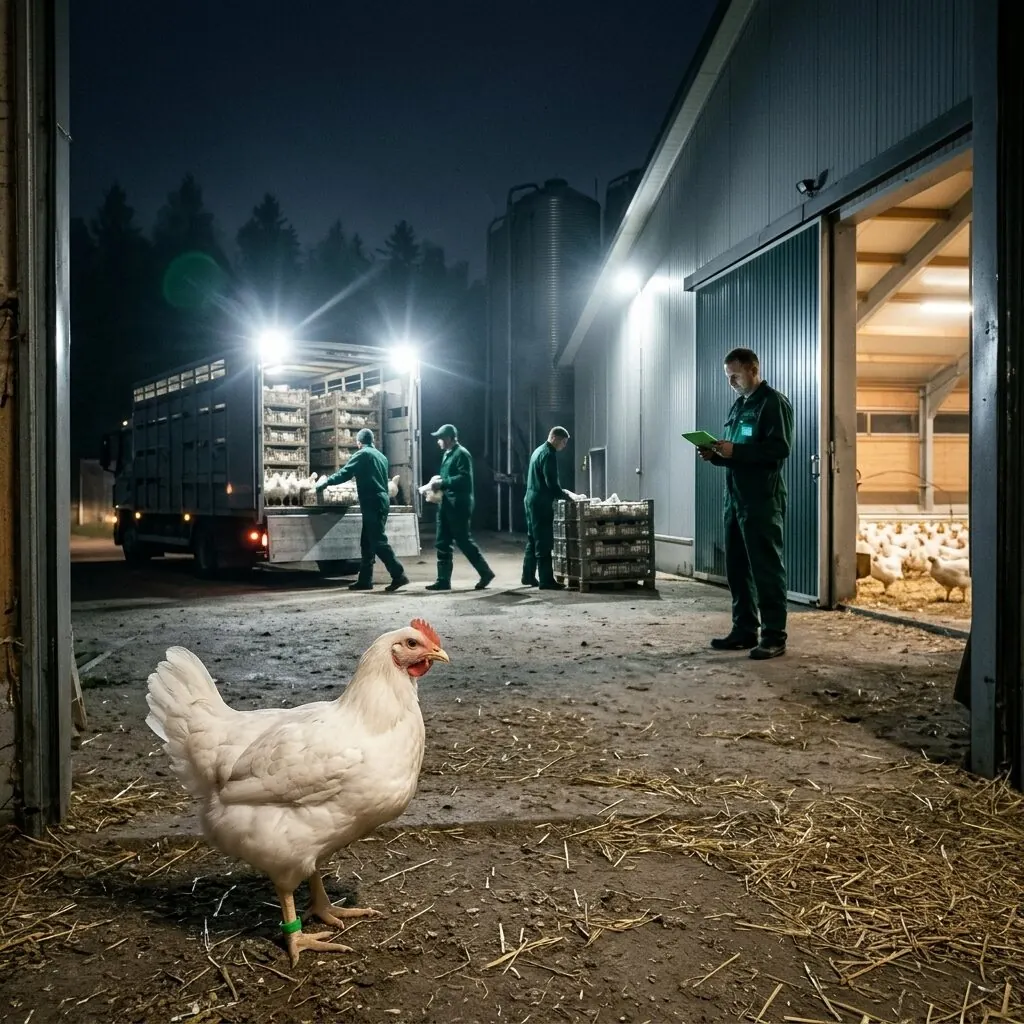
Pick the crate to suit the weight and number of birds, not what is easiest to load. Work out the size from how many birds, and of what weight, must fit inside. A crate that is too tight causes squeezing, overheating and wing injuries. One that is too loose lets birds slide and fall over while the vehicle moves.
Where to start
Start from the weight of the birds on the day of transport, not from the crate size. According to the Ross 308 / 308 FF Broiler Performance Objectives 2022, the target weight for a broiler at day 20 is 2.125 lb (about 0.96 kg), and at day 30 it is 4.194 lb (about 1.9 kg). These are target values from a performance table, not the results of your flock, because real weight depends on the line, the feed and the housing conditions. Before transport, weigh a sample of birds, for example with poultry scales, and only then work out the crate stocking.
Crate size by bird weight
Floor space per bird
Floor area is the main parameter. A bird must be able to lie down and stand without lying on its neighbor. Recommended space per bird depends on weight and species, so before ordering crates ask the maker for a stocking table for your weight class and compare it with the crate dimensions. Do not count only the outer size, because walls, doors and dividers take up part of the space. Record your calculations in farm management software so you know how many birds fit in each crate.
Crate height
Choose a height that lets the bird stand in a natural position without touching the top and without bending its neck. A crate that is too low damages combs and feathers, and with heavy birds the wings scrape on the ceiling. With stacked crates, check that droppings and water from the upper level do not fall on the lower one, and that birds at the bottom still get air. Measure the height inside, after subtracting the thickness of the floor and the grid.
Material, doors and floor
Material
Crates are most often made of plastic or galvanized metal. Plastic is lighter and easier to wash, but it can warp in high temperatures. Metal takes loads and stacking, but corrodes faster if it stays wet after disinfection. Check that the edges are smooth, because sharp parts are a common cause of injuries during loading. If you will reuse the crates many times, ask whether they can be pressure-washed without taking them apart.
Doors and latches
Doors should open wide so birds can be lifted out without being pushed through a narrow gap. The latch must hold firmly yet be simple to use, because loading at night or in the cold takes longer. Check that the crate stops a bird from slipping out as you open it and that its corners do not catch wings.
Floor
A grid or solid floor affects bird comfort and cleanliness during the journey. A solid bottom collects droppings and moisture, which spoils the air. A grid reduces soiling, but with weaker birds it can rub their feet. For long routes choose a floor that is easy to clean, and put an absorbent liner on the bottom.
How many birds per crate
Calculating stocking
Divide the usable floor area of the crate by the recommended area per bird for the weight on dispatch day, and round the result down. With heavier birds the count falls, because each one takes more room. The difference between carrying light and heavy birds in the same crate can be large, so do not carry over the stocking from the previous batch without weighing again. Keep the batch and stocking record in the digital flock record.
Mixing batches
Do not mix birds of very different weights, or from different houses, in one crate. Lighter birds get crushed or pushed into a corner, and strange birds may peck each other. Each crate should hold one batch, marked with a number and dispatch date, which makes settlement easier and helps explain any problem.
Ventilation, temperature and journey time
Ventilation
A crate must have ventilation openings on the sides and in the walls. On the trailer, place crates so air can flow between them. Covered sides, or crates stacked tightly on one another, trap heat and ammonia. Before leaving, check that openings are not blocked by feathers or bits of litter. We cover welfare during transport in welfare indicators.
Temperature and time of day
Birds tolerate overheating badly. In summer, and during long stops in the sun, the risk rises fastest. Plan loading for the cooler hours and choose the shortest possible route to the slaughterhouse or collection point. Do not leave crates on a hot yard without shade and ventilation. In winter, protect birds from chilling and from drafts when the vehicle doors are open.
Time on the road
The longer the journey, the more important breaks, access to water and a quick check on the birds become. Maximum driving time and the duty to take breaks are set by the rules on animal transport. You can find their current text in ISAP (Internetowy System Aktów Prawnych, Poland's online legal database). The person responsible for transport should carry a checklist and go through it at every stop.
Cleaning and disinfecting crates
Washing before and after transport
Wash the crate after every unloading, before it goes back to the house or on the next trip. First remove litter and droppings, then wash with pressurized water, and finally disinfect following the product instructions. Dry the crates before the next use, because moisture speeds up corrosion and bacterial growth. Choose products together with your vet or supplier, and do not rely only on this description.
Storage
Store crates in a dry, covered place, apart from equipment used with a sick flock. Plan the route of the vehicle and crates so that clean equipment does not cross the dirty zone. A biosecurity plan describes this split, and you can prepare one in the biosecurity plan generator.
Rules, documents and legal state
What to check in the rules
The law sets the requirements for crates, stocking, driving time and transport documents. We describe the legal state as of 22 November 2026. Check the current text of the rules in ISAP, and the guidance of the Chief Veterinary Inspectorate (Główny Inspektorat Weterynarii) on gov.pl. Rules change, so this text does not replace the legal basis. We write more about poultry transport rules.
Transport records
For each batch record a transport document, the date, the number of birds, the weight and the buyer's details. Such a record helps with roadside checks and with settlement with the slaughterhouse. Entries in your records are also the basis when you need to show when birds left the farm. If medicines were given before dispatch, apply the withdrawal periods set by your vet and record them.
Frequently asked questions
How do I choose the size of a poultry transport crate?add
Start with the weight of the birds on dispatch day and the number of birds in the batch. Then check the recommended floor area per bird for that weight with the crate maker, and the crate height. The usable size must be enough for a bird standing in a natural position.
How many chickens fit in a crate?add
It depends on the usable floor area, the weight of the birds and the journey time. Divide the area by the recommended area per bird for that weight and round down. Heavier birds mean lower stocking, so weigh a sample before every trip.
Are plastic crates better than metal ones?add
It depends on how you use them. Plastic is lighter and easier to wash, but it can warp in heat. Metal is strong, but must be dried well so it does not corrode.
Do I have to disinfect a poultry crate after every trip?add
Yes, we advise washing and disinfecting after every unloading, before the crate goes back to the house or on another trip. Choose the product and method with your supplier or vet, and follow the maker's instructions.
Where can I check the current rules on moving poultry?add
You can find the current text of the rules in ISAP at isap.sejm.gov.pl, and the Chief Veterinary Inspectorate publishes guidance. We describe the legal state as of 22 November 2026, but check before each trip that nothing has changed.
Can I carry different batches in one crate?add
We advise against it. Birds of different weights take up space unevenly, and strange birds may peck each other. Each crate should hold one batch marked with a number and dispatch date.
How do I record a transport in the farm records?add
Record the dispatch date, the number of birds, the weight and the buyer of the batch. Such an entry links easily with the treatment and withdrawal records and with settlement with the slaughterhouse. Keep records up to date, ideally in farm management software.
Sources & resources
- linkRoss 308 / 308 FF Broiler Performance Objectives 2022
- linkChief Veterinary Inspectorate (Główny Inspektorat Weterynarii) — gov.pl/web/wetgiw
- linkInternetowy System Aktów Prawnych (Poland's online legal database) — isap.sejm.gov.pl
Prepared by: DlaFerm Team based on data from the sources listed · Publisher: INSTA-TECH sp. z o.o.
Planning to send a batch to the slaughterhouse?
DlaFerm.pl farm management software lets you keep batch, stocking and dispatch records in one place. Create a free farm account and see how it works in practice.
Phone
+48 796 258 151