Poultry house fire: prevention and response
A poultry house fire usually starts with an overheated wiring system, a spark, or badly stored litter and feed, and it spreads fast. The best protection is prevention: sound wiring, safe heating and a tidy building. We also cover what to do in the first minutes if you see fire or smoke.
verifiedFrom the team that has organised work on poultry farms for years.
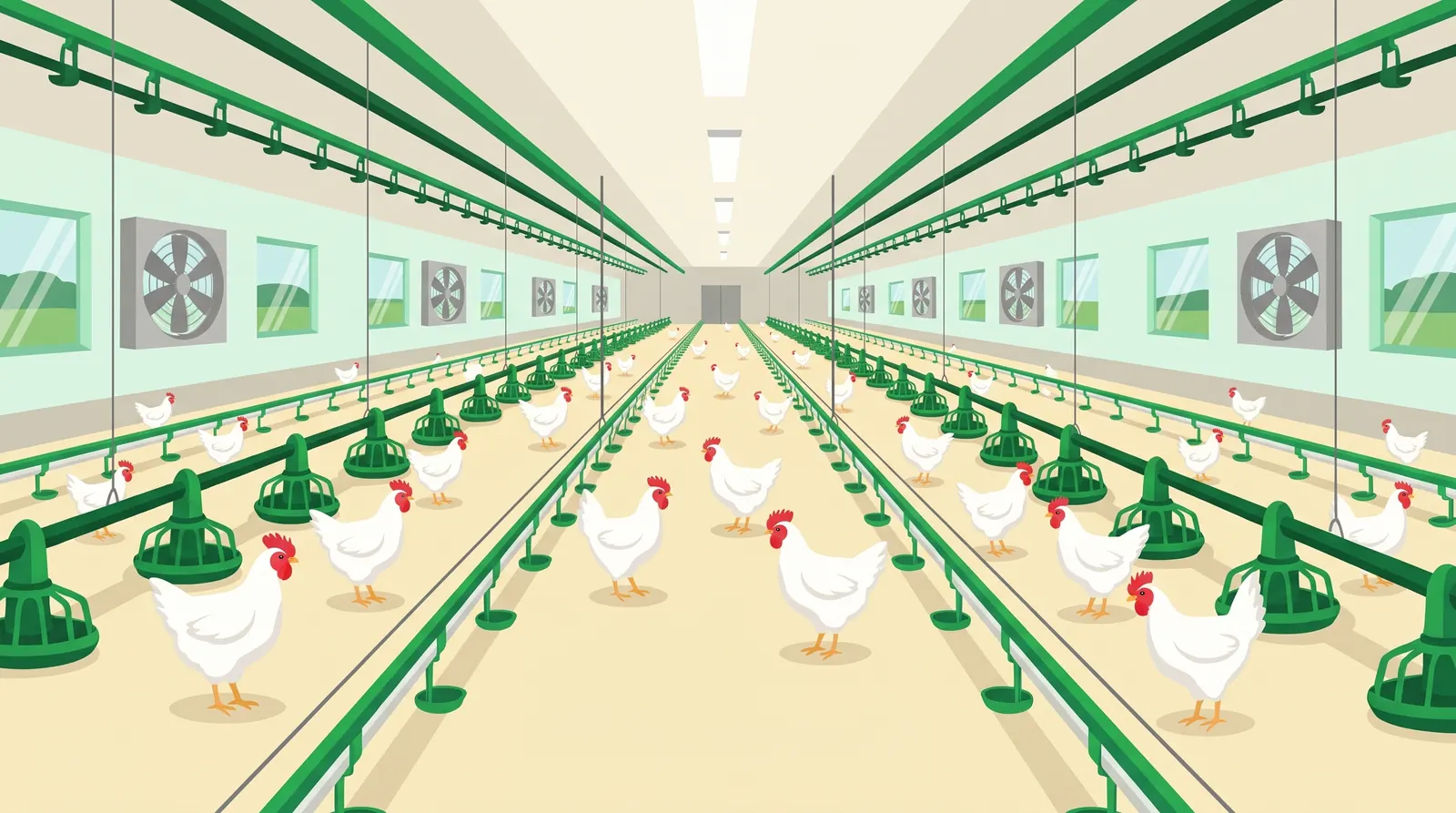
Fires in poultry houses most often start where a heat source or a spark meets dry, flammable material. Typical spots are litter, straw, dust settled on bulbs and cables, and feed packaging stored by the entrance. Fire spreads fast because the building is full of dry material, and smoke and heat threaten the animals before the flames reach them. That is why prevention is always cheaper and more effective than firefighting. Below we describe what to check in the building and what to do when something goes wrong.
Why prevention matters most
A poultry house carries a heavy electrical load: fans, lighting and heating, often running around the clock. Any loose connection, overheated cable or damaged light fitting can become a source of ignition. Most protective measures are therefore routine checks, not expensive upgrades. A farmer who knows what to check and when can cut the risk without big spending. Remember that fire safety covers the people working in the building, not only the birds.
Preventing fires in a poultry house
Electrical wiring
Have a qualified electrician assess the wiring in the house, not just a quick visual check. Look for cables with cracked insulation, loose connectors, overheated sockets and extension cords left plugged in permanently. Light fittings and fan motors must be rated for damp and dusty conditions, with sealed housings. If a fuse or breaker trips more often than usual, do not swap it for a stronger one. Find the cause. Write down your inspections so you know when they were last done.
Heating and heat sources
Heaters, radiant heaters and stoves are a common cause of fires in livestock buildings. Mount them firmly, away from litter, feed and walls made of flammable materials. Do not leave devices running unattended unless they are designed for unattended operation. With gas or oil heating, check that the system is tight and the chimney works properly. We cover heat exchangers and building heating in more detail in Heat exchangers in the poultry house.
Litter, feed and housekeeping
Store straw, wood shavings and feed outside the building or in a separate closed room, away from heating equipment. Do not leave sacks and empty packaging by the entrance or under a window. Remove dust and litter residue from light fittings, cables and fans regularly. Take used litter out of the building according to a plan, and keep the storage area tidy. We describe ways of removing and drying litter in Removing and drying litter.
Ventilation and fire risk
Dust on equipment
Fine dust from feathers, litter and feed settles on bulbs, motors and cables. A layer of dust makes it harder for equipment to shed heat, and together with heat it can smolder or ignite. Add cleaning of light fittings, fan motors and air inlet grilles to a fixed schedule rather than doing it once a year. After each restock and clean-out, check that no buildup has been left on the equipment.
Ventilation and working fans
Good ventilation removes moisture, ammonia and excess heat, but fans are also a source of heat and risk. A motor overheated by dust or blocked blades can ignite what is around it. Check that fans run without excessive noise or vibration and that bearings and belts are in good condition. We describe how to choose and maintain ventilation in Poultry house ventilation.
Fire regulations: where to check them
Where to find current regulations
Check the legal acts on building fire protection in ISAP, Poland's online database of legal acts (isap.sejm.gov.pl), legal state as of 22.11.2026. Rules on health and safety at work and on animal keeping conditions are published by the Ministry of Agriculture and Rural Development and by the Chief Veterinary Inspectorate (Główny Inspektorat Weterynarii). We do not give specific distances or required fire-fighting equipment here, because they depend on the particular building and on provisions you must read in the current version of the act and regulations.
Talking to your local fire brigade
Before you start upgrading a building, discuss your protection plan with the local fire brigade or a fire protection expert. The fire brigade knows local requirements and can judge whether the access road, water supply and layout of buildings are suitable. A talk like this before investing saves later corrections and disputes with inspectors.
What to do if you see fire or smoke
Alarm and people's safety
Call the emergency number 112 straight away and give the farm address, the type of incident, and whether people or animals are in the building. Do not enter a smoke-filled building without respiratory protection. If it is possible and safe, cut the power using the main switch located outside the poultry house. Do not use water on burning electrical wiring until you are sure it is disconnected from the power.
Evacuating birds and firefighting
Evacuating birds is possible only if it does not put people at risk. Open doors or emergency exits where it is safe, and let birds out from the least smoky side. Try to put out a small fire with an extinguisher suitable for electrical equipment and solid materials only if you have an escape route behind you. If the fire is growing, leave the building and wait for the fire brigade. After the incident, do not enter the building until the structure has been assessed.
The vet after the incident
Birds that survive a fire may have respiratory burns, smoke poisoning and injuries. Report the incident to your vet, who will assess the flock and decide what to do next. Medicines and doses are chosen by the vet, not by the farmer on their own. Also report the incident to the district veterinary officer (powiatowy lekarz weterynarii), in line with the requirements that apply in your case.
Inspections and records in one place
Inspection schedule
Record in a schedule the dates of inspections of the wiring, heating and fans, and of equipment cleaning. With each entry, note who did the work, what it covered and any comments. This history helps during an inspection visit and with your insurer, and shows which equipment needs attention more often. Keep the building's records so that every worker can read them.
Record-keeping tools
In DlaFerm.pl you keep the poultry house register and building records, and the farm management module helps link that data to the production cycle. That keeps inspection and incident dates at hand, not in a notebook by the door. Read more about practical record-keeping in Poultry house register, and about running a whole poultry farm in the Poultry farm management software module.
Frequently asked questions
What most often causes a poultry house fire?add
The usual ignition sources are overheated or damaged wiring, heaters and radiant heaters placed near flammable materials, and dust settled on light fittings and motors. The risk rises when straw, wood shavings and feed are stored in the building. Regular inspections and good housekeeping remove most of these causes.
How do you prevent a fire in a chicken house?add
Have a qualified electrician inspect the wiring and clear dust from equipment on a fixed schedule. Store litter and feed outside the building or in a separate room, away from heat sources. Do not leave heaters running unattended unless they are designed for it.
What should you do if a poultry house catches fire?add
First call the emergency number 112 and give the farm address. If it is safe, cut the power at the main switch and let the birds out from the least smoky side. Do not enter a smoke-filled building, and do not use water on burning wiring until the power is off.
Do you have to report a poultry house fire to a vet?add
Yes, you should report it to your vet, who will assess the birds for smoke damage and burns. The vet decides on any treatment, and you record medicine withdrawal periods in your records. Agree with your flock vet how to report it to the district veterinary officer.
Where can you check fire regulations for a poultry house?add
Current legal acts are in ISAP, Poland's online database of legal acts (isap.sejm.gov.pl), legal state as of 22.11.2026. Requirements depend on building size and type of production, so talk to the local fire brigade or an expert before you invest.
Is an electrical inspection once a year enough for a poultry house?add
How often you need one depends on the condition of the wiring and on how damp and dusty the building is, so there is no single answer. Record each inspection with the date, the contractor and the scope of work. If a fuse trips more often, order a check straight away rather than waiting for the next date.
Sources & resources
- linkISAP, Poland's online database of legal acts — isap.sejm.gov.pl
- linkChief Veterinary Inspectorate (Główny Inspektorat Weterynarii) — gov.pl/web/wetgiw
- linkMinistry of Agriculture and Rural Development — gov.pl/web/rolnictwo
Prepared by: DlaFerm Team based on data from the sources listed · Publisher: INSTA-TECH sp. z o.o.
Want your inspections and poultry house records in one place?
The poultry house register module in DlaFerm.pl helps you keep records of the building and its condition without a paper notebook. Create a free farm account or get in touch, and we will show you how it works in practice.
Phone
+48 796 258 151