Pork half-carcass price per kg, EUROP grades and dressing percentage
A pork half-carcass has no single fixed price per kilogram. The price depends on the rate per tonne of carcasses in a given EUROP grade, on dressing percentage, and on the bonuses or deductions written into your contract. We show how to read offers, convert weights and check whether your sales result matches your production cost.
verifiedFrom the team that has organised work on poultry farms for years.
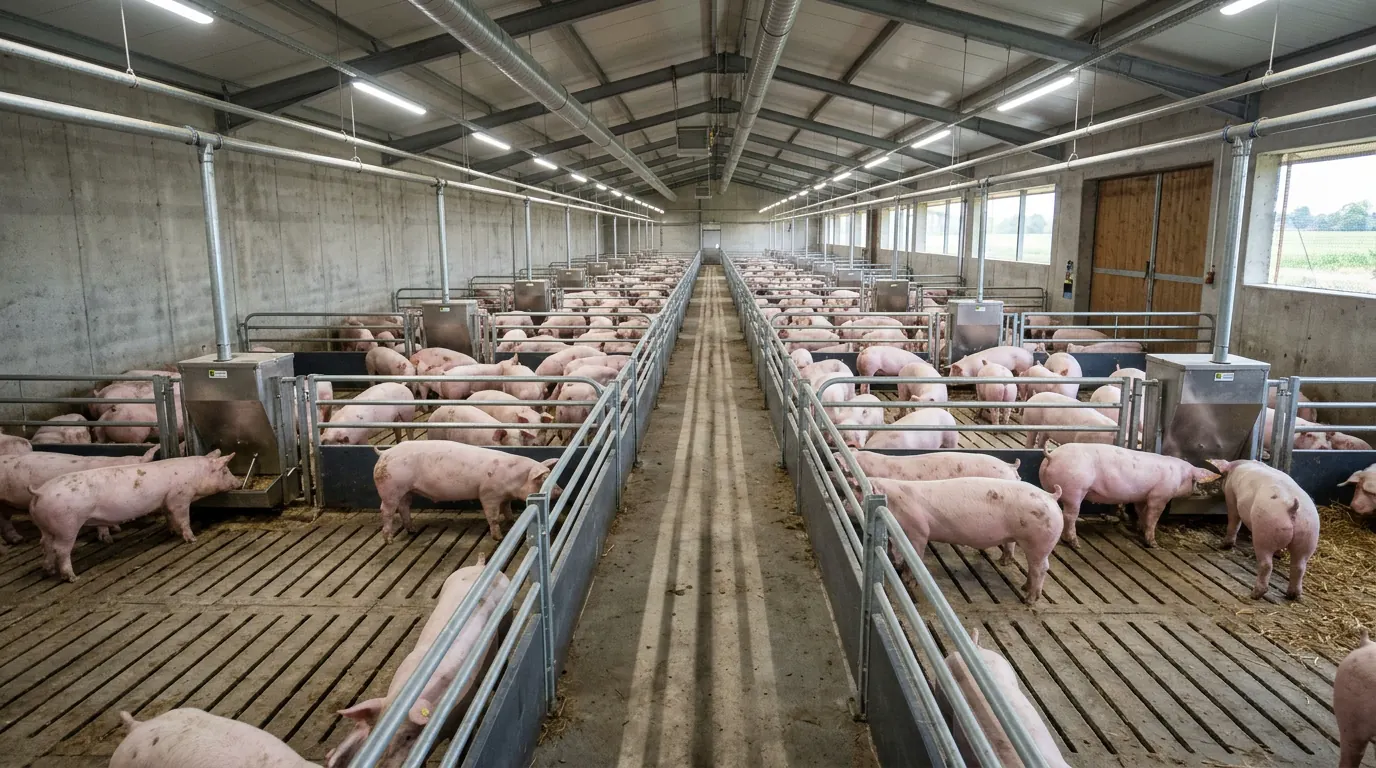
You get the price of a half-carcass per kilogram by dividing the price per tonne of carcasses in a given grade by 1000. The rate per tonne comes from the purchase price. According to the methodology of Poland's Ministry of Agriculture and Rural Development (MRiRW), that is the average price a buyer pays the supplier, excluding VAT, including bonuses, premiums and deductions. Before you compare offers, check whether the amount is per tonne of carcasses, per kilogram of carcass or per kilogram of live weight, and whether it is net.
Why there is no single national price
Each slaughterhouse and each buyer settles on its own terms: they grade differently, treat bonuses differently and count transport differently. So two offers with the same base rate can give different results at the end of the month. Compare them for the same grade, the same carcass weight and the same pickup date. You can check current quotations in MRiRW publications and with the buyer that actually purchases your finishing pigs.
Pork half-carcass price per kilogram
From tonne to kilogram
The MRiRW source gives the purchase price in PLN per tonne of pork carcasses, calculated separately for each grade. To get to kilograms, divide the rate by 1000, because a tonne is 1000 kg. Remember that the converted result still includes bonuses and premiums, so the base rate in the contract may be lower than the amount actually paid. If the buyer quotes only a price per kilogram, ask for the conversion to a tonne and for the grade it refers to.
What is and is not in the price
According to the methodology, the purchase price does not include the costs of transport, storage, pallets and insurance. These items may be billed to you on a separate invoice or may already be hidden in the price per kilogram. Before you sign a contract, ask who pays for loading and delivery, and whether bonuses are paid automatically or only when conditions are met. Record all these components so that after a month you can compare real income with production cost.
EUROP grades: S, E, U, R, O
Lean meat ranges
EUROP classification is based on the percentage of lean meat in the carcass, set out in Annex IV part B of Regulation No 1308/2013. Grade S covers carcasses with 60% lean meat or more. Grade E is 55% or more but less than 60%. Grade U is 50% or more but less than 55%. Grade R is 45% or more but less than 50%. Grade O covers carcasses with lower lean meat content. The higher the grade, the higher the rate per tonne, as a rule.
Carcass weight and classification range
Purchase prices refer to slaughter pigs with a warm carcass weight of 60 to 120 kilograms, graded under carcass classification with the percentage of lean meat given. A carcass outside this range may be settled differently. So before delivery, check that the batch fits the weight range in your contract or the buyer's price list, and agree with the buyer how heavier or lighter carcasses are paid.
Dressing percentage and weight conversion
Carcass weight vs live weight
In an example from the AGROKOSZTY project, described by KPODR Minikowo (a Polish agricultural advisory center), two farms sold finishing pigs by warm carcass weight (wbc). One got 11.22 PLN/kg wbc, the other 10.72 PLN/kg wbc. To compare them with live-weight prices, a dressing percentage of 80% was assumed. Then 11.22 PLN/kg × 0.8 gives 8.98 PLN/kg of live weight, and 10.72 PLN/kg × 0.8 gives 8.58 PLN/kg. The same multiplier works both ways: divide the live-weight price by the dressing percentage to get the carcass price.
Why dressing percentage decides the result
Two finishing pigs of the same live weight can give different carcass weights and different lean meat content. Higher dressing means more kilograms to sell from the same feed, and a better grade raises the rate per tonne. We describe how to assess dressing and slaughter parameters on a separate page: slaughter yield and EWW. You can put herd performance indicators, including FCR, together in FCR and EPEF online.
How the grade is checked on a half-carcass
Chilling and weighing
According to IZ PIB (Poland's National Research Institute of Animal Production), after about 24 hours of chilling the half-carcasses are taken out of the cold room and weighed separately to the nearest 100 g. If the weight difference between the halves does not exceed 0.5 kg, the left half can be passed whole for consumption. With a bigger difference, both halves must be partly dissected. This rule shows why the weighing result depends on when you measure.
Carcass length and backfat
On the right half-carcass, after the leaf fat is removed and weighed, carcass length is measured from the front edge of the junction of the first rib and the breastbone to the front edge of the pubic symphysis, to the nearest 0.5 cm. Backfat thickness is measured with calipers to the nearest 0.1 cm at five points: over the shoulder, over the joint between the last thoracic and first lumbar vertebra, and at three places on the rump. Ask the slaughterhouse for the classification record and compare the results with your own measurements.
Price vs cost of producing a kilogram
An example from an ODR calculation
A sample calculation by ODR Lubań (a regional agricultural advisory center), published by PODR, shows a production cost of 5.94 PLN per 1 kg of live weight for medium-intensity finishing and 6.08 PLN for intensive. The profitability index came out negative in this example: -16% and -19%. Feed made up 36.7% and 38.3% of costs, and buying the weaner 48.2% and 47.1%. This is a calculation with set assumptions, not current quotations. Base your own figures on your own cost, not someone else's table.
What lowers the cost per kilogram
The biggest cost item in this calculation is buying piglets, and feed comes second. So keep a close eye on feed use per kilogram of gain, finishing time and losses from deaths. It pays to monitor feed stocks in silos continuously, before they show up in your result. Feed silo monitoring is built for this, and you can set feed consumption costs against herd results.
Disease and regulations affecting pig sales
African swine fever
The MRiRW regulation of 12.03.2026 on measures to control African swine fever (Dz.U. 2026 poz. 344, Poland's Journal of Laws) sets rules that can restrict the movement and sale of pigs. We give the legal state as of 22.11.2026. Before you sell a batch, check the current requirements with the county veterinary officer (powiatowy lekarz weterynarii) and in ISAP, Poland's online legal acts database. Rules change with the epidemiological situation, so do not rely on an old letter.
Withdrawal periods
The vet chooses the medicine and dose for each animal. The farmer must observe the withdrawal period after giving a medicine, because a carcass with residues cannot be sold. Keep exact records of treatments, dates and batches so that at pickup you can show the withdrawal period was kept. Treatment and withdrawal records help with this.
Frequently asked questions
How much does 1 kg of pork half-carcass cost?add
We do not give a fixed amount, because the price changes every week and depends on the grade, carcass weight and your contract with the buyer. Convert the rate per tonne by dividing by 1000, then add or subtract bonuses and deductions. You can check current quotations in ministry publications and with your buyer.
What do the EUROP grades S, E, U, R, O mean?add
They are carcass grades based on the percentage of lean meat. Grade S is 60% and more, E is 55–60%, U is 50–55%, R is 45–50%, and O covers carcasses with lower lean meat content. The ranges come from Regulation No 1308/2013.
How do I convert carcass weight price to live weight price?add
Multiply the price per kilogram of warm carcass weight by the dressing percentage. In the KPODR example 80% was assumed, so 11.22 PLN/kg wbc gives 8.98 PLN/kg of live weight. Dressing in your herd may differ, so check it against your own data.
What is the difference between purchase price and selling price?add
According to the MRiRW methodology, the purchase price is an average, excluding VAT, including bonuses and deductions, and excluding the costs of transport, storage, pallets and insurance. Your selling price may be higher or lower, depending on extra costs and contract terms.
Why is the price quoted per tonne of carcasses?add
A tonne is a handy unit for settlement at the buyer and in market statistics. It lets you compare batches and grades without rounding. For the farmer, what matters most is converting it to a kilogram and comparing it with your own production cost.
Where do I check whether a batch can be sold?add
Ask the county veterinary officer about the current rules on moving pigs, especially because of ASF. You can find the regulations in ISAP, Poland's online legal acts database. For withdrawal periods, your records and your vet's advice decide.
Sources & resources
- linkMRiRW (ZSRIR) — Methodology for recording market data on purchases of slaughter pigs on the pork market
- linkKPODR Minikowo (PROW 16 Cooperation) — A quality system as a guarantee of good pork
- linkIZ PIB — Farming and breeding of livestock over 70 years. Department of Pig Breeding, Department of Horse Breeding
- linkODR Lubań (PODR publication) — Sample calculation of farm income from pig meat production (piglet bought in, different intensity levels)
- linkInternetowy System Aktów Prawnych — isap.sejm.gov.pl
Prepared by: DlaFerm Team based on data from the sources listed · Publisher: INSTA-TECH sp. z o.o.
Selling finishing pigs from your own farm?
The DlaFerm.pl app for pig farmers keeps your herd production data in one place, from placement to sale. Create a free farm account in DlaFerm.pl and see how it works in practice.
Phone
+48 796 258 151