Pig barn equipment: feeders, drinkers, pens and driving boards
The feeder, drinker, pen and driving board are the basic equipment of a pig barn. Their design decides whether pigs eat and drink regularly, whether the group stays calm and whether you can keep the barn clean. We describe what to expect from each item and how to check it in daily work.
verifiedFrom the team that has organised work on poultry farms for years.
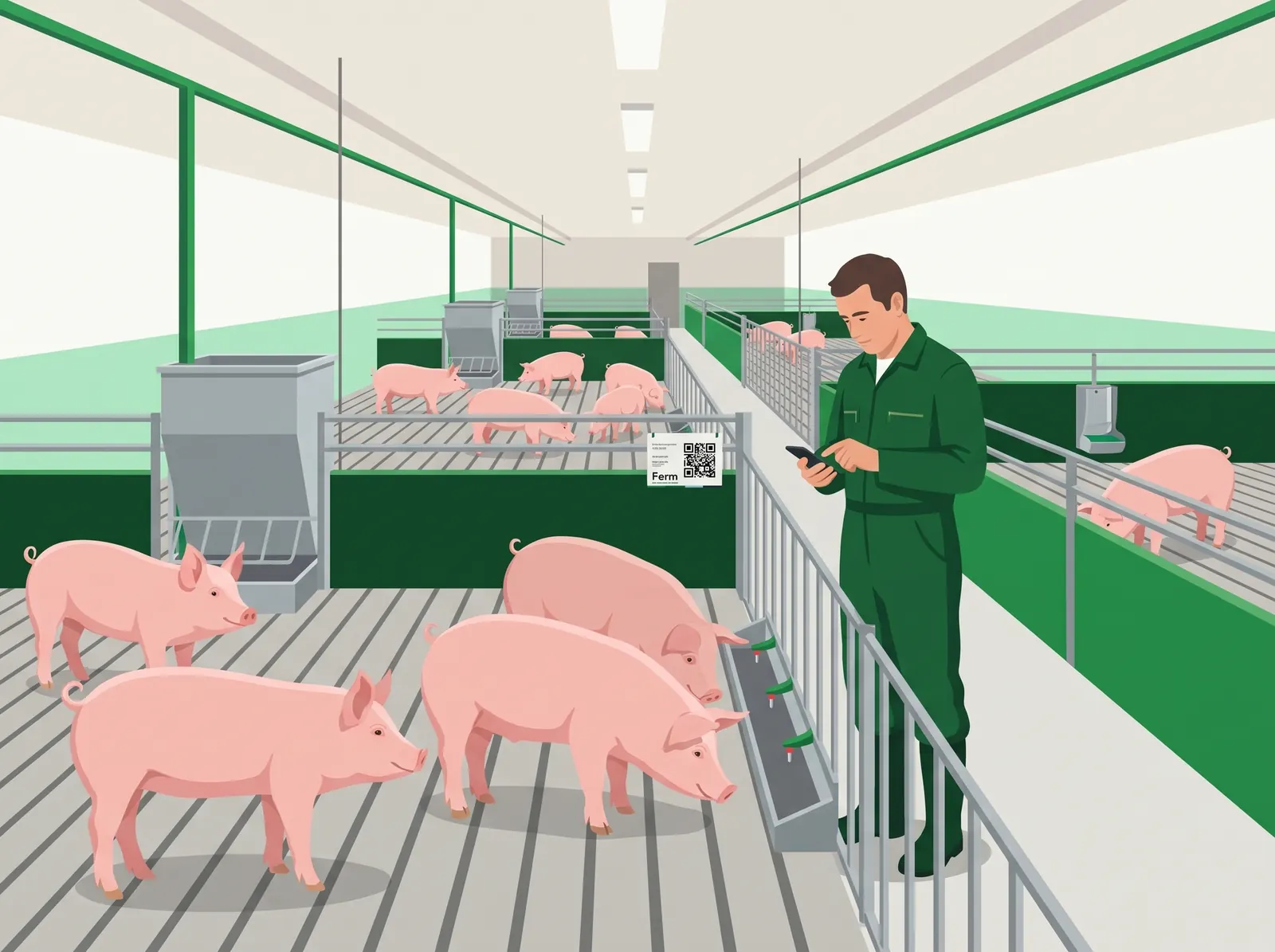
A pig feeder should be easy to wash and disinfect, with no sharp edges and no corners where feed collects. The base document of Poland's Chief Veterinary Inspectorate (GIW) on farm biosecurity says outright that feeders and drinkers must be easy to wash and disinfect. Choose equipment for the weight and age of your animals, not only for the purchase price. The pig farmer app helps you organize inspections and purchases.
What decides your choice of equipment
Before you buy a feeder or drinker, check three things: can you wash it thoroughly after every batch, do all pigs have equal access to it, and does the design avoid fights over space. The second criterion is how well the material holds up in the damp barn. The third is how easily you can replace a single part without taking the whole pen apart. These rules apply to every housing system, with or without bedding.
Pig feeders: requirements and daily care
Material and hygiene
The feeder must be smooth and tight so feed and leftovers do not collect in gaps. After every batch, check for damp, fermented feed. It puts pigs off eating and helps bacteria grow. Wash and disinfect feeders and drinkers according to your biosecurity plan, separately for the clean and dirty zones. If you are unsure about the protocol, use the biosecurity plan generator.
Access and layout
Every pig should be able to reach feed at the same time as the other animals in the pen. If the feeder is too short, stronger pigs push out weaker ones and weight differences grow within the group. Watch whether all animals eat without shoving. If daily gains differ noticeably, check feeder access first and the feed composition second. Feed and its quality are a separate topic, and you can follow silo stock in the silo monitoring module.
Pig drinkers: access to water
How pigs drink in practice
According to the pig behavior ethogram prepared by the National Research Institute of Animal Production (Instytut Zootechniki PIB), drinking is a separate behavior category, next to eating. A pig drinks from the drinker, so its position and height must allow free access, without stretching or squeezing through a crowd. The drinker should give a steady flow, and its design must not trap dirt, which forms deposits and helps microbes grow.
Checking and responding
Check every day that each drinker works, does not leak, and that the water looks and smells right. Watch the group: animals that stand at the drinker without drinking and keep coming back may signal a flow problem. If health worsens or water intake falls, treatment decisions are made by a vet, not the farmer. Record events and treatments in the treatment and withdrawal period module.
Pens and barn conditions
Climate parameters
According to a guide from KPODR Minikowo (a regional agricultural advisory center in Poland), barn climate is made up of temperature, humidity, gas content, lighting, noise and dust. The permitted concentrations are: no more than 3000 ppm carbon dioxide, 20 ppm ammonia and 5 ppm hydrogen sulfide, at relative humidity of 60–70%. The recommended minimum lighting is 40 lux with an 8-hour light day. Ventilation must exchange the air so that these values are not exceeded.
Temperature for different weights
The PIC Wean to Finish Guidelines table shows that target temperature depends on the weight and age of the pigs. For pigs weighing about 24 kg (44 days after weaning), the winter setpoint is 21.1 °C, and for pigs weighing about 46 kg (72 days after weaning) it is 17.8 °C. As pigs grow, they produce more heat, so ventilation must match stocking density. The table applies to a specific building type, so treat it as a reference point, not a ready setting for your barn.
Driving pigs: rules without violence
Why and how to use it
A driving aid helps move pigs from one place to another, for example to the scale or for loading. Use it sparingly and calmly, only as far as the task needs. Instead of hitting, walk behind the animals and use a barrier such as a sorting board. Pigs quickly learn where they meet unpleasant stimuli, and then every move gets harder.
Rules and training
General minimum standards for protecting pigs come from Council Directive 2008/120/EC, and you can find Poland's national rules in ISAP, the online legal acts system. Check the current legal state, because requirements can change. Before you buy, pick a driving aid that does not require stimuli on sensitive body parts, and train everyone who works in the barn. Keep electric prods for a last resort and use them following the manufacturer's instructions and current rules.
Equipment inspection and hygiene
Inspection schedule
Set a fixed schedule: check drinkers and feeders daily, run a full pen inspection every batch, and now and then check the structure and fixings. Record the results so you can see over time which parts wear out fastest. The worker app helps here, as your team reports faults as they happen.
African swine fever
The regulation of Poland's Ministry of Agriculture and Rural Development (MRiRW) of 12.03.2026 on measures to control African swine fever (Dz.U. 2026 poz. 344, Poland's Journal of Laws, legal state as of 22.11.2026) sets out the requirements for fighting the disease. Your duties depend on the epidemiological situation, so check the current text in ISAP and agree with your vet how to clean and disinfect equipment. According to the GIW base document, washing and disinfection equipment should be separate for the dirty and clean zones.
Frequently asked questions
What kind of feeder should I choose for pigs?add
Choose a feeder that is smooth, tight and easy to wash and disinfect thoroughly. Match its length and height to the weight and age of the pigs in that pen. Before you buy, check how cleaning works in practice.
Do pig drinkers need cleaning every day?add
Check a drinker daily for how it works and how the water looks. Do full washing and disinfection according to your biosecurity plan. Agree the frequency with your vet.
What temperature is right in a pig barn?add
Temperature depends on the weight and age of the pigs and the building type. According to the PIC Wean to Finish Guidelines, the winter setpoint is 21.1 °C for pigs of about 24 kg and 17.8 °C for pigs of about 46 kg. Use these values as a starting point and watch how the animals behave.
Can you use a pig driving board or prod?add
You can use a driving aid, but only as far as needed to move the animals. Do not hit pigs or use stimuli on sensitive body parts. Check the rules in their current legal state.
What gas levels are allowed in a pig barn?add
According to the KPODR Minikowo guide, carbon dioxide should not exceed 3000 ppm, ammonia 20 ppm and hydrogen sulfide 5 ppm, at relative humidity of 60–70%. Provide ventilation that keeps these values. Discuss measurements and assessment with an advisor or your vet.
What should I do if pigs are not eating from the feeder?add
First check the feeder, the feed quality and water access, because without water animals eat less. Watch the group for a few days and note any changes. If appetite stays low, report it to your vet.
Sources & resources
- linkGIW — Base document — farm biosecurity rules (exemption from testing), ver. 5.0
- linkIZ PIB — Pig welfare in a sustainable animal production system (eds. A. Rekiel, G. Żak)
- linkKPODR Minikowo — Pig behavior and welfare (P. Dorszewski et al.)
- linkPIC — PIC Wean to Finish Guidelines
- linkEU / Publications Office of the EU — Council Directive 2008/120/EC laying down minimum standards for the protection of pigs
- linkMRiRW / Journal of Laws — MRiRW regulation of 12.03.2026 on measures to control African swine fever (Dz.U. 2026 poz. 344)
Prepared by: DlaFerm Team based on data from the sources listed · Publisher: INSTA-TECH sp. z o.o.
Planning to buy equipment or inspect your pig barn?
The DlaFerm pig farmer app module helps you keep inspections and fault reports in one place. Get in touch or create a free farm account, and we will show you how it works in practice.
Phone
+48 796 258 151