Pig farming: what it is, breeds and production types
Pig farming means keeping pigs to produce piglets, finishing pigs or breeding stock. What you sell and the cycle you work in decide your production type. Below we cover breeds, production types, performance results and the rules that inspectors and vets ask about.
verifiedFrom the team that has organised work on poultry farms for years.
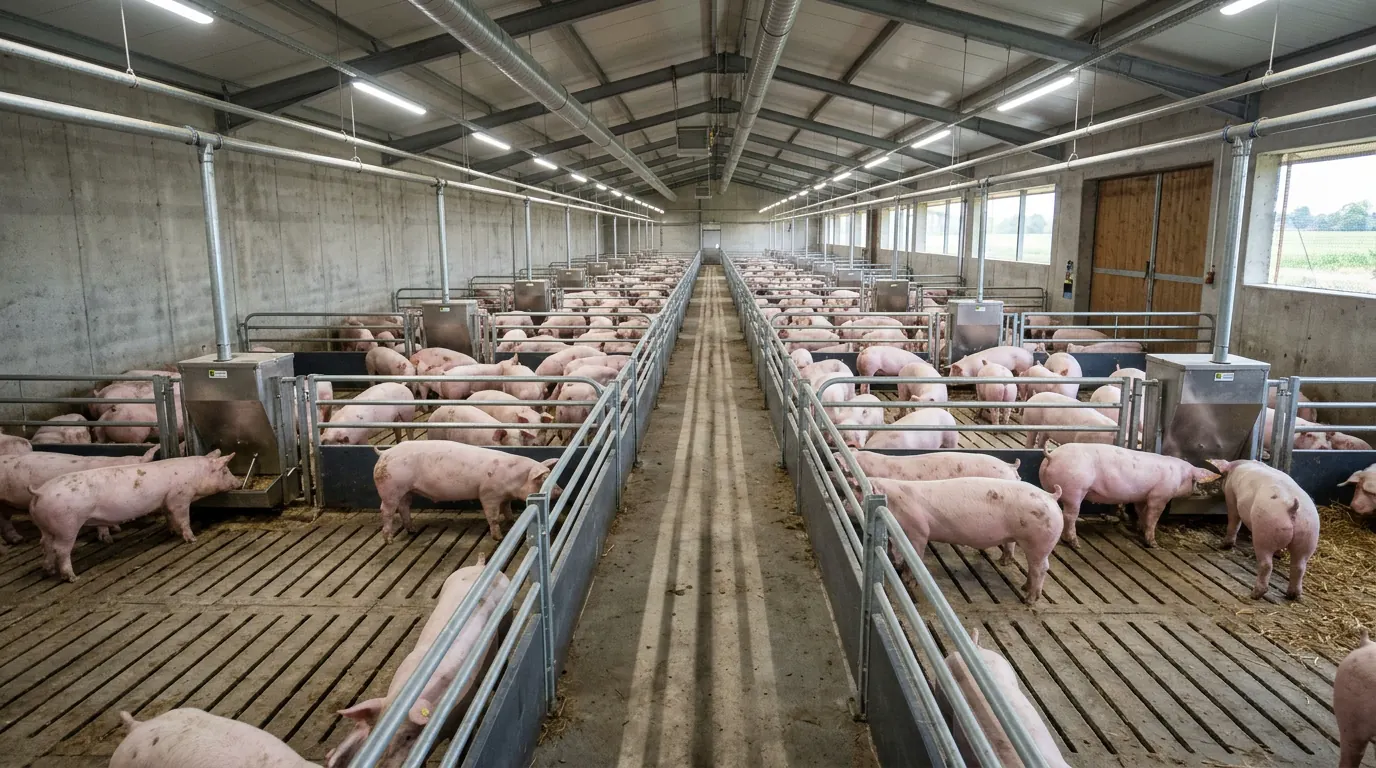
Pigs kept on a farm for meat or for breeding fall into one of three roles. Nucleus breeding supplies gilts and boars. Sow farming produces piglets. Finishing brings piglets to slaughter weight. Each type has different needs for pens, feeding and records. Before you choose, check your buildings, your space and your market. A well-described production cycle makes it easier to plan batches and calculate costs.
Why the production type matters
Your production type decides how many animals you keep, how you feed them and which results you track. For a finishing pig, daily gain and feed use matter most. For a sow, the number of piglets weaned per litter counts. For a nucleus breeder, the genetic value shown in performance testing counts. FCR is the feed used per kilogram of gain, and EPEF is a production efficiency index for finishing pigs. Compare both regularly, for example in the FCR and EPEF online module. If you mix goals in one herd without records, you cannot tell which type earns money.
Pig breeds on Polish farms
Native breeds
Native breeds developed in a given region or country from local, primitive breeds. Kept pure on individual farms, they preserve valuable genes that serve as a genetic reserve for the future. According to a 2020 presentation by KPODR (Kujawsko-Pomorski Agricultural Advisory Center) and IZ PIB (National Research Institute of Animal Production), these breeds are well adapted to the local climate, feed resources and housing conditions, and their products have special flavor qualities. The album of farm animals covered by genetic resources conservation programs, published by IZ PIB, shows which populations are protected.
Meat and sire breeds
In finishing and breeding programs you will meet breeds such as PBZ Puławska, Hampshire, Duroc and Pietrain. IZ PIB testing results list them next to line 990 for the same fattening traits, which makes comparison easier. Your choice of breed ties to your goal: growth rate, carcass yield and meat quality. When you buy stock, ask the breeder for the test result of the specific line and check that it covers the year the animals were born.
Three types: piglets, finishing pigs, breeding stock
Piglet rearing
Rearing runs from birth to weaning and beyond, when piglets are most exposed to disease. In its booklet on piglet rearing, KPODR describes the basics: warmth in the lying area, constant access to water and starter feed, and prevention of diarrhea. At weaning, prepare a feeding plan and a batch record, because your finishing result depends on it. Your vet sets the deworming and vaccination rules for your herd, not a textbook.
Finishing
Finishing ends with the sale of live pigs to a slaughterhouse. A sample calculation from ODR Lubań (an agricultural advisory center) shows the economics: it splits costs by bought-in piglet and by different intensity levels. The result depends mainly on piglet price, feed price, daily gain and feed use. Market prices change often, so check current quotes with your buyer and with the agricultural chambers. Record feed use for every batch, or you cannot calculate FCR.
Nucleus and sow breeding
Breeding sows and boars go through live performance testing, which IZ PIB describes in its publication on gilts and boars. In sow farming, the number of piglets weaned per litter and sow condition count. IZ PIB's BLUP breeding evaluation results cover reproduction, fattening and carcass traits, and the 2026 issues are the basis for choosing animals. Keep the origin and results of each animal in your herd records so you can quickly name the parents of every litter.
What performance testing results show
Daily gain by class
In IZ PIB's pig performance results, daily gain is split into classes, usually every 50 g. For PBZ Puławska, 10.14% of tested matings fell in the 600–649 g range and 15.46% in the 900–949 g range. For line 990, as many as 23.66% of matings reached the 800–849 g range. These figures show the spread within one breed, so compare your herd with the average, not with one best mating.
Carcass traits
Besides gain, testing covers carcass traits such as loin eye area, which IZ PIB presents in separate tables. The tables give the share of matings in each range, not single animals. When choosing stock, check both groups of traits, because high gain does not always come with good carcass yield.
How to read the results
Before you apply a result to your herd, check the data year and the housing conditions. A result from a breeding station with different feeding will not carry over directly to finishing on your farm. Compare results with your own FCR and daily gain, and look into any gap before you change lines.
Pig welfare on the farm
Conditions in the building
In its opinion on pig welfare on farm, EFSA (European Food Safety Authority) states that animals need enough space, good air quality and the chance to show behaviors typical of the species. The PIC Wean to Finish checklist gives a target building humidity below 65% and advises checking for drafts at animal level. Build these checks into your regular rounds rather than treating them as a one-off inspection.
Transport
EFSA also assesses welfare during transport. Before loading, check that the animals are healthy, and plan loading so that stress is not prolonged. Record the dates and times of shipments and the condition of animals on arrival, because this is the basis for explaining any losses.
Watching behavior
KPODR's material on pig behavior and welfare says that behaviors such as rooting or lying together signal good conditions. Regular observation lets you spot problems with heating, ventilation or feed early. Keep your observation and treatment records in the app for pig farmers.
Biosecurity, ASF and medicines
African swine fever
EFSA published an epidemiological analysis of ASF in the European Union for 2025. In Poland, control measures are set by the Ministry of Agriculture and Rural Development regulation of 12.03.2026 on measures to control African swine fever (Dz.U. 2026 poz. 344, Poland's Journal of Laws), with legal status as of 22.11.2026. Always check the detailed duties in the current text in ISAP (Poland's online legal acts database) and with your county veterinarian.
Biosecurity
A biosecurity plan describes who enters the buildings and when, how footwear and vehicles are cleaned, and how to handle dead animals. A written plan is easier to put in place and to show at an inspection. You can organize the plan's points in the biosecurity plan generator. Keep the entry and exit log in the QR entry and exit book so you know who was on the farm on a given day.
Medicines and withdrawal periods
Your vet always chooses the medicine and dose. You are responsible for recording every treatment and for observing the withdrawal period before slaughter. Keep a register with the date, animal group, product name, person who gave it and the end of the withdrawal period. Such a record speeds up an inspection and protects you from sending animals to slaughter with a drug still in their system. For record details, see treatment records and withdrawal periods.
Feeding finishing pigs and sows
Feeding phases
Breeders' manuals such as the PIC Nutrition and Feeding Guidelines and the Topigs Norsvin Feeding Manual TN70 describe separate diets for piglets, finishing pigs and sows. The rule is the same: match the feed to weight and purpose, not one mix for the whole cycle. Exact norms depend on breed and line, so take them from the manual of your stock supplier and from your feed adviser.
Feed and its quality
In its Wean to Finish checklist, PIC points to mycotoxins in feed, salt content and actual feed intake compared with the budget. Record intake every week, because a deviation is often the first sign of a health problem or poor water. Check silo stock in the silo monitoring module so deliveries never run out.
Frequently asked questions
What pig breeds are raised in Poland?add
In IZ PIB results you will find PBZ Puławska, Hampshire, Duroc, Pietrain and line 990, among others. Native breeds keep valuable genes and are well adapted to local conditions. Your choice depends on your goal: adaptation to conditions, or growth rate and carcass yield.
What are the types of pig production?add
The usual split is nucleus and sow breeding, piglet rearing and finishing. Nucleus breeding supplies gilts and boars, sow farming produces piglets, and finishing produces pigs for slaughter. Match the type to your building, your market and how you keep records.
What decides whether pig finishing pays?add
Mainly piglet price, feed price, daily gain and feed use. The ODR Lubań sample calculation shows different intensity levels. Market prices change often, so check current quotes with your buyer rather than old tables.
Can I choose a medicine for my pigs myself?add
No. Your vet chooses the medicine and dose. You record every treatment and keep to the withdrawal period before slaughter. Missing records make inspection harder and can lead to a halt in the sale of animals.
What is ASF and how do I protect my herd?add
ASF is African swine fever, fought with special measures set out in the regulations. Start with a biosecurity plan and an entry and exit log for the farm. Check current duties in ISAP and with your vet.
How do I read pig performance test results?add
Compare average results, not single matings. Check the data year and housing conditions. Set the result against your own FCR and daily gain before you change lines in your herd.
Sources & resources
- linkIZ PIB — BLUP breeding evaluation results: fattening and carcass traits, 2026 issue 1
- linkIZ PIB (National Centre for Animal Breeding / trzoda.izoo.krakow.pl) — State of breeding and pig performance results in 2025
- linkKPODR / IZ PIB — Advantages of breeding native pig breeds and the RASY RODZIME mark (presentation, M. Szyndler-Nędza, P. Radomski)
- linkEFSA AHAW Panel — Welfare of pigs on farm (EFSA Journal 20(8):7421)
- linkMRiRW / Dziennik Ustaw — Regulation of the Minister of Agriculture of 12.03.2026 on measures to control African swine fever (Dz.U. 2026 poz. 344)
- linkPIC — PIC Wean to Finish Guidelines
Prepared by: DlaFerm Team based on data from the sources listed · Publisher: INSTA-TECH sp. z o.o.
Running a finishing or sow farm?
The DlaFerm module for pig farmers keeps herd, treatment and performance records in one place. Create a free farm account and see how it looks with your own data.
Phone
+48 796 258 151