Livestock Unit (LU) Calculator: Convert Your Herd to LU
A livestock unit (in Poland: DJP, duża jednostka przeliczeniowa) turns animals of different categories into one common number. The EU convention sets 1 LU at 500 kg of live weight. We explain how to convert a beef herd and show how the DlaFerm.pl calculator adds up your animals.
verifiedFrom the team that has organised work on poultry farms for years.
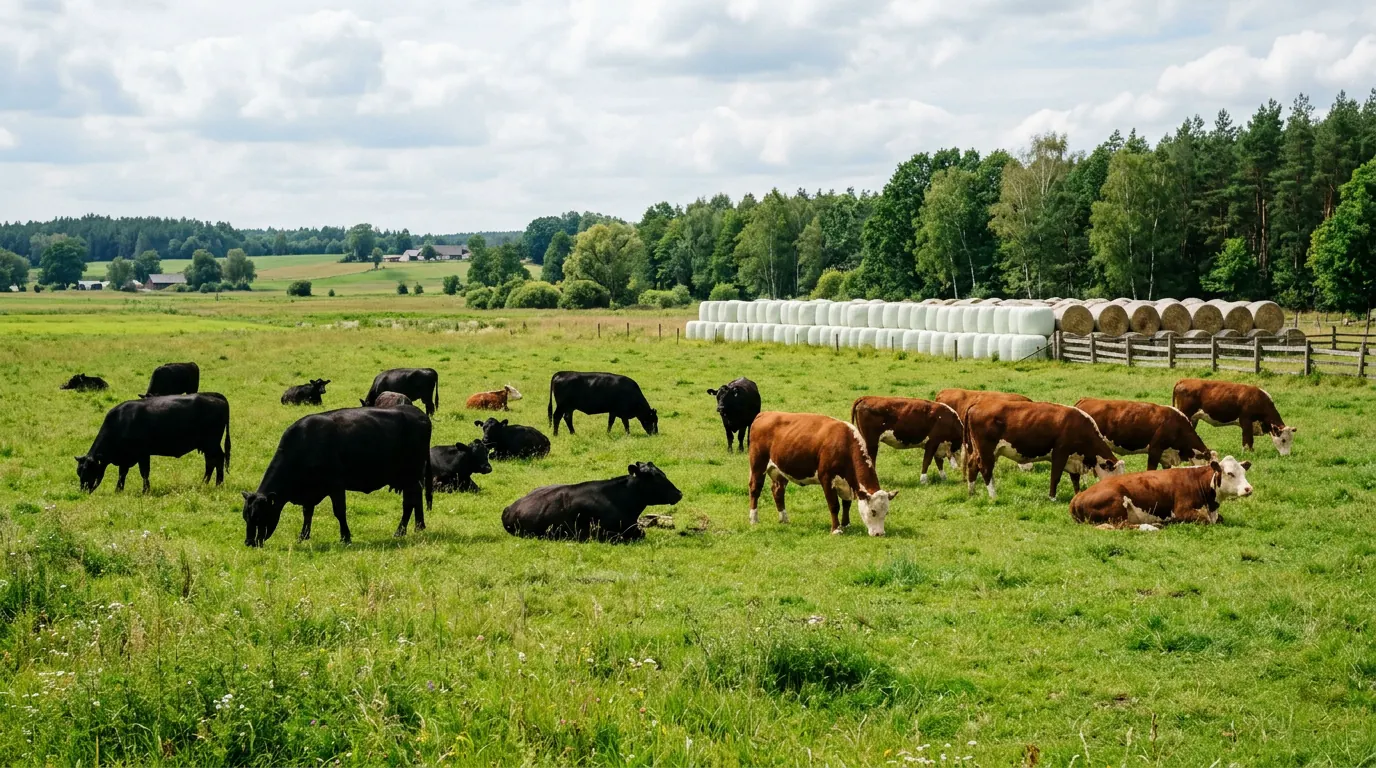
A livestock unit (LU, called DJP in Poland) is a way to bring animals of different categories and species down to one common number. In the European Union, 1 LU corresponds to 500 kg of live weight. The DlaFerm.pl converter works for pigs, cattle and poultry together: you enter the number of animals in each category, and the LU calculator multiplies them by the coefficients from the regulation Dz.U. 2019 poz. 1839 (Poland's Journal of Laws), gives the total LU for your herd and shows the thresholds for an environmental decision. You will find more tools among our calculators for farmers.
Why cattle farmers count LU
The LU number helps you judge stocking rate per hectare of grassland, plan feed, and fill in applications that ask for animals converted to units. This matters most for beef cattle, because a herd mixes suckler cows, calves, young stock and bulls of very different weights. Stocking thresholds and support rules depend on the specific program. Before you apply, check the requirements with ARiMR (Poland's Agency for Restructuring and Modernisation of Agriculture) and do not rely only on the examples here.
How the LU converter works
Coefficients assigned to categories
Each animal category has its own LU coefficient. The value depends on species, age and sex, not on the breed or on what the animal weighs on a given day. A calf that grows into another category must be converted again. Check the coefficients in current regulations or ARiMR guidance and do not copy them from memory.
A practical example
A publication from ODR Lubań (a Polish farm advisory center) on beef fattening calculates costs per animal over the whole production period, up to 24 months, in a herd of about 30 animals. The same way of thinking works for LU: first split the herd into categories, then count the animals in each one, and add the results last. If your herd has suckler cows, calves and young stock, count each group separately. Mixing up categories gives a total that does not match your real stocking.
Suckler herd and calf rearing
Suckler cows and calves
In a beef herd the suckler cow is the base, and her numbers decide how many calves you rear. According to studies from the Institute of Animal Science (IZ PIB), breeding work in beef herds rests on a mating plan and on breeding stock bought in or reared on the farm. In LU conversion, each suckler cow and her calf fall into different categories, so any change in herd makeup changes the total at once. Record every calving and weaning in your register.
Grazing and feeding
Grazing on grassland cuts labor costs, but it does not replace a full ration. IZ PIB research on organic cattle notes that on roughage alone animals may lack protein and rearing results may drop. Teagasc, in its beef manual, describes feeding systems for suckler cows and calves through the whole year. Set pasture stocking so that the ration is sufficient, not just so that it fits within LU per hectare. A feed calculator can help with that.
Head counts must match the register
Data source: the animal register
Head counts in each category should match the animal register kept under the act of 4 November 2022 on the animal identification and registration system, consolidated text Dz.U. 2026 poz. 591, legal status as of 22.11.2026. A gap between the herd on paper and the herd in the barn causes an error in the result. If you keep records in software, link them through the IRZplus integration (IRZplus is ARiMR's online animal register).
When to recalculate
Recalculate LU after every event that changes the herd: bringing in new animals, a sale, a death, a calf moving into the young stock category, or a bull changing category. Write down the date and the herd size before you recalculate, because applications and inspections usually refer to a specific day. If changes are frequent, it is easier to keep running records in farm management software than to count on paper.
Prices and the cost of live weight
What drives prices
Cattle and beef prices change often and depend on carcass weight, grade, demand and the market situation. We give no amounts here because they would soon be out of date. Check current quotes in market systems and in advisory center publications. Comparing costs and revenue needs a separate calculation, which the LU converter does not replace.
Cost of one kilogram
To judge whether rearing pays, work out the cost of producing one kilogram of live weight: feed, grazing, vet care, transport and labor, divided by weight gain. ODR calculations describe this rule, and a ready tool is the cost per 1 kg of live weight calculator. When purchase prices move, a margin calculator also helps.
Losses, medicines and notifiable diseases
Losses in the herd
Deaths and slaughter shrink the herd, and so the LU total. Record them with the date and the cause. If you suspect disease, report it to a veterinarian, who will carry out the next steps. The rules for reporting animal diseases and supervision are run by the Chief Veterinary Inspectorate (Główny Inspektorat Weterynarii).
Skin diseases and medicines
One disease you should know about is lumpy skin disease (LSD) in cattle. PODR Szepietowo (a Polish farm advisory center) describes it in a leaflet for farmers. A vet always chooses the medicine and the dose. You are responsible for recording the treatment and the withdrawal dates, because without them you do not know when the animal can go to slaughter. Keep these records in the treatment and withdrawal records.
Frequently asked questions
How much is 1 livestock unit (LU)?add
The EU convention says 1 LU corresponds to 500 kg of live weight. Check the coefficients for specific cattle categories in current regulations or with an ARiMR advisor. The DlaFerm.pl calculator is for quickly adding up your herd.
How do I convert suckler cows and calves to LU?add
Count each category separately: the cow by her category, the calf by its age category. Multiply the number of animals in each group by its coefficient and add up the results. Do not add calves to cows before converting.
Is LU the same as stocking rate per hectare?add
No. LU is the herd converted into units, while stocking rate per hectare is the number of LU divided by the grassland area. Only the second figure tells you how many animals the pasture carries.
Does the LU converter work for pigs and poultry?add
Yes, the DlaFerm.pl calculator covers pigs, cattle and poultry. Each species has its own categories and coefficients, so you choose the species before entering numbers. Do not compare results between species without checking the rules for each.
How often should I recalculate my herd's LU?add
Recalculate after every change in herd makeup: new animals, a sale, a loss or a change of category. Write down the date of each calculation, because inspections and applications usually refer to a specific day. Resolve any gap with the animal register before you send documents.
Can I rely on the calculator result in an application?add
The calculator helps with the math, but the rules are set by the program you apply to. Check the requirements with ARiMR before you send anything and compare the result with the animal register. If in doubt, contact an advisor or your ARiMR branch.
Sources & resources
- linkIZ PIB — Wiadomości Zootechniczne — Breeding work in a beef cattle herd (Z. Choroszy et al.), WZ L(2012)1:11–20
- linkIZ PIB — WZ — Breed selection and breeding work in organic beef cattle herds (P. Wójcik, A. Czubska)
- linkODR Lubań (PODR publication) — Sample calculation of farm income from beef production (different intensity levels)
- linkTeagasc (Ireland) — Teagasc Beef Manual — Section 3: Beef Systems
- linkSejm RP / Journal of Laws — Act of 4.11.2022 on the animal identification and registration system — consolidated text (Dz.U. 2026 poz. 591)
- linkPODR Szepietowo — Lumpy skin disease (LSD) in cattle — leaflet (Z. Marciniak)
Prepared by: DlaFerm Team based on data from the sources listed · Publisher: INSTA-TECH sp. z o.o.
Counting your beef herd in one place?
The <a href="/program-do-zarzadzania-ferma-drobiu">farm management software</a> from DlaFerm.pl keeps your herd records and helps you keep the numbers in line with your documents. Create a free farm account or get in touch, and we will show you how it works in practice.
Phone
+48 796 258 151