Leg bands for pigeons and chickens: types and sizes
Pigeons usually get closed, numbered bands put on at a young age. Chickens more often get open bands or printed bands. Pick the size by the leg diameter on the day you fit the band, not by the bird's age. Below we cover the types, how to choose and fit a band, and how to link the band number to your flock records.
verifiedFrom the team that has organised work on poultry farms for years.
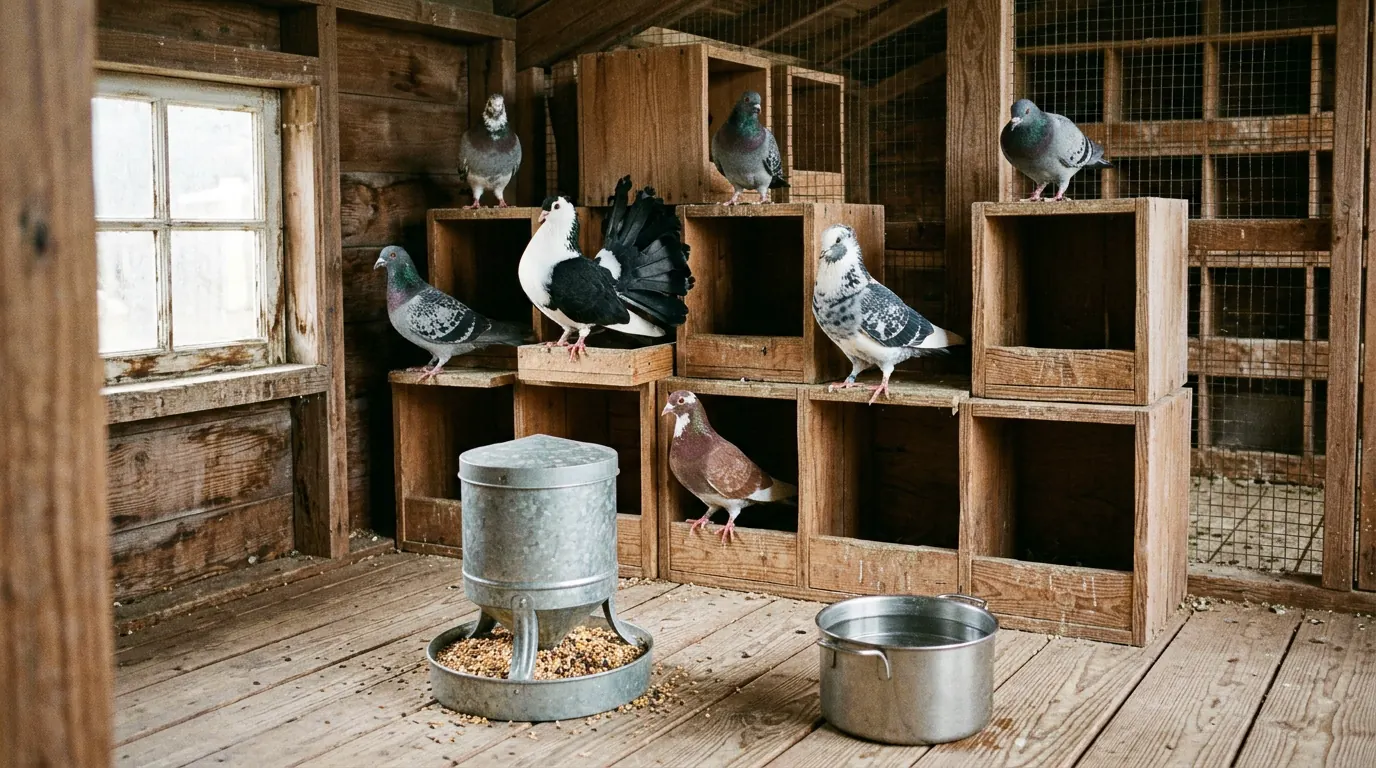
A leg band is a ring fitted on a bird's leg. It marks one bird and tells it apart in the flock. For pigeons, closed numbered bands fitted young are the standard. For chickens, most keepers choose open bands or printed bands, depending on whether the bird only needs to be marked in the flock or also entered in your records. Choose the size by the leg diameter at the fitting point, not by age or breed. A band that is too tight presses on the leg and can damage the skin. A band that is too loose falls off easily.
Why mark your birds
In breeding, a band tells you which bird is which, when it hatched and which line it comes from. It makes it easier to pick breeding birds, cull weaker ones and run health checks. Without a number, it is hard to link a bird to a treatment, a vaccination or its laying results. Enter the band number in your records right away so it is tied to that bird's history. For a new keeper this is the first thing to get in order before the flock grows. For more on running a small flock, see keeping chickens for beginners.
Closed, open and printed bands
Closed bands for pigeons
A closed band is a ring with no split. You slip it onto a young pigeon's leg before the leg reaches full size. Once closed, it cannot be removed without damage, so the diameter must be exact. The number and year stamped on the band let you identify the bird later. Racing pigeons carry bands issued by the breeders' association, with an assigned number. Check the fitting rules with your association.
Open bands for chickens
An open band has a split that lets you fit it on an adult bird's leg. After fitting, you close it at the overlap. This suits chickens, because adult legs are thicker and a closed band often will not go on. On laying hens, the edges must be smooth and must not catch on litter or run fencing, which is where small injuries happen most. Check wire fencing for this before you start banding. For run setup, see the chicken run guide.
Printed and colored bands
Print (number, letters, year) and color let you mark groups without reading every number. A color can stand for the hatch year, a batch or a flock. Set the marking system in advance and keep to it across the whole farm, because changing colors later complicates your records. Prices depend on material, print and the number of bands per pack. They change, so check current offers with suppliers.
How to choose a band size
Measuring the leg diameter
Measure the leg at its thickest point, usually just above the hock joint. Use calipers, or a tailor's tape and convert the circumference to diameter. Measure a calm bird, without a long struggle. Band sizes come in different systems, and numbering and diameters differ between makers. Always compare your measurement with the chart of the specific supplier, not with a chart from another catalog.
Allowing for growth in young birds
A young pigeon's leg changes size fast, so a closed band must fit on the day you fit it. Too much slack lets the band spin and rub the skin. Too tight can disturb circulation in the toes. If you see swelling, bluish toes or the bird starts to limp, remove the band if you can and talk to a vet. Medicine and dose are always chosen by a vet, not by the keeper.
Fitting bands without injuring the leg
Preparation
Work in a quiet place with good light. Have the bands, the fitting tool and a disinfectant ready. Before fitting, check the bird's leg for wounds, scabs or swelling. To limit the spread of disease between birds and flocks, follow your biosecurity plan: disinfect tools between birds and change gloves. You can prepare a plan in the biosecurity plan generator.
Fitting step by step
Slide the band over the foot, then move it up the leg to where it sits snug but does not press. Close it with gentle pressure, so the edges meet evenly. After fitting, check that the bird walks freely and stands on both legs. If it drags a leg or has trouble walking, adjust or remove the band.
The bird after banding
Put the bird in a quiet spot without sharp edges or wire. Check the legs over the next days during your daily flock walk-through. The band stays on for the bird's whole life, so a fitting mistake stays too. Fix places with sharp litter or snag points before injuries happen.
Bird identification and the law
What to check in the rules
Requirements for identifying and registering poultry are set out in legal acts published in ISAP, Poland's Internet System of Legal Acts. The legal state used for this text is 22.11.2026. Rules change, so before you buy bands and assign numbers, check the current wording in ISAP. Also ask the county veterinary officer (powiatowy lekarz weterynarii) how it works in your county. A band alone does not replace the records the law requires from a keeper.
Records an inspector will look at
An inspection usually checks clear flock records: the number of birds, the dates of placements and losses, and where the birds came from. A band number is not enough if it is not linked to a record. Keep a flock log with numbers, dates and bird movements. You can hold that data in one place in the coop records module.
The band number in your flock records
How to enter the number
For each band, record the number, the fitting date, the sex (if known), the breed or line and the place in the flock. When a bird moves to another pen or is sold, move its record with it. Enter numbers straight away, because after a few days copying from a scrap of paper invites mistakes. You can keep data for the whole farm in the poultry farm management software.
Linking to treatment
If a bird gets a medicine, the record with the band number shows which birds the treatment covers. A vet sets the withdrawal period, together with the information on the medicine's leaflet. You keep track of the end date. Treatment and withdrawal records help here, saving the dates and reminding you when they end.
Band stock and placements
Keep a stock of every band size you use, and do not mix batches with different print. Note which batch went on which birds. When you sell, the buyer asks for the number, which is easy to give if it was recorded from the start. Match your stock to planned placements. Placement and cycle planning helps you set the dates.
Frequently asked questions
What leg band should I use for a pigeon?add
Young pigeons get closed numbered bands, fitted at an early age. You choose them by leg diameter on the day of fitting. Racing bands are issued by the breeders' association, so check the rules with yours.
How do I choose a leg band size for a chicken?add
Measure the leg diameter at its thickest point and compare it with the specific maker's chart, because numbering differs between suppliers. Adult chickens more often get open bands, which go on without forcing them over the leg.
Can a leg band be removed?add
A closed band cannot be removed without damage, so you fit it once, after careful measuring. An open band can be opened at the overlap. If the leg is injured, have a vet remove the band.
How much do pigeon and chicken leg bands cost?add
The price depends on material, print, size and the number of bands per pack. We give no amounts because suppliers change them. Check the current offer with the maker or a poultry supply shop.
Are leg bands for chickens mandatory?add
It depends on the rules in force at the time and on the purpose of marking. The legal state used in this text is 22.11.2026. Check the rules in ISAP and ask the county veterinary officer before you start marking your flock.
Does a leg band bother the bird?add
A well-chosen, correctly fitted band does not bother the bird. A badly chosen one presses on the skin, rubs it or catches on wire. A daily check of the legs picks up a problem early.
Sources & resources
- linkMain Veterinary Inspectorate (GIW) — gov.pl/web/wetgiw
- linkARiMR (Agency for Restructuring and Modernisation of Agriculture) — gov.pl/web/arimr
- linkNational Research Institute of Animal Production — izoo.krakow.pl
- linkInternet System of Legal Acts (ISAP) — isap.sejm.gov.pl
Prepared by: DlaFerm Team based on data from the sources listed · Publisher: INSTA-TECH sp. z o.o.
Keeping a flock and want to link band numbers to each bird's history?
The poultry farm management module in DlaFerm.pl lets you record the number, date and location of every bird in one place. Create a free farm account and see how it looks in your own coop.
Phone
+48 796 258 151