Layer feed to boost egg laying: how to choose a good one
Feed sold as "to boost egg laying" is usually a complete layer mix with more protein and calcium. On its own it will not make a hen lay against her natural cycle. We explain what to check on the label and when a feed change makes sense at all.
verifiedFrom the team that has organised work on poultry farms for years.
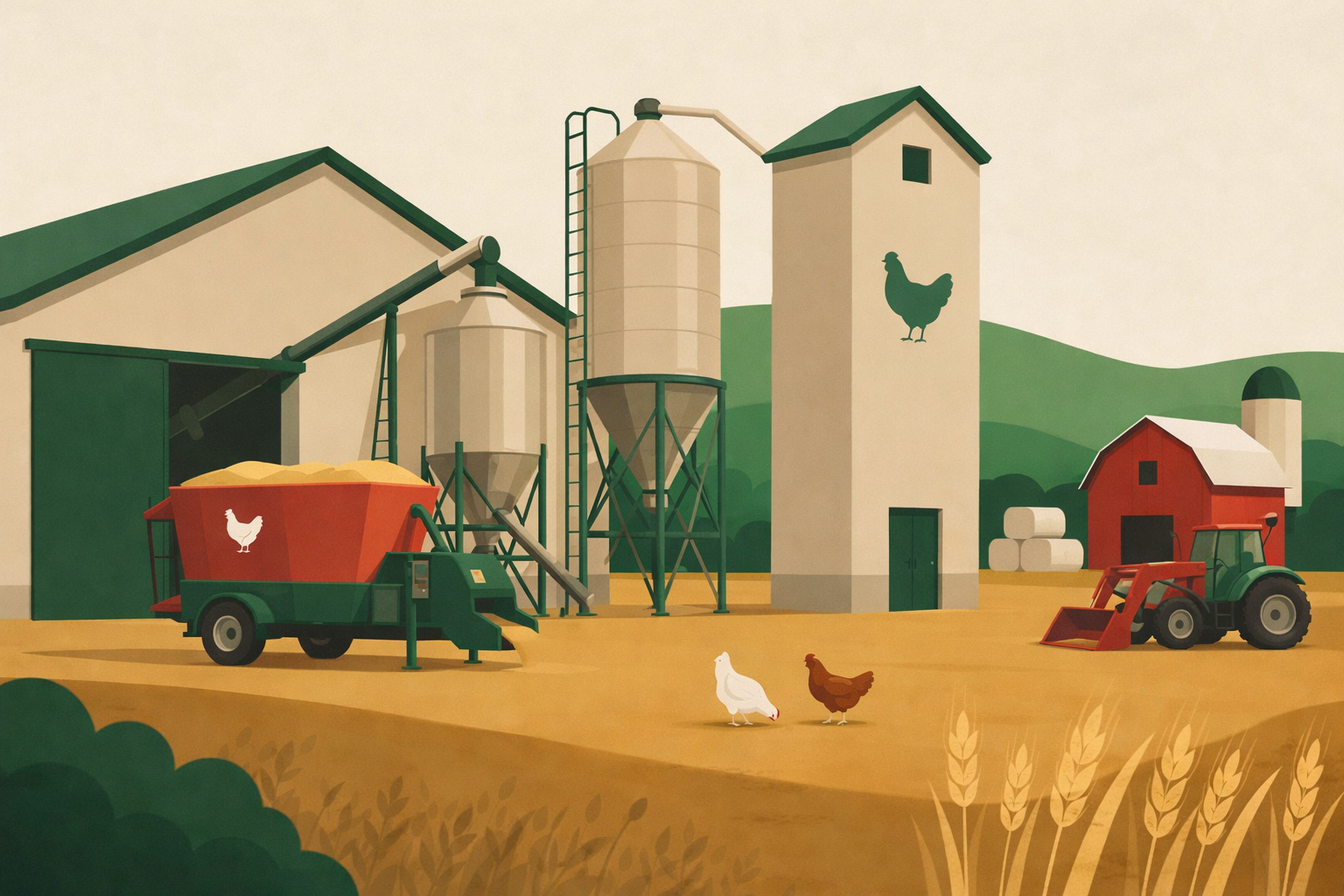
"Layer feed to boost egg laying" is in practice a trade name for complete feed mixes for hens in active egg production. These are not starter or chick feeds, but layer feeds. Compared with "maintenance" feed (for birds not in intensive lay), they usually contain clearly more protein and calcium, because that is what a hen's body needs when she builds an egg every day.
Feed supports laying but does not force it
Before we get to the label, one important caveat. Good feed lets a hen lay as many eggs as her natural potential allows at that moment. It does not switch laying on by force. If a hen is not laying because of short days, molting, age, broodiness or disease, no feed change will reverse that. Layer feed helps when diet really was the limiting factor, and not in any other case. If you are not sure what affects your flock, start with the full list of causes: why hens are not laying eggs.
Two numbers to look at on the label
When choosing a bag, two numbers matter most. The first is crude protein. In ready-made layer feeds you most often see values of roughly 16–18%. That is the range found in practice, not a fixed standard for every mix. The second is calcium. A hen that is actively laying needs clearly more of it than a bird out of lay, because much of the calcium goes into the shell. We cover calcium and ways to supplement it separately: chalk for hens.
What to check on a layer feed label
Protein and calcium first
The composition printed on the label or in the product sheet is the first place to look, not the trade name or the slogan on the bag. Roughly 16–18% crude protein is a value often found in layer feeds, and the calcium level in a mix for actively laying hens should be noticeably higher than in maintenance feed. If the mix does not state these values outright, or they are close to those of "ordinary" feed, it is hard to call it truly aimed at laying, whatever the packaging says.
Ingredients, not just the protein percentage
Also look at the ingredient list. The higher up it you see grains and specific protein sources (for example soybean meal), the easier it is to judge the quality of the mix, compared with a vague composition. This is general advice on reading a label, not a recommendation of any brand. There are many good feed producers, and what works best varies with local availability and flock size.
Packaging and buying: 25, 50 or 100 kg
Layer feed is usually sold in 25 kg bags, less often 50 kg. For larger flocks, 100 kg packs or bulk delivery may be available. Availability in farm stores, from local feed producers or on online marketplaces depends on the region. For a small backyard flock a smaller bag makes sense logistically, because the feed does not sit too long before it is used. On a larger farm buying bigger quantities pays off more. That is a matter of convenience and transport cost, not a difference in the nutritional value of the feed.
When layer feed helps and when it doesn't
It helps when diet was the weak link
If the flock was fed unbalanced grain, table scraps as the main part of the diet, or feed not meant for layers (for example starter or maintenance feed), switching to a complete layer feed with the right protein and calcium can really improve laying, because it removes the actual limit. This is the most typical case where a feed change brings a visible effect within a few weeks.
It won't help when the cause lies elsewhere
A feed change will not reverse a laying pause caused by short days in autumn and winter, molting, old age, broodiness or disease. These are physiological or seasonal processes that feed composition does not affect. Buying ever "stronger" feed in that situation brings no result and is simply a cost with no return. First find the real cause.
Season and energy needs in winter
In colder months a hen's energy needs rise slightly, because part of the energy from feed goes to keeping her body warm. This is why "layer feed for winter" appears on sale. In practice it is most often the same base as ordinary layer feed, perhaps with a little more energy, and not a separate product "to boost egg laying". Extra energy in winter will not make up for short daylight, which remains the main seasonal brake on laying. Also keep an eye on vitamin supply, especially in months with less sun and green forage. More in our article on vitamins for hens.
Frequently asked questions
What should I feed hens to lay more eggs?add
The basis is a complete layer feed with the right protein level (roughly 16–18%) and calcium, plus free access to an extra calcium source (for example feed chalk). This helps when diet really was the limit. If laying dropped despite good feed, the cause may lie elsewhere: season, molting, age or health. Diet is not the only factor.
What is the best feed for laying hens?add
There is no single universally best feed. Instead of hunting for a brand name, look at the numbers on the label: crude protein (roughly 16–18% in layer feeds), a calcium level suited to actively laying birds, and a sensible ingredient list. A good feed for one flock is not necessarily the best choice for another. It also depends on flock size and local availability.
What helps hens lay more eggs?add
It is several factors at once, not feed alone: a long enough day (roughly 14 hours or more of light), a well-balanced diet with protein and calcium, the age of the hen (laying is highest in the first year), and good general health with no stress. Diet is one lever you can really control, but if the other factors are not met, a feed change alone is not enough. For a full review of the causes of a laying drop, see why hens are not laying eggs.
What conditions make hens lay best?add
The best results come from a combination: complete layer feed with the right protein and calcium, constant access to an extra calcium source, a long enough day, and calm, low-stress living conditions. No single "trick", feed included, replaces the other conditions if one of them is missing.
Sources & resources
- linkNational Research Council — Nutrient Requirements of Poultry
- linkInstytut Zootechniki PIB (National Research Institute of Animal Production) — poultry feeding standards
- linkMerck Veterinary Manual — Nutrition and Management of Poultry
- linkWorld's Poultry Science Association — nutrition and eggshell quality
Prepared by: DlaFerm Team based on data from the sources listed · Publisher: INSTA-TECH sp. z o.o.
Want better control of your flock's feeding and laying?
DlaFerm helps you plan feeding and record daily egg numbers, so you can check whether a feed change really works. Create a free farm account or get in touch and we will show you how it works.
Phone
+48 796 258 151