Guinea fowl eggs: when they lay, how many, and what to expect
Guinea fowl usually start laying in spring and lay the most eggs when days are long. The eggs are smaller than hen eggs, with a hard, speckled shell and a similar composition. We explain when to expect the first eggs and what affects laying.
verifiedFrom the team that has organised work on poultry farms for years.
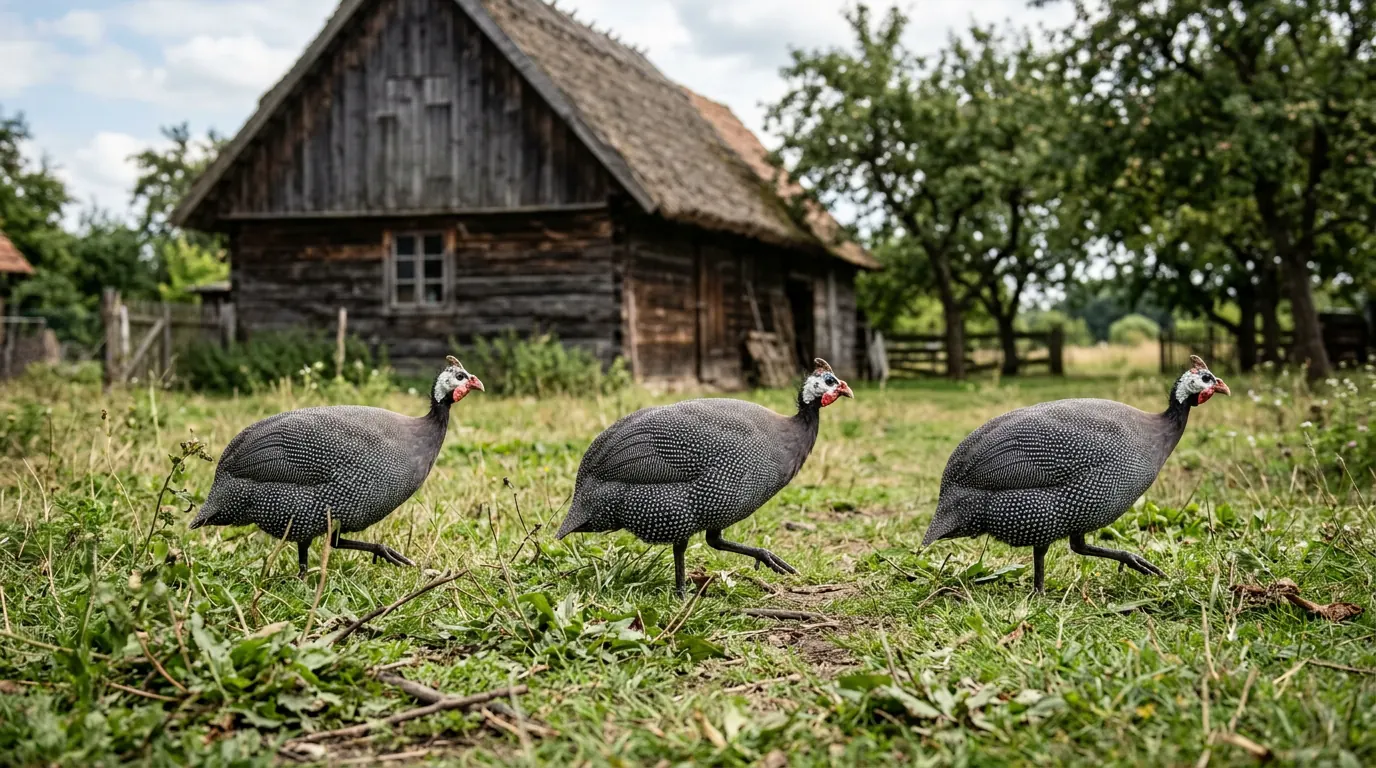
Guinea fowl usually start laying in spring, once they reach sexual maturity, and lay the most eggs in season, when days are long. The eggs are clearly smaller than hen eggs, with a hard, finely speckled shell and usually a lighter background. Laying depends on the bird, its age, feeding and housing, so every group looks a little different. For the basics of keeping them, see our guide to guinea fowl: keeping and facts.
What decides when laying starts
A guinea hen usually reaches sexual maturity in her first year. The first eggs come gradually: at first they are irregular, then the daily count evens out. Lighting matters a lot. Laying rises with long days and drops clearly in autumn and winter. When you buy young birds, ask the breeder about the age of the group and how it was reared, because that decides when they start. If your flock mixes young and adult birds, egg counts will be harder to predict, so record them separately for each group.
When guinea fowl start laying
The laying season
You collect the most eggs from spring to late summer, when days are long and birds have access to light and room to move. In autumn the count falls, and in winter laying often stops completely. Do not treat this as a flock failure: it is a natural rhythm. Before you plan sales or hatching, check your records for last season. That gives you an honest estimate of how many eggs to expect next year.
Feeding and laying
A shortage of protein or minerals quickly shows in the number of eggs and in shell quality. A well-balanced feed matched to the laying stage is the foundation. We cover feeding standards in a separate guide to feeding guinea fowl. Change the diet gradually and watch the birds' behavior and egg count over a few days.
Health and a drop in laying
A sudden fall in eggs can be a sign of disease, not only of the season. Before you change anything in feeding, watch the birds, check the litter and water, and write down what you see. If you suspect infection or parasites, contact a vet. Examples of problems are in our text on worm infections in guinea fowl. The medicine and dose are always chosen by a vet.
What guinea fowl eggs look like
Size and shape
Guinea fowl eggs are smaller than hen eggs and usually oval, sometimes a little elongated. Size differs a lot between birds, so when selling it is better to judge eggs by weight and appearance than by a single standard. The shell is clearly hard, which helps transport but calls for careful handling when you collect.
Shell and speckles
The shell is usually light, in cream or beige shades, covered with fine brown or rusty speckles. The strength and spread of the speckles differ between birds, so eggs from one group can look very alike and eggs from another clearly different. Looks alone say nothing about quality. Judge cleanliness, cracks and shell condition against the light.
Quality inside
The quality of white and yolk is described with Haugh units, which depend on the height of the thick white. The test is done in a lab or with simple equipment, and the result depends on storage time. Read more in our guide to egg quality and Haugh units.
Properties of guinea fowl eggs
Nutritional composition
The composition of guinea fowl eggs is close to that of hen eggs: they contain protein, fat, vitamins and minerals. The exact values depend on feeding, breed and age, so there is no single table for all guinea fowl eggs. If you need data for a label or an offer, order a lab analysis of samples from your own group.
What we do not promise
You will hear claims about special health benefits of guinea fowl eggs. We have no reliable basis to confirm them, so we do not repeat them as facts. For questions about diet or health, ask a dietitian or doctor. When you describe eggs for sale, stick to what you can measure: weight, appearance and laying date.
Shelf life and storage
Store eggs in a cool place at a steady temperature, away from strong smells and damp. Do not wash them before storing, because you wash off the shell's natural protective layer. Set up a clear rotation so the oldest eggs go first. Set the shelf life according to the rules, and if in doubt ask a vet or the inspection service.
Collection hygiene and egg safety
How often to collect
Collect eggs several times a day, especially in hot weather and when birds are crowded. The longer an egg lies in the nest, the higher the risk of dirt and cracks. Mark each collection with the date and group, so if a problem appears you know where a batch came from. Such records are the base of quality control.
Salmonella and hygiene
Salmonella is one of the main hazards with eggs, so hygiene of the house, nests and litter matters. We describe the rules and signs in our text on Salmonella in guinea fowl. If you suspect infection, contact a vet and have samples taken by an authorized laboratory.
Medicines and withdrawal periods
When the flock is treated, eggs usually cannot be sold during the withdrawal period. Record every dose, the end date and the withdrawal deadline, so you do not slip at collection. A treatment and withdrawal period log helps keep this data in order. The vet sets the length of the withdrawal period based on the product.
Managing laying in practice
Egg records
Write down the number of eggs every day, separately for each age group. After a few weeks you will see a trend, and after the season you can compare years. Your records are the best argument when talking to buyers and when planning stock for the next year.
Rules for selling
Selling eggs requires meeting sanitary, veterinary and marking requirements. The legal state in this guide is 22.11.2026, but rules change. You can check current acts in ISAP (Poland's Internet System of Legal Acts) and supervision requirements at the Chief Veterinary Inspectorate (Główny Inspektorat Weterynarii). Before you start selling, talk to your county veterinary officer (powiatowy lekarz weterynarii).
Frequently asked questions
When do guinea fowl start laying eggs?add
Guinea fowl usually start laying in spring, after reaching sexual maturity, most often in their first year. The first eggs can be irregular and the count rises gradually. The exact moment depends on the bird, the age of the group and lighting, so ask the breeder about the age of the flock.
What do guinea fowl eggs look like?add
They are smaller than hen eggs, with a hard shell and fine, usually brown or rusty speckles on a light background. Color and spread of the speckles differ between birds. The shape is usually oval.
Are guinea fowl eggs healthier than hen eggs?add
The composition of guinea fowl eggs is close to hen eggs, and the details depend on how the birds are fed. There is no reliable basis to attribute guaranteed health benefits to them. Ask a dietitian or doctor about diet.
How many eggs does a guinea hen lay per season?add
The number depends on breed, age, day length and feeding, so we give no single figure. Record daily collections so you can compare your group's results after the season. Ask the breeder or an advisor for specific performance standards.
How long can you store guinea fowl eggs?add
Store them in a cool place at a steady temperature, away from damp and smells. Do not wash eggs before storing, because you damage the shell's natural protective layer. Set the shelf life according to the rules, and if in doubt ask a vet.
Can you sell guinea fowl eggs?add
Selling requires meeting sanitary, veterinary and marking requirements. The legal state in this guide is 22.11.2026, but rules change. You can check current acts in ISAP (Poland's Internet System of Legal Acts) and supervision requirements at the Chief Veterinary Inspectorate.
Sources & resources
- linkChief Veterinary Inspectorate (Główny Inspektorat Weterynarii) — gov.pl/web/wetgiw
- linkNational Research Institute of Animal Production (Instytut Zootechniki PIB) — izoo.krakow.pl
- linkEFSA — efsa.europa.eu
- linkInternet System of Legal Acts (ISAP) — isap.sejm.gov.pl
Prepared by: DlaFerm Team based on data from the sources listed · Publisher: INSTA-TECH sp. z o.o.
Keeping a guinea fowl flock and collecting eggs?
The DlaFerm farm management system lets you record egg collections, losses and treatments in one place. Create a free farm account or get in touch, and we will show you how it works in practice.
Phone
+48 796 258 151