Guinea fowl broilers: raising for meat, weight, how many weeks
You raise guinea fowl broilers for meat, and the target weight agreed with your buyer sets the length of the cycle, not the calendar. Guinea fowl grow more slowly than chicken broilers, so we do not carry chicken tables over directly. We show what data is available, how to track flock weight and what to watch in feeding and in the house.
verifiedFrom the team that has organised work on poultry farms for years.
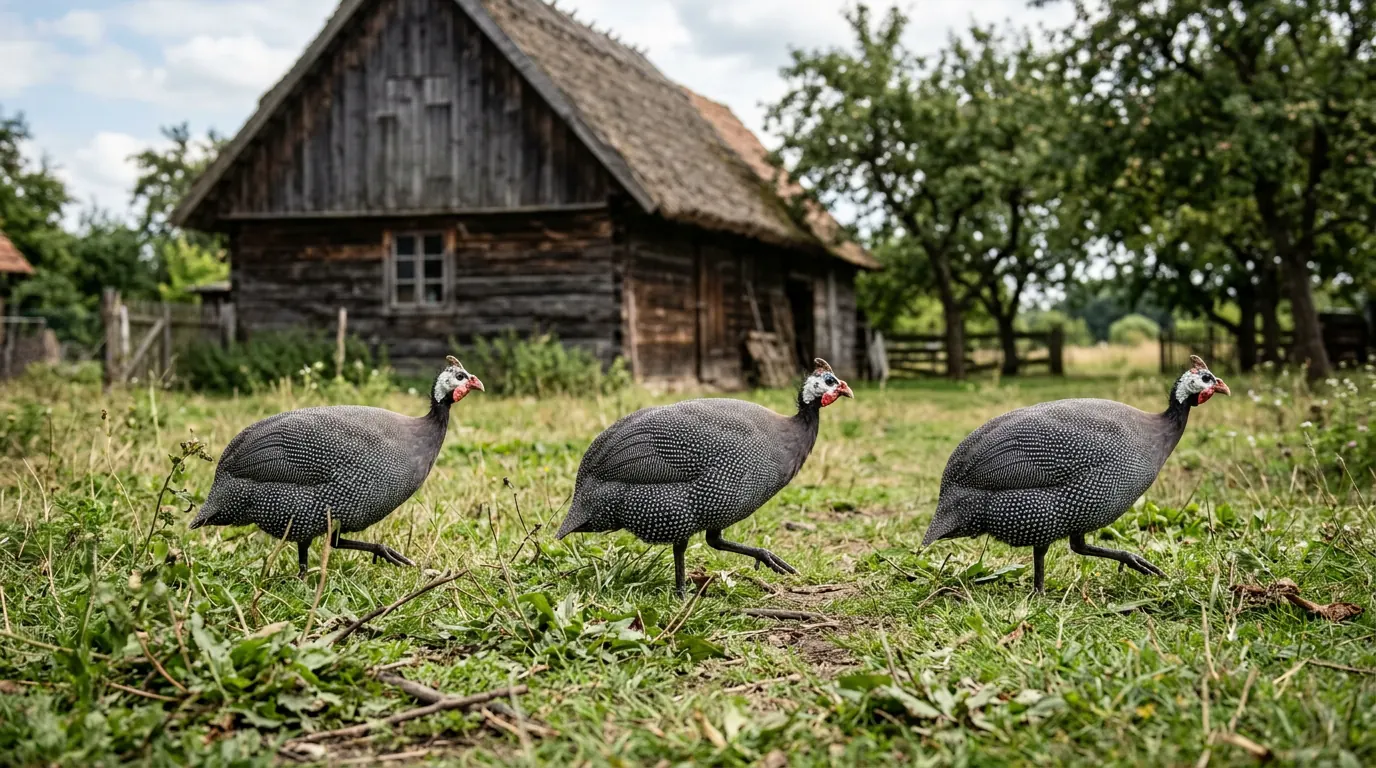
You raise guinea fowl broilers for meat in a fattening cycle. Slaughter time depends on live weight, flock uniformity and your contract with the buyer. We give no weight table for guinea fowl, because the published tables cover Ross broiler chickens. Below we show how to read that data and what carries over to guinea fowl. The basics of rearing are in our guide to raising guinea fowl.
Why we do not copy chicken tables directly
Chicken broilers grow very fast and guinea fowl grow more slowly, so the same calendar will not work. When you plan a flock, set a target weight in kilograms and work out the time from it, instead of copying weekly gains from chicken tables. Before placing chicks, ask your buyer for the expected live weight and pickup date, because the whole plan depends on them. Also look at how raising broilers works, to see the differences in practice.
The first weeks: temperature and uniformity
Temperature under the heat source
The Ross Broiler Management Handbook 2025 gives ambient temperature for chickens by bird weight. For a bird weighing 44 g (0.10 lb) it is 30 °C, for 425 g (0.94 lb) 25 °C, for 1015 g (2.24 lb) 22 °C, and for birds above 1530 g 20 °C. Do not copy these values for guinea fowl without watching the birds. Watch the chicks and adjust heating so they neither huddle under the heat source nor move away from it. Agree the starting temperature range with your vet or adviser. For comparison, see the first week of raising a broiler chick.
House requirements at the start
A guinea fowl house needs dry litter, even lighting and spots where birds can move away from the heat source. Check that ventilation removes moisture without drafts at floor level. We describe the details in a separate guide: guinea fowl housing requirements.
Flock weight and growth rate
Data from Ross 308 chicken broilers
The Ross 308 / 308 FF Broiler Performance Objectives 2022 gives average body weights for chickens. We converted the values from pounds: about 214 g at day 7, about 525 g at day 14, about 978 g at day 21 and about 1536 g at day 28. These numbers describe chickens. Use them as a reference for how to plan, not as a target for guinea fowl. Record your own weights in the flock record so you can compare your rearing over time.
How to weigh a sample without skewing the result
The Ross Parent Stock Management Handbook 2023 describes a method for breeding birds: you weigh individual birds on a hand scale and write the result in the record. From the results you calculate the average weight, the range (highest minus lowest weight) and CV%, which is the standard deviation divided by the average and multiplied by 100. The lower the CV%, the more uniform the flock. You can also collect weight without catching birds, as we describe in flock weight without catching birds. Enter results in the digital broiler flock record.
Feed, energy and consumption
Energy density and rations
The Ross 308 Parent Stock Nutrition Specifications 2021 base their recommendations on an energy level of 2800 kcal/kg. Note that at a different energy density, nutrient values must be adjusted proportionally, and the amount of feed matched to weight and growth rate. This rule applies to every species, so for guinea fowl check with an adviser how to adjust rations to your mix. Species-specific advice is in our guide to feeding guinea fowl.
How much feed chicken broilers eat
According to the Ross 308 Performance Objectives 2022, cumulative chicken feed intake is about 529 g to day 14, about 1117 g to day 21 and about 1956 g to day 28. FCR at day 28 is 1.273. FCR shows how much feed was used per kilogram of gain, and it is the figure to judge economics by. The feed requirement calculator helps estimate needs, and you collect FCR and EPEF in the FCR and EPEF online module.
Water, ventilation and disease
Water and ventilation
Birds on fattening drink a lot of water. Measure water use every day, because a sudden rise usually signals a problem. Ventilation must remove moisture and ammonia without drafts. Check water use in broilers and the rules of house ventilation to plan your measurements.
Salmonella and treatment
Salmonella in guinea fowl calls for testing and a biosecurity plan. Set it up with a vet, not with home remedies. The vet chooses the medicine and dose. Every medicine has a withdrawal period that must be observed before slaughter, so record each treatment in the treatment and withdrawal record. We also cover salmonella risk in salmonella in broilers.
Slaughter age, rules and costs
Setting the slaughter age
You set slaughter age with the buyer or processing plant, based on live weight and market requirements. Check the rules on transport and slaughter in Poland's Internetowy System Aktów Prawnych (ISAP, the online legal acts database) and on the website of the Główny Inspektorat Weterynarii (Chief Veterinary Inspectorate). If you are unsure what applies to your business, ask your county vet (powiatowy lekarz weterynarii).
Price and rearing costs
The price of guinea fowl depends on weight, season and your contract with the buyer. We give no amounts, because prices change every week. We describe chicken rearing costs in the report what a broiler flock costs. For settling catching and transport services, the poultry service settlements module is useful.
Frequently asked questions
How many weeks does it take to raise guinea fowl broilers?add
We give no single number, because the length of rearing depends on the target weight and your buyer's requirements. Set the weight and slaughter date before placing chicks. Chicken broilers grow faster than guinea fowl, so do not carry the chicken calendar over directly.
What is the target weight of a guinea fowl broiler?add
Your buyer or processing plant sets the target weight, not one standard. Weigh a sample every week and compare the results with the target. If the flock falls behind the planned weight, check feeding, temperature and bird health.
Can you raise guinea fowl in a chicken house?add
Yes, if the house meets guinea fowl needs: dry litter, good ventilation and spots away from the heat source. Guinea fowl are skittish, so check that doors and fencing pose no hazards. We cover the details in our guide to guinea fowl housing requirements.
What do you feed guinea fowl broilers?add
Feed and rations are set from weight, growth rate and the energy density of the mix. Nutrient values must be adjusted when feed energy changes. If in doubt, talk the plan over with a feed adviser.
How much does a guinea fowl broiler cost?add
The price depends on weight, season, buyer and contract. We give no quotes, because they change every week. Check current offers with buyers and agricultural chambers, and work out costs including feed and vet care.
How do you check flock weight without catching every bird?add
You can judge weight on a sample of birds, and in larger flocks also without catching, as described in our article on weighing broilers. Record results in the flock record to follow progress over time and compare it with the target.
Sources & resources
- linkRoss Broiler Management Handbook 2025
- linkRoss 308 / 308 FF Broiler Performance Objectives 2022
- linkRoss 308 Parent Stock Nutrition Specifications 2021
- linkChief Veterinary Inspectorate (Główny Inspektorat Weterynarii) — gov.pl/web/wetgiw
- linkInternet System of Legal Acts (Internetowy System Aktów Prawnych) — isap.sejm.gov.pl
Prepared by: DlaFerm Team based on data from the sources listed · Publisher: INSTA-TECH sp. z o.o.
Raising guinea fowl for meat?
The digital broiler flock record keeps your flock data in one place, and we calculate FCR and EPEF online. Create a free farm account in DlaFerm.pl and start with your first flock.
Phone
+48 796 258 151