Grazing Beef Cattle: Stocking Rate, Fencing and Rotation
Grazing is a cheap way to feed beef cattle, but it only works when the number of animals matches the amount of grass. We explain how to set the stocking rate per hectare, split a pasture into paddocks and rotate them, with figures from IZ PIB (Poland's Institute of Animal Production) and Teagasc manuals. A vet always chooses the medicine and dose.
verifiedFrom the team that has organised work on poultry farms for years.
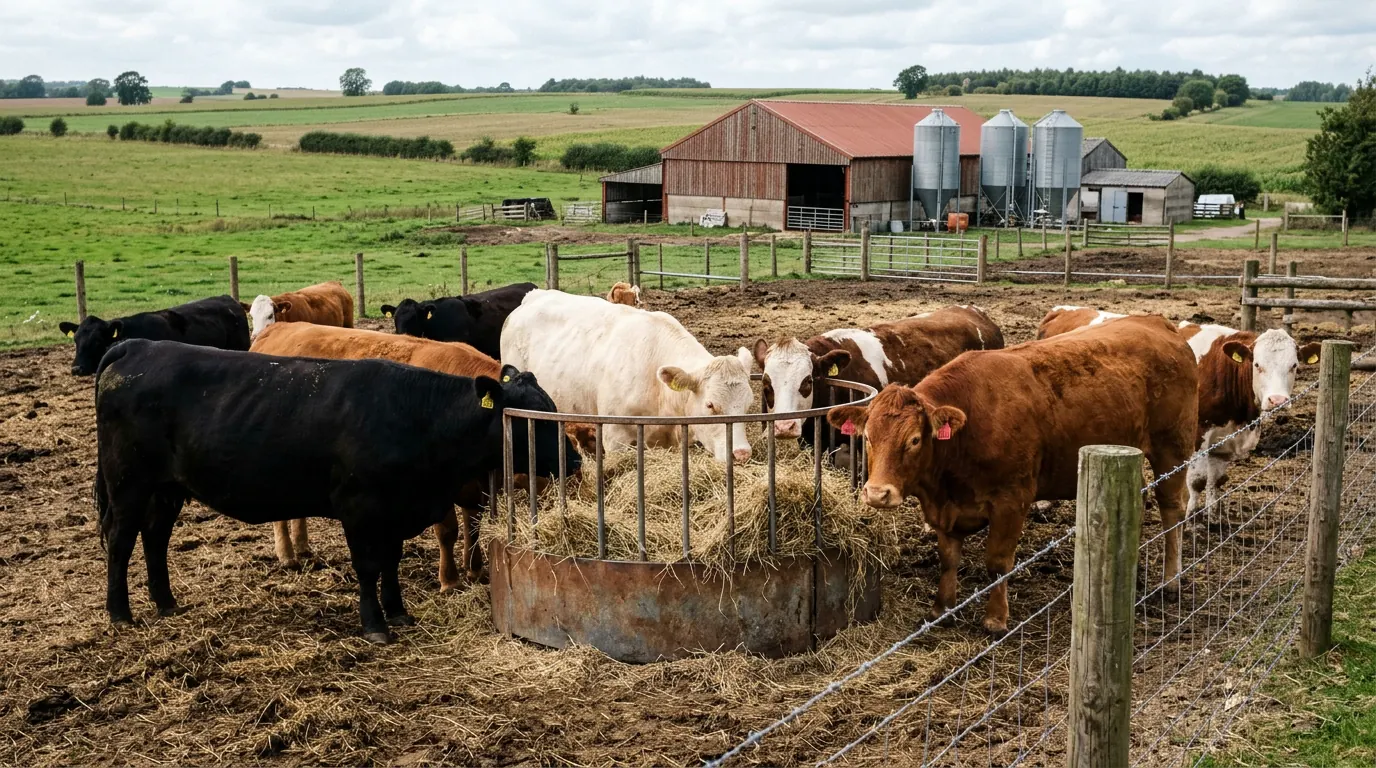
On pasture you set the stocking rate by the live weight of animals per hectare, not by head count. The same field carries more cattle in spring than in summer, because the amount and quality of the sward fall as the grass matures. The Irish Teagasc manual for finishing systems gives 2,200–2,700 kg of live weight per hectare for April–June, 1,800–2,200 kg for July–August and 1,400–1,800 kg for September–October. These values come from a different climate. In Poland, set your stocking rate with an advisor from the ODR (regional agricultural advisory center) and by what actually grows on your meadows.
Why we count kilograms, not head
A heifer and a bull of different weights eat different amounts of grass, so head count does not show the load on the pasture. The calculation is simple: add up the live weight of all animals in the paddock, divide by the area in hectares and compare the result with the stocking table. Take weights from the latest weighing and current daily gain. Suckler calves count toward the stocking rate too, because they graze alongside their mothers.
How many cattle per hectare of pasture
Stocking rate through the season
Grass grows fastest in spring and has the most protein, so the pasture carries the most animals then. In summer growth slows, and a drought can take a large share of the growth within a few weeks. In autumn there is less sward, and the animals need more feed from other sources. Plan the stocking rate for the weakest month of the season, not the best. If in July your stocking rate is above the table values, move some animals to another field or start supplementary feeding.
Sward quality drives output
According to an IZ PIB paper on feeding beef cattle in organic systems, a well-managed pasture lets animals harvest about 80% of the forage from the total yield, while on a neglected pasture use falls to just 30%. The difference comes from management, not from stocking rate alone. Spreading manure or slurry, shortening the stay in each paddock and grazing at the right stage of grass growth all raise utilization. Record stocking rates and move dates in the DlaFerm.pl farm management software, so you have your own data after the season.
When to reduce stocking
Cut the stocking rate when the sward is shorter than usual after a drought, when you see worn turf and mud in the paddock, or when the animals' gains clearly drop. Do not wait for the end of the season. It is better to move part of the herd to a spare field in midsummer than to try to rescue an exhausted pasture in autumn.
Paddocks and pasture fencing
Dividing into paddocks
We divide the pasture into paddocks, meaning separate parts that the animals graze one after another. A paddock should last a short stay of a few days, not the whole season. The faster the animals move through the paddocks, the less grass is trampled and the faster it regrows. Set paddock size from your stocking rate and the regrowth speed of the sward on your field, not from a fixed rule.
Fencing, electric fence, water and shade
The fence should hold the animals without stress and without risk of injury. Check the voltage of the electric fence after rain and after mowing near the wires, because overgrown wires lose voltage. Keep paddocks away from roads and watercourses. Every paddock needs constant access to drinking water, and in hot weather a tree-lined edge of the field helps. The EFSA review of beef cattle welfare (the European Food Safety Authority) covers grazing and shelter, among other topics, so it is worth reading before you plan fences.
Rotating paddocks through the season
How to run rotation step by step
First, assess the sward height before you let the animals in and note the date. Put the cattle in the first paddock and move them to the next before the grass is grazed down to the ground and trampled. Leave the first paddock to regrow and return to it after a full cycle. The number of paddocks follows from the regrowth speed and the number of days you want the herd on one field. There is no single universal length of stay.
Supplementary feeding when grass runs short
When the sward weakens, supplementary feeding helps. IZ PIB research on feeding organic cattle describes feeding cut forage from arable crops, for example legumes with grasses, and cereal concentrate at 1.5–2.5 kg per day. In good weather and on a well-fertilized meadow, supplementary feeding may be unnecessary. Keep an eye on feed stocks with silo monitoring, and agree concentrate rations with a feeding advisor or a vet.
Herd health on pasture
Bought-in animals
In its beef manual, Teagasc recommends testing purchased animals for BVD virus and keeping them in isolation for 28 days after purchase. For other diseases, such as paratuberculosis or leptospirosis, agree the tests with your vet. The manual also notes that grazing together with sheep can pass diseases between species. Agree an isolation and testing plan for your herd with your vet.
Insect-borne diseases
The risk of diseases spread by biting insects rises in the grazing season. A leaflet from PODR Szepietowo (a regional agricultural advisory center) on lumpy skin disease (LSD) says that suspected infection must be reported to a vet. You do not treat it on your own. Write down your observations, check the herd after every inspection and follow the instructions of the county veterinarian.
Withdrawal periods and medicines
Record every treatment, medicine and withdrawal period straight away in the treatment and withdrawal records, because after you turn animals out it is easy to forget them. A vet always chooses the medicine and dose. The withdrawal period is the time after which products from a treated animal may go to market. Its length is given on the product leaflet and recommended by the vet. Before sending animals to slaughter, check that the withdrawal period has passed.
Is grazing profitable?
What affects the result
The result depends on fencing and labor costs, sward quality, the rate of gain and beef cattle prices. Prices change often, so we do not give amounts. You can check quotes with buyers, in market listings and in materials from Poland's Ministry of Agriculture and Rural Development. Compare two scenarios: a lighter stocking rate without supplementary feeding and a higher stocking rate with it. Keep animal data in order with the IRZplus integration (ARiMR's online animal register), so you calculate on current data.
Income calculation
ODR Lubań publishes a sample calculation of farm income from beef cattle production at different intensity levels. A model like this lets you compare the cost of pasture feed with the cost of concentrate. You need to rework the results with your own prices and the yield of your meadows. Grazing pays the most when meadows are well managed and the stocking rate suits the sward.
Frequently asked questions
How many beef cattle per hectare of pasture?add
There is no single head count, because the stocking rate is set by live weight per hectare. The Teagasc manual for finishing systems gives 2,200–2,700 kg of live weight per hectare in April–June, with lower values in autumn. Add up the weight of your herd and compare it with the amount of grass on your field.
What is the difference between stocking rate and rotation?add
Stocking rate is how many cattle you keep on a given area at a given time. Rotation is how often the animals move to the next paddock and when they return to the first. Good rotation lets the grass regrow and protects the turf from trampling.
Do you need to feed cattle extra on pasture?add
It depends on the weather, sward quality and stocking rate. On a good pasture, supplementary feeding may be unnecessary. When the grass weakens, IZ PIB describes feeding forage or concentrate at 1.5–2.5 kg per day. Agree rations with an advisor or a vet.
How do you fence a pasture for beef cattle?add
Divide the field into paddocks, give constant access to water and check the electric fence voltage. Inspect the wires regularly, especially after rain and after mowing. Keep paddocks away from roads and watercourses.
Should bought-in cattle be isolated before going out to pasture?add
Teagasc recommends testing bought cattle for BVD virus and keeping them in isolation for 28 days. Agree the testing and isolation plan with your vet, because it depends on the disease and the herd's health status.
Where can you check current cattle regulations in Poland?add
You can find current regulations in Poland's Internet System of Legal Acts (isap.sejm.gov.pl). Information on veterinary supervision is published by the Chief Veterinary Inspectorate (Główny Inspektorat Weterynarii). This article reflects the legal state as of 22.11.2026, so check the current wording before you decide.
Sources & resources
- linkIZ PIB — WZ — Feeding beef cattle in organic farming (K. Bilik et al.)
- linkTeagasc (Ireland) — Teagasc Beef Manual — Section 3: Beef Systems
- linkTeagasc — Teagasc Beef Manual — Section 6: Nutrition
- linkPODR Szepietowo — Lumpy skin disease (LSD) — leaflet (Z. Marciniak)
- linkODR Lubań (PODR publication) — Sample farm income calculation for beef cattle production (different intensity levels)
- linkEFSA AHAW Panel — Welfare of beef cattle (EFSA Journal 23:9518)
Prepared by: DlaFerm Team based on data from the sources listed · Publisher: INSTA-TECH sp. z o.o.
Grazing beef cattle and want your data in one place?
The treatment and withdrawal module records treatments and withdrawal dates, and the farm management software keeps your herd and stocking data in order. Create a free farm account on DlaFerm.pl and see how it works in practice.
Phone
+48 796 258 151