Free-range eggs (code 1): requirements and differences
Free-range eggs come from hens that can go outside the house during the day. You can spot them by the first digit of the code on the shell: 1. We explain what this means for the farm, how free-range differs from barn and cage systems, and how to document it in your records.
verifiedFrom the team that has organised work on poultry farms for years.
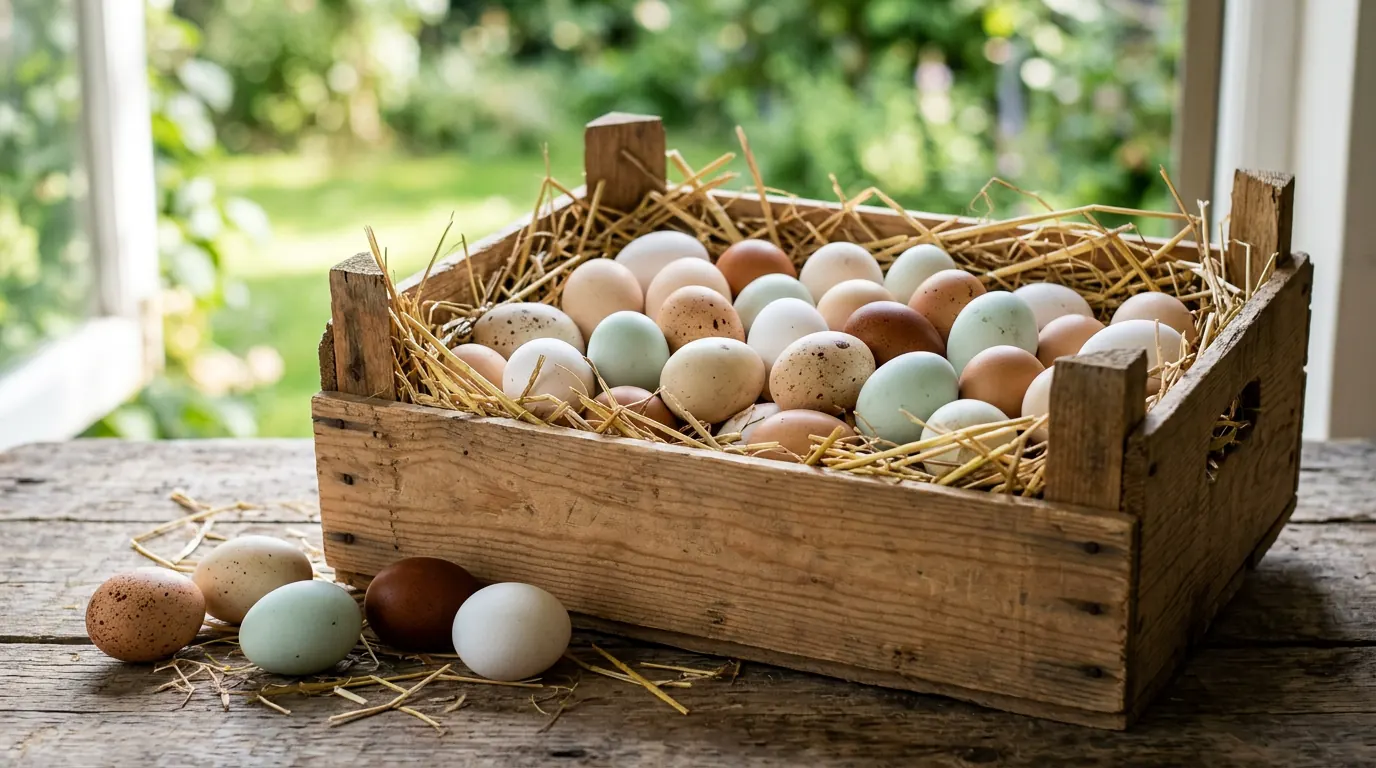
Free-range eggs come from hens that can spend the day outside the building. This system is marked with the digit 1 in the code printed on every egg. The difference from barn eggs (2) and cage eggs (3) lies in how the birds are kept, not in the look or taste of the egg. The rules come from European Union law and Polish national law. You can check the current wording in ISAP (Internetowy System Aktów Prawnych, Poland's online database of legal acts). The legal position described here is as of 22.11.2026.
What the 1 on the egg means
The code consists of a digit for the farming system, a country code and a flock number. The first digit 0 means organic eggs, 1 free-range, 2 barn and 3 cage. The code is mandatory for commercial eggs sold in the European Union, so it is not an extra marketing label. If you sell free-range eggs, code 1 must match how the birds are really kept. If you change the system during a cycle, you must change the marking, and your records should show the date of the change. Relying on a label without farm records is a common reason for problems at an inspection.
Requirements for a free-range farm
Access to the range
Birds must have free access to the range during the day. The pop holes from the house to the outside should be open all the time, not only for an inspection. The range should be mostly covered with vegetation or have a surface that allows natural behavior such as scratching and roaming. When you design it, plan for roofing or shelter so birds can get away from rain and predators. We cover the rules for the range in a separate guide: free-range run for hens.
Stocking and area
The rules set a maximum number of birds in the house and a minimum range area per hen. The exact values change in the legal acts, so we do not quote them here. Check the current text in ISAP and confirm your reading with the county veterinarian (powiatowy lekarz weterynarii). When you build or rebuild a house, you also need to meet the requirements for the building itself, described in the guide house requirements for laying hens.
Husbandry records
The Veterinary Inspection (Inspekcja Weterynaryjna) checks that your husbandry matches your records. Useful entries include the number of birds, the date birds were let onto the range, the state of the range and any breaks in its use. Good records show the range was really in use, not just declared. Keep them in one place, for example in a poultry house register, which also lets you match dates and bird numbers to the code on the eggs you sell.
Free-range, barn and cage eggs
Barn system
Hens in the barn system live inside the building on deep litter and have no outdoor range. They have more room than in cages and can do some natural behavior, such as scratching in the litter. But that is not access to fresh air and green ground. That is why barn eggs carry code 2, not 1, and cannot be sold as free-range.
Cage system
The cage system, marked with code 3, gives each bird the least space and the least room to move. For the keeper it is the simplest system to run, but it needs close attention to welfare. Free-range is the opposite of cages in terms of housing conditions, not in the nutritional value of the egg. You can compare the systems in the context of classification in our description of the KAT system: the KAT system for eggs and poultry.
Organic system
Organic eggs carry code 0 and must meet extra requirements, including those for feed and flock management. Not every free-range farm meets organic rules, and every organic farm must meet certification requirements. We describe the differences in a separate article: organic eggs (code 0).
Does a range improve egg quality?
Code and internal quality
Code 1 tells you how the hens are kept, but it does not guarantee better internal egg quality. Quality depends on the age of the bird, the diet, the freshness of the egg and storage conditions. Free-range eggs can be of higher quality only if good feeding and quick egg collection go with them. You can assess quality in a laboratory or with the indicators we describe in the article egg quality (Haugh, Roche).
Freshness and collection
Free-range eggs often lie in grass or on the ground before they are collected. Collect eggs regularly, several times a day, and set aside eggs that are dirty, cracked or laid outside the nest. Clean dirty shells dry, without soaking, because water can get in through the pores. For good quality, daily practice at the nest matters more than the fact of range access alone.
Free-range chickens: different rules
No code as on eggs
Poultry meat has no code 1 printed on each bird the way an egg does. Labels such as "free-range" for chickens are subject to requirements on how the birds are kept. In practice, inspectors expect records that confirm the range, its size and the time birds spend outside. Check the labeling rules in the legal acts available in ISAP and talk to a veterinarian or an adviser. Do not rely on label claims alone.
Slow-growing chickens
Slower-growing birds, such as slow-grow breeds, suit a system with a range better than fast-growing broilers, because they cope better with activity outdoors. We describe them in the article slow-growing chickens (slow-grow). The requirements for the building in this system differ from those for intensive fattening, as we explain in the guide house requirements for broilers.
The range and flock health
Risk from wild birds
A range increases contact with wild birds, rodents and predators, as well as with contaminated water and feed. When the risk of wild bird disease is higher, inspectorates may advise limiting range use or keeping birds indoors. Check current notices from the Chief Veterinary Inspectorate (Główny Inspektorat Weterynarii) and apply biosecurity rules before you let birds out. You can prepare your measures in the biosecurity plan generator.
Treatment and withdrawal period
If the flock is treated, the veterinarian chooses the medicine and the dose. The egg withdrawal period is the time after which eggs from a treated flock may not go on sale, and it is set for each medicine in its documentation. Record the date of treatment, the name of the product and the end of the withdrawal period. You can keep treatment records and withdrawal dates in the module treatment and withdrawal period records.
How to document free-range husbandry
Records that confirm husbandry
Record the number of birds, the dates the range was opened, breaks in its use and any periods when birds were kept indoors because of a threat. Also note events that may affect range access, such as repairs or flooding. Records like this let you answer an inspector's questions without searching for documents. The data can also help you compare flock performance with the code on the eggs you sell.
Production and collection plan
On a larger farm, plan when flocks go in and out so that the range is used according to the rules and gets time to rest. A good tool for this is a poultry farm management program, which links flock records with the work schedule. Keeping everything in one place also makes settlements with buyers easier.
Frequently asked questions
What does code 1 on an egg mean?add
Code 1 means eggs from free-range hens. The first digit shows the housing system, and the next parts are the country code and the flock number. The code must match how the hens are really kept.
What is the difference between free-range and barn eggs?add
Free-range hens can go to an area outside the building during the day, while barn hens stay inside on litter. The difference is range access, not the look or nutritional value of the egg.
Are free-range eggs healthier?add
The code alone says nothing about nutritional value. Quality depends on the hens' diet, freshness and storage. A range can improve bird welfare, but other factors also decide egg quality.
What do I need to sell free-range eggs?add
The requirements cover house stocking, range area and husbandry records. The exact values change in the legal acts, so check the current text in ISAP. Confirm your reading with the county veterinarian.
Do free-range chickens have a code like eggs?add
No. Poultry meat has no code printed on each bird as eggs do. A free-range claim still needs husbandry records, and you should check the rules in the legal acts and with a veterinarian.
What should I do when a free-range flock is treated?add
The veterinarian chooses the medicine and the dose. Record the product name, the date of treatment and the end of the withdrawal period. Eggs from a treated flock may not be sold before the withdrawal period for that medicine ends.
Sources & resources
- linkChief Veterinary Inspectorate — gov.pl/web/wetgiw
- linkMinistry of Agriculture and Rural Development — gov.pl/web/rolnictwo
- linkOnline System of Legal Acts (ISAP) — isap.sejm.gov.pl
- linkEFSA — efsa.europa.eu
- linkNational Research Institute of Animal Production (Instytut Zootechniki PIB) — izoo.krakow.pl
Prepared by: DlaFerm Team based on data from the sources listed · Publisher: INSTA-TECH sp. z o.o.
Do you run a free-range flock and want your records in one place?
The poultry house register in DlaFerm helps you record bird numbers, dates and range events. Create a free farm account and see how it works in your own house.
Phone
+48 796 258 151