Finishing pig: weight, how long it takes, how much it eats
A finishing pig (tucznik in Polish) is a pig in the fattening phase, from weaning until it is sold for slaughter. Weight, finishing time and feed use depend on starting weight, daily gain and feeding, not on one fixed number. Below we give figures from research and show how to calculate them in your own herd.
verifiedFrom the team that has organised work on poultry farms for years.
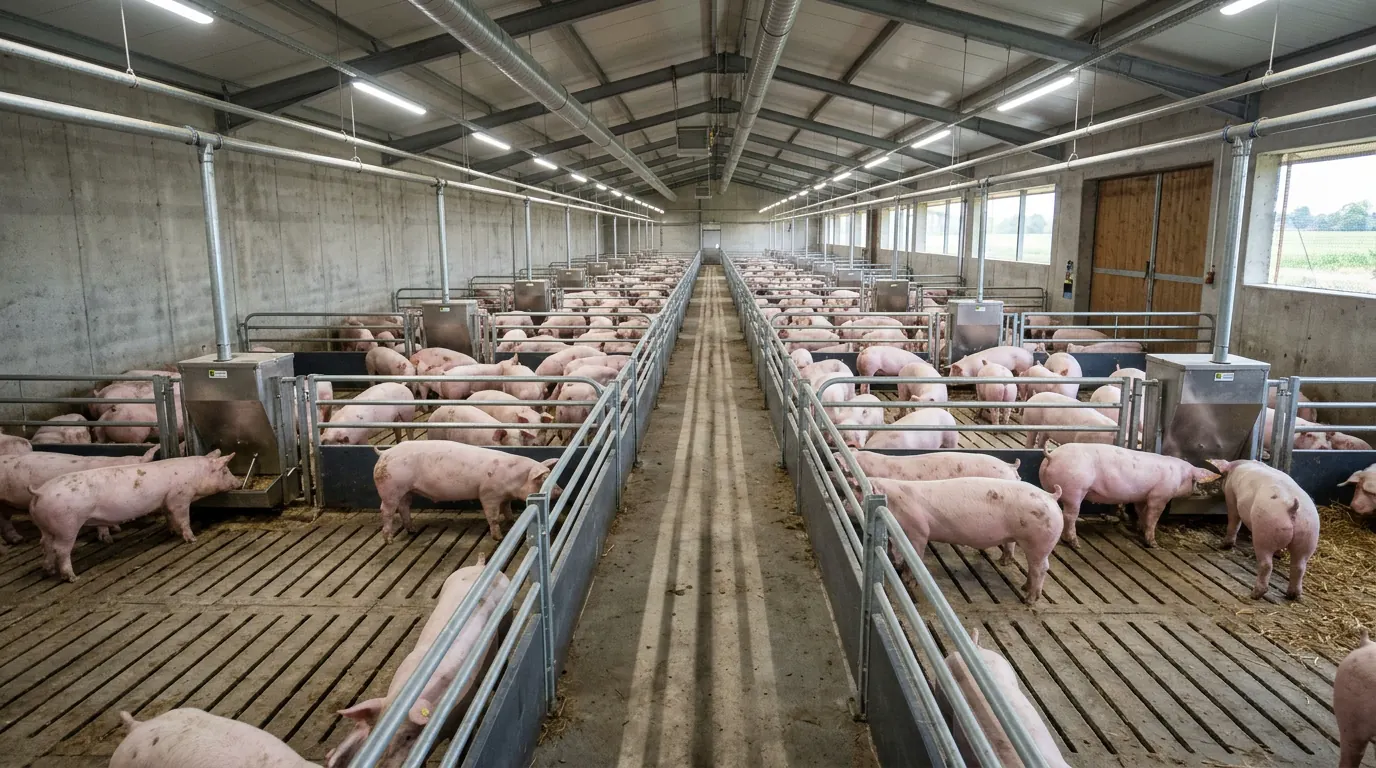
There is no single answer to how much a finishing pig weighs, because weight depends on age, breed, feeding and growth rate. It is best to rely on population data. Irish Teagasc data for 2022 give an average live weight at sale of 118.4 kg and a carcass weight of 90.6 kg, with a killing-out percentage of 76.5%. These numbers are not a standard for a Polish farm, but they show the scale and the way to calculate.
What to measure in finishing
Three numbers tell you the most: weight at sale, daily gain and FCR. Recording them in your herd records shows whether the pigs are growing as planned. You can calculate the indicators by hand or in the FCR and EPEF online module, which works them out from the data you enter on the farm.
How much a finishing pig weighs before sale
Live weight and carcass weight
Teagasc gives the average live weight of a finishing pig at sale: 115.3 kg in 2020, 118.4 kg in 2021 and 118.4 kg in 2022. Carcass weight was 88.2 kg, 90.7 kg and 90.6 kg respectively, and killing-out percentage 76.5%, 76.6% and 76.5%. The difference between live and carcass weight is roughly the part that does not go to sale as a carcass. Before transport, agree with the slaughterhouse whether settlement is on hot or cold weight, because that decides which numbers you enter in your accounts.
Piglet weight at the start
The weight at which piglets enter finishing affects when they reach slaughter weight. Teagasc gives the average weight at transfer to finishing as 39.2 kg in 2020, 39.4 kg in 2021 and 38.4 kg in 2022. It notes, however, that in Ireland these weights are usually estimated, not weighed. On your farm, weigh a sample of the litter at weaning and write the results down. Planning batches and the production cycle helps you set the dates.
Why weight differs between herds
The same age does not give the same weight in every herd. Genetics, feed quality, water access, house temperature, stocking density and disease all play a part. If some pigs keep lagging behind the average, check feeding and housing first, and only then blame the genetic line. Record weights by groups of pens, not only as one average for the whole batch.
How long finishing lasts and how to calculate daily gain
Daily gain
Daily gain is the basic measure of finishing speed. Teagasc reports that average daily gain of finishing pigs in Ireland fell from 930 g in 2021 to 909 g in 2022, a drop of 21 g. The report's authors link this to weaker results in the finishing phase. Calculate gain like this: weight at sale minus weight at placement, divided by the number of finishing days. Compare the result with your own earlier batches, not with other people's data.
What decides the length of finishing
Finishing length depends mainly on the weight at which the pig enters finishing, its growth rate and the weight at which you sell. Pigs sold lighter finish earlier but give a smaller carcass. Batches that stop gaining for a long time often point to a health or feeding problem. Record the sale date, for example in the app for pig farmers, so you can plan pick-up in advance.
How much a finishing pig eats: daily and total feed use
Daily feed intake
Teagasc gives the average daily feed intake of a finishing pig: 2,391 g in 2020, 2,443 g in 2021 and 2,454 g in 2022. Higher intake with falling gain means poorer feed use, so look at both numbers together. If daily intake in your house rises while gain stands still, check feed composition, access to feeders and the health of the animals.
Feed from weaning to sale
In its table of feed use per pig from weaning to sale, Teagasc gives for 2022: 3.1 kg in the creep phase, 8.5 kg in the link phase, 45.8 kg for weaners and 214.7 kg for finishers. The sum of these four items is 272.1 kg, calculated by us from the table. Remember that this is data from Irish farms, and feed composition and availability on your farm may differ. Keep track of feed stock in the feed silo monitoring module, which lets you spot losses before the batch ends.
Feed cost in finishing
According to PIC, feed makes up 60–65% of the total cost of raising a weaned pig to market weight. So small changes in feed waste, feeder type and feeding space directly affect the result of a batch. Feed prices change over time and depend on the grain and meal markets, so check current quotes with your feed supplier or in market publications, not in guides.
Finishing pig FCR: how much feed per kilogram of gain
How to read FCR
FCR (feed conversion ratio) is the ratio of feed used to weight gained. Teagasc reports that in the finishing phase FCR rose from 2.63 in 2021 to 2.70 in 2022. That means more feed was used for the same kilogram of gain. A higher FCR means higher finishing cost, even at a constant feed price. Compare the result with your own earlier batches, because values depend on conditions and the genetic line.
Amino acids and gain
PIC states that about 20 g of digestible lysine (SID Lys) is needed to lay down 1 kg of body weight gain. According to PIC, an amino acid shortage reduces protein deposition and increases fat deposition. Lysine levels are matched to weight, growth rate and feed composition, so set them with a feed adviser. Do not copy values from foreign tables without checking that they suit your feeds.
Space and welfare of finishing pigs
Space to lie on the side
In its opinion on the welfare of pigs during transport, EFSA gives the minimum area needed to lie on the side. For a 100 kg pig it is 1.03 m² per animal, and for 110 kg it is 1.10 m². These values apply to transport and are not a standard for pig houses. They do show how quickly the need for space grows with weight. Set the number of pigs per pen so that all of them can lie down without pushing each other.
Daily observation
Check the health of finishing pigs at feeding time, when the animals are calm and their behavior is easy to see. Record dead animals, symptoms and treatments, because this is the basis for a quick response. Treatment is always led by a vet, who chooses the medicine and dose. After giving a medicine, respect the withdrawal period and enter it in the treatment and withdrawal records, so you do not send a pig to slaughter too early.
African swine fever: what to check in finishing
Legal basis
The regulation of Poland's Ministry of Agriculture and Rural Development (MRiRW) of 12.03.2026 on measures to control African swine fever was published in Dz.U. 2026 poz. 344 (Poland's Journal of Laws). Rules may change, so before deciding to move animals, check the current text in the Internet System of Legal Acts (Internetowy System Aktów Prawnych). EFSA's analysis of ASF in the EU for 2025 describes an epidemiological situation that justifies caution on every pig farm.
Everyday biosecurity
The basics of protecting finishing are control of entry to the farm, clean clothes and footwear, separation of batches and limited contact with outside animals. Write your biosecurity plan down and update it from time to time. The biosecurity plan generator helps you prepare a ready outline, and people entering and leaving are recorded in the farm visitor log.
Frequently asked questions
How much does a finishing pig weigh before slaughter?add
According to Teagasc, the average live weight of a finishing pig at sale in 2022 was 118.4 kg, and carcass weight was 90.6 kg. On your farm it depends on the sale weight you choose, the genetic line and feeding. Agree it with the slaughterhouse before you place the batch.
How long does pig finishing take?add
Finishing time depends on the weight at which the pig enters finishing and on daily gain. Teagasc gives an average daily gain of 909 g in 2022. Work out batch length from your own data, based on the weight to be gained and the growth rate.
How much does a finishing pig eat per day?add
According to Teagasc, average daily feed intake in 2022 was 2,454 g per animal. The value depends on feed composition, the weight of the animal and house conditions, so check it on your own herd.
What does FCR mean in pig finishing?add
FCR is the amount of feed used per kilogram of weight gain. The lower the result, the better the feed use. Teagasc gives an FCR of 2.70 in 2022 against 2.63 in 2021.
Can you sell a finishing pig at 70 kg?add
The decision to sell at a given weight belongs to the farmer and depends on the terms of the contract with the slaughterhouse. Age and weight at sale depend on growth rate, so analyze the batch data and agree the date before you decide.
Where can I check the current rules on pig finishing in Poland?add
You will find current rules in the Internet System of Legal Acts (Internetowy System Aktów Prawnych) and on the website of the Chief Veterinary Inspectorate (Główny Inspektorat Weterynarii). For herd health and treatment, talk to your vet.
Sources & resources
- linkTeagasc (Ireland) — National Pig Herd Performance Report 2022
- linkPIC — PIC Wean to Finish Guidelines
- linkPIC — PIC Nutrition and Feeding Guidelines (metric)
- linkEFSA AHAW Panel — Welfare of pigs during transport (EFSA Journal 20(9):7445)
- linkMRiRW / Dziennik Ustaw — Regulation of the Minister of Agriculture of 12.03.2026 on measures to control African swine fever (Dz.U. 2026 poz. 344)
Prepared by: DlaFerm Team based on data from the sources listed · Publisher: INSTA-TECH sp. z o.o.
Calculating FCR and feed use in your finishing herd?
The FCR and EPEF online module works out the indicators from your farm's data, with no manual tables. Create a free farm account in DlaFerm.pl and check your first batch.
Phone
+48 796 258 151