Chickens That Lay Green and Blue Eggs: Breeds
Green and blue eggs are not the trait of a single breed. Araucanas, Ameraucanas and Cream Legbars lay blue shells. A green tint most often comes from a crossbred hen, such as an Easter Egger, where brown pigment is laid over a blue shell. We explain which birds to choose, what not to promise customers and how to record such a purchase in your farm log.
verifiedFrom the team that has organised work on poultry farms for years.
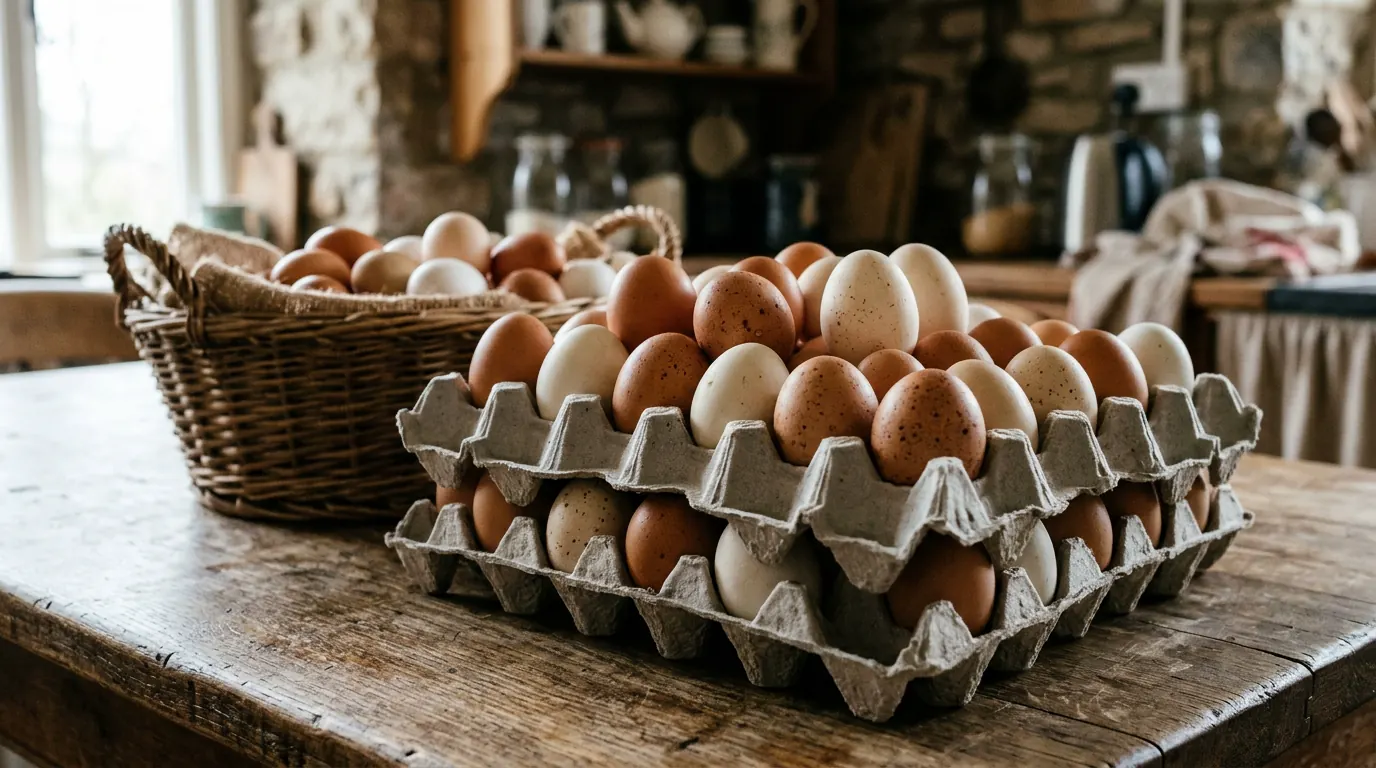
Hens that lay blue eggs belong to a few breeds and lines. The best known are the Araucana, the Ameraucana and the Cream Legbar. Green eggs usually come from mixed birds: a hen that lays blue eggs crossed with a hen that lays brown eggs gives a shell from olive to greenish. No breed guarantees a green egg every time. The color depends on the genetics of the individual bird, not on the label in an advert. For a full overview, see our overview of ornamental chicken breeds.
Where shell color comes from
The eggshell forms in the oviduct. The gene responsible for blue pigment (oocyanin) colors the shell while it is being made, so the blue is present on the inside as well as the outside. Brown pigment (protoporphyrin) is laid on in the last stage of shell formation, in varying amounts. That gives a green tint over a blue base, and a pure blue shell when there is no brown pigment. The amount and spread of pigment depend on the bird, so eggs from one flock can differ in shade.
What this means for you as a keeper
Shell color does not decide what is inside the egg. Feed and the age of the bird matter most for egg value. If you sell eggs as green, expect some to be paler or browner. Before you promise customers a specific color, watch your birds over several weeks of collection and write the results in your records.
Breeds that lay blue eggs
Araucana
The Araucana comes from Chile and is known for blue eggs. In some lines the birds have no tail or a very short one, and they carry tufts of feathers on the head. The breed standard describes these traits as depending on the line, not as a guarantee. Araucanas are both ornamental and utility birds, and their laying rate is usually lower than that of typical commercial layers. When you buy, ask about the line's origin and whether the breeder keeps records of the parent birds.
Ameraucana
The Ameraucana was developed in the United States as a blue-egg breed, with a standard set by American breed clubs. Unlike some Araucanas, Ameraucanas have a tail that matches the standard. The breed is less common in Poland than the Araucana, so talk to a breeder with documented bird origins before you buy.
Cream Legbar
The Cream Legbar was bred in Great Britain. It lays blue eggs and is autosexing: chicks can be told apart by down color right after hatching. This makes sex records easier to keep, because you do not have to sort chicks by hand. It is a utility breed, and it makes sense where you want both eggs and a predictable split of the flock.
Green eggs from crossbreeds
Easter Egger
Easter Egger is the name for a group of crossbreeds, not a breed recognized in standards. The birds usually vary in plumage, and egg color ranges from blue through greenish to pink or cream. Two hens of the same origin can lay different shades, so a seller should not promise a specific color. If you buy several crossbreeds, ask about the parents, not only the name on the label.
Olive Egger
The Olive Egger is a cross between a hen that lays blue eggs and a breed that lays brown eggs. The result is eggs in olive, greenish or brown-green shades. Such a bird is not a breed in the classic sense, so if you breed them, keep your own line and note which birds give the most even egg color.
Why green shells vary
The amount of brown pigment depends on the bird's age and condition. Young hens often lay paler eggs, and the shade can change as the hen matures. Check eggs you sell as green with every batch, not only at the start of the season.
How to buy birds that lay blue or green eggs
Check the origin
Ask the seller about the parents and the line. For Araucanas and Ameraucanas there are breed clubs and standards you can refer to. Documented origin lets you judge whether a bird is purebred or a crossbreed, whatever the advert says. Do not buy birds from a random source with no information about the flock they came from.
Health and biosecurity
Introduce new birds to your flock only after a quarantine period and after talking to a vet. Before you bring them in, check their health and record their origin. Describe how you protect the flock from disease in the biosecurity plan generator, and check current rules for any reporting duties.
Laying rate and housing
Laying rate depends on the breed
Araucanas and ornamental crossbreeds usually do not reach the laying rate of a commercial layer. If your goal is selling eggs, laying breeds or utility lines give predictable output, and ornamental birds work as an addition to the flock. Compare breeds with classic layers in the overview of laying hen breeds. You can only work out the real output of your own flock from several months of records.
Housing and shell quality
Feed has little effect on shell color, but shell quality depends on calcium in the feed, access to water and low stress. Provide clean litter, constant access to feed and water, and enough calcium. If in doubt, talk to a nutrition adviser. We describe the basics in our guide to keeping hens for eggs. Collect eggs regularly, because eggs left longer in the nest get dirty.
Marking and describing eggs for sale
Egg marking
Eggs meant for sale fall under EU rules on egg marking, including the producer code and sales requirements. Check current national rules in Poland's Internetowy System Aktów Prawnych (ISAP, the online legal acts database), and supervision requirements at the Główny Inspektorat Weterynarii (Chief Veterinary Inspectorate). If in doubt, ask your county vet (powiatowy lekarz weterynarii). Keeping records in your henhouse log makes it easier to show where a batch came from.
Describing color on the pack
Do not state a color on the pack that you cannot repeat in every batch. If you write "green eggs" and part of the batch is paler, a customer may complain. Describe the eggs honestly, for example "eggs from crossbred hens, shell color varies". Such a label protects you from complaints and matches what you actually sell.
Frequently asked questions
What chickens lay blue eggs?add
The most often named are Araucanas, Ameraucanas and the Cream Legbar. The blue color comes from a gene for shell pigment found in these lines. You only get certainty from the documented origin of the bird and information from the breeder.
What chickens lay green eggs?add
Green eggs usually come from crossbreeds, such as the Easter Egger or Olive Egger, where a blue shell is covered with brown pigment. No breed always lays green eggs. Color varies between birds and over time.
Are green eggs healthier?add
Shell color does not decide what is inside the egg. Nutritional value depends mainly on feed and the age of the bird. Base your egg description on origin and how the birds are kept, not on health claims.
Do Araucanas lay a lot of eggs?add
The laying rate of Araucanas is usually lower than in laying breeds. You can work out the real output from your own flock records. If you need predictable production, compare laying breeds before you buy.
How do I record crossbred hens in my farm log?add
Record each bird with the date it joined the flock and its origin, and add the parents if they are known. For a group of crossbreeds, also note the egg color you see over the following weeks. A henhouse log lets you link eggs to a specific group of birds.
Do I have to register ornamental birds?add
Birds kept on a holding fall under registration and reporting duties set by the rules. Check the details in Poland's ISAP database and with your vet. If in doubt, ask your county vet.
Sources & resources
- linkChief Veterinary Inspectorate (Główny Inspektorat Weterynarii) — gov.pl/web/wetgiw
- linkInternet System of Legal Acts (Internetowy System Aktów Prawnych) — isap.sejm.gov.pl
- linkNational Research Institute of Animal Production (Instytut Zootechniki PIB) — izoo.krakow.pl
- linkMinistry of Agriculture and Rural Development (Ministerstwo Rolnictwa i Rozwoju Wsi) — gov.pl/web/rolnictwo
Prepared by: DlaFerm Team based on data from the sources listed · Publisher: INSTA-TECH sp. z o.o.
Keeping ornamental and utility hens in one henhouse?
The DlaFerm henhouse log records breeds, crossbreeds and egg batches in one place. Create a free farm account and add your first group of birds.
Phone
+48 796 258 151