Cattle hay feeder: loose hay and bales, space per head
A feeder should let every animal in the herd eat without being pushed aside and without feed lost on the floor. The space you need depends on the cattle category, the type of feed and how you offer it, so there is no single universal number. We show where to start and which rules to check before you build or buy.
verifiedFrom the team that has organised work on poultry farms for years.
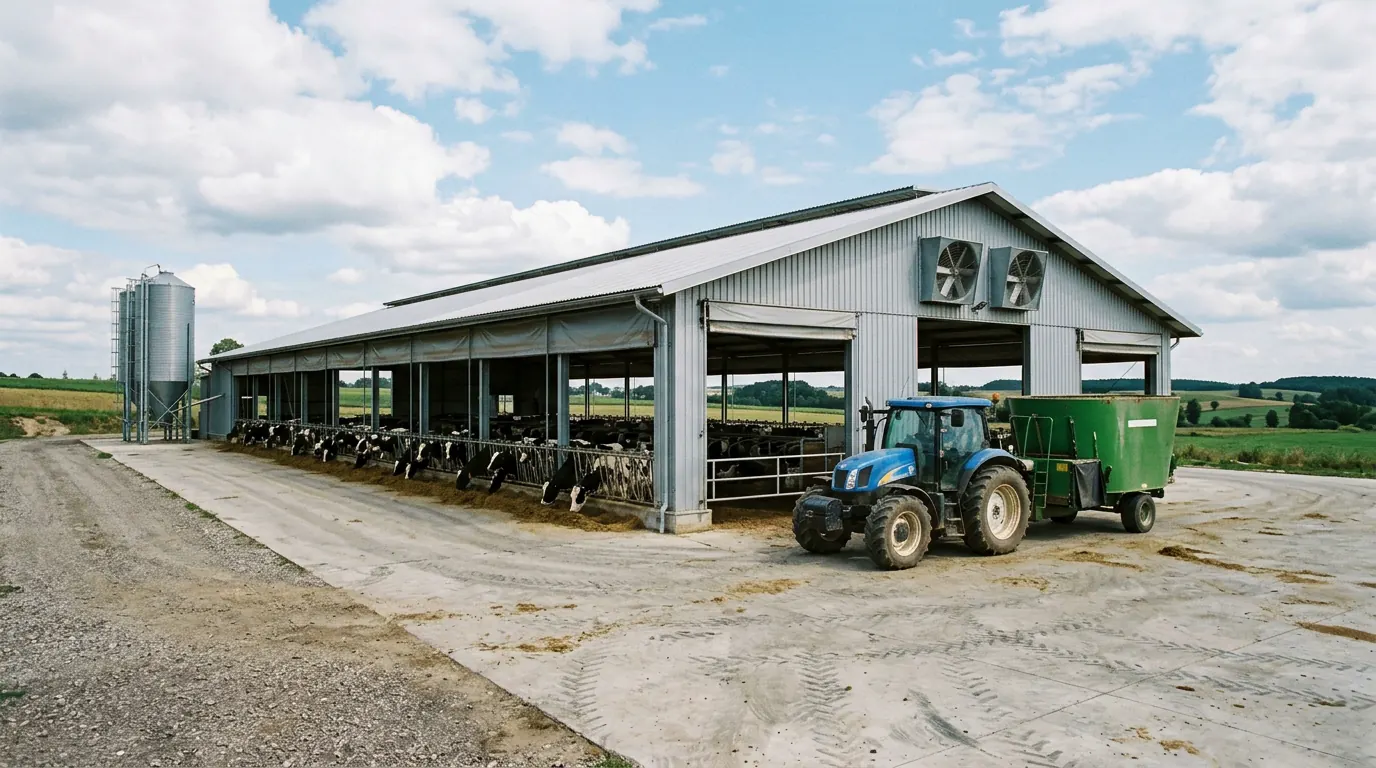
A cattle feeder has one job: every animal in the herd gets to the feed without pushing and without losses on the floor. Space per head depends on the animal category, the type of feed (loose hay, bales, silage) and whether you feed at set times or keep feed available all the time. We do not give one figure in meters per cow, because the materials this article is based on do not state a feed-front width for feeders. Agree the dimension with an adviser from Poland's ODR (agricultural advisory center) or with your vet. Below we describe what affects it.
Where to start
Start by working out dry matter demand, because it decides how much feed the feeder has to hold. According to the IZ PIB table (K. Bilik et al.; IZ PIB is Poland's National Research Institute of Animal Production), a medium-frame suckler cow with a calf up to 250 kg body weight eats approximately 14 kg of dry matter per day. Finishing cattle of 200–350 kg eat about 5.9 kg, and finishing cattle of 350–500 kg about 8.7 kg per day. These figures refer to an organic system with pasture and green forage use at 80%, so for winter feed treat them as a starting point and check on your own farm how much really stays in the trough.
How much feed cattle eat at the feeder
Cow with calf
A suckler cow with a calf needs more than finishing cattle of the same weight, because she also covers the calf's milk needs. The same IZ PIB table gives total dry matter intake over the period it uses: about 2310 kg per cow with calf, 974 kg for cattle of 200–350 kg and 1436 kg for cattle of 350–500 kg. If the feeder is the only source of feed in winter, convert these values to your own feeding period and to the dry matter content of your hay and bales.
Finishing cattle and feed costs
With finishing cattle, weight gain matters as much as the amount of feed. It helps to record gain in your farm records, for example in the FCR and EPEF online module, so you can compare feed with results. A beef income calculation from ODR Lubań shows that maize silage and rapeseed meal are the largest feed cost items, about 25% and 16% of costs respectively in the crossbred variant. So any mistake in the stock of these feeds quickly shows in the result.
Space per head: rules instead of one number
All animals eat at once
Design the feeder so animals do not have to wait their turn. The weakest and youngest animals are most often pushed away from feed by stronger ones, so check that the whole group has access from every side of the feeder. If the herd has a clear pecking order, add a second feeding point or split the groups between two feeders.
Categories kept apart
Calves, weaners, cows with calves and finishing cattle differ in body weight and needs. A small animal at a big feeder usually eats at the end of the trough while a large one takes the middle, which leads to uneven feeding. Separating categories lets you match trough height and length to the group, not to the heaviest animal.
A hay feeder and a bale feeder
Loose hay
Loose hay is easily scattered, and if it lies on wet ground it quickly goes moldy. A hay feeder should have a roof or cover and a fence that limits animals pulling hay onto the floor. Keep an eye on hay quality and silage stocks, for example with feed silo monitoring, especially in seasons with high humidity.
Bales and feeding
Bales are easier to handle, but with open access animals eat part of them and trample the rest. A bale feeder should have a stable structure that holds the bale in position, and space to remove the twine or net wrapping before the bale goes into the trough. Check that bales fit through the passage, because heavy farm machinery often cannot get through narrow entrances.
Material, height and cleaning of the feeder
Access height
The trough should be at muzzle height for the animals in that category, not at the height of the tallest animal. A trough that is too high causes animals to pull feed out and scatter it, and one that is too low makes eating harder for adult cows. Allow for the difference between calves and adult cattle at the design stage, ideally with an ODR adviser.
Cleaning and waste
Feed leftovers, especially damp ones, must be removed regularly, because they become a source of mold and poor animal health. Set a fixed day and a person responsible for checking the feeder. A simple checklist for the worker, for example in the worker app, helps you not to skip a step in the rush of daily jobs.
What to check in the rules and with the inspector
Calves and minimum standards
Council Directive 2008/119/EC sets minimum standards for the protection of calves in the EU, and Polish national rules describe how it is implemented in Poland. Before building a feeder for calves, check the current wording of these rules in ISAP, Poland's online legal acts system (isap.sejm.gov.pl); the legal state here is 22.11.2026. Send questions about interpretation to the county vet (powiatowy lekarz weterynarii) or the Chief Veterinary Inspectorate (Główny Inspektorat Weterynarii).
Medicines, withdrawal periods and herd health
Your vet chooses the treatment and the doses, not the farmer. You are responsible for recording treatments and observing withdrawal periods before an animal goes to slaughter or milk goes to the dairy. It is best to keep this in the treatment and withdrawal module, so deadlines do not depend on one person's memory.
What a feeder and feed cost: what the result depends on
Price of the feeder and feed
The cost of a feeder depends on material, size, roofing and whether you buy a ready-made structure or build it yourself. Feed prices change regularly and depend on season, region and batch quality. Check current prices with local suppliers, agricultural chambers or Poland's Ministry of Agriculture and Rural Development (gov.pl/web/rolnictwo).
Calculation before investing
Before you invest in a feeder, work out how much feed you use in a year, how much space storing it takes and what the weight gain is. Such a balance is easier to keep in farm management software, which gathers herd data in one place. That lets you compare building a new feeder with carrying on feeding as you do now.
Frequently asked questions
How much space per head should a cattle feeder have?add
We do not give one figure, because we found no published feed-front width for feeders. The dimension depends on the animal category, the type of feed and how you feed. Agree it with an ODR adviser or your vet, and plan for all animals to have access at the same time.
How much dry matter does a suckler cow with a calf eat?add
According to the IZ PIB table (K. Bilik et al.), a medium-frame suckler cow with a calf up to 250 kg eats approximately 14 kg of dry matter per day. The value refers to an organic system with pasture, so for winter feed check it on your own farm.
Does a hay feeder need a roof?add
A roof or cover protects hay from rain and damp, which lead to mold. Without cover, hay outdoors loses quality faster, especially in wet seasons. Also pay attention to a fence that limits feed being scattered.
What is the difference between a bale feeder and a loose hay feeder?add
A bale feeder has to hold a heavy bale in a stable position and allow you to remove the wrapping before feeding. A loose hay feeder needs better roofing and protection against scattering. In both cases check the trough height for the cattle category.
Where can I check current cattle welfare rules in Poland?add
You will find current rules in ISAP, Poland's online legal acts system (isap.sejm.gov.pl); the legal state here is 22.11.2026. Confirm the interpretation and requirements for your farm with the county vet or the Chief Veterinary Inspectorate (gov.pl/web/wetgiw).
How do I keep track of drug withdrawal periods in a cattle herd?add
The vet chooses the drug and the dose, and the farmer is responsible for recording treatments and observing the withdrawal period. Record every treatment with the date and animal number before it goes to slaughter or milk goes to the dairy. Records in a treatment module make these deadlines easier to control.
Sources & resources
- linkIZ PIB — WZ — Feeding beef cattle in organic farming (K. Bilik et al.)
- linkTeagasc (Ireland) — Teagasc Beef Manual — Section 6: Nutrition
- linkAHDB Beef & Lamb (UK) — Beef BRP Manual 5: Feeding suckler cows and calves for Better Returns
- linkOODR Łosiów (gov.pl) — Feeding beef cattle (leaflet)
- linkODR Lubań (PODR publication) — Sample farm income calculation for beef production (different intensity levels)
Prepared by: DlaFerm Team based on data from the sources listed · Publisher: INSTA-TECH sp. z o.o.
Do you keep a beef herd and count your feed?
The treatment and withdrawal module helps you record treatments and keep to deadlines, and the farm management software gathers herd data in one place. Create a free farm account on DlaFerm.pl or get in touch, and we will show you how it works in practice.
Phone
+48 796 258 151