Broiler feed on the farm: how much and what kind
Match broiler feed to the weight and age of the birds instead of buying one type for the whole flock cycle. The amount depends on target weight, not on the number of days. We explain how to split feeding into phases and how to check feed use at the feeder.
verifiedFrom the team that has organised work on poultry farms for years.
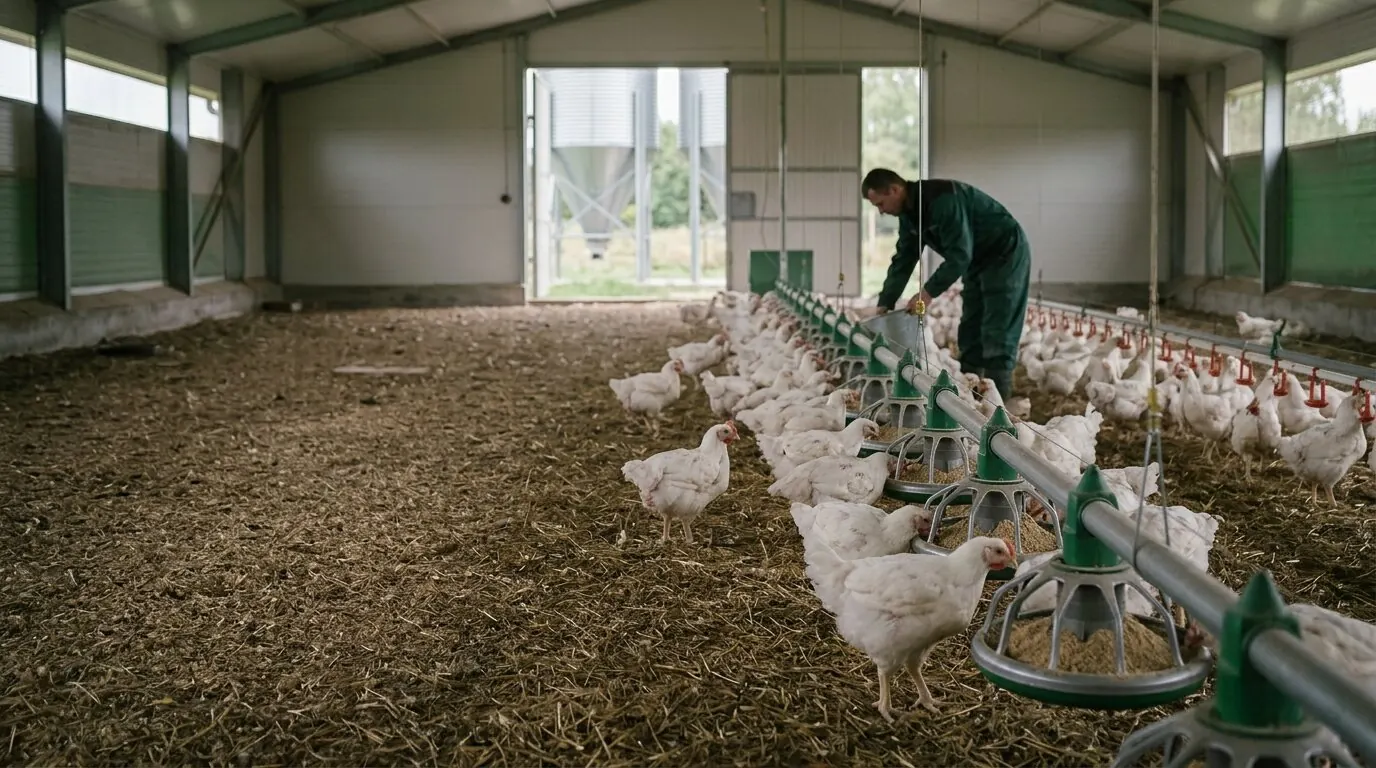
Broiler feed must fit the growth phase and the live weight of the birds. A broiler's needs change fast: at the start it needs highly digestible feed, and near the end the amount eaten and the protein level matter most. The rule is simple: set your feeding phases, match the ration to each phase, and check how much feed actually leaves the feeder. You can estimate rough tonnages in the broiler feed requirement calculator.
How much feed do broilers need? The short answer
The amount of feed depends on how much a bird weighs and how much it eats on a given day. Breed companies publish requirements in tables by target live weight. According to Aviagen (Ross 308 / 308 FF Broiler Nutrition Specifications 2022), the nutrition specifications are split into three tables: for birds up to 2.0 kg target weight, from 2.0 to 3.5 kg, and above 3.5 kg. So when you plan a purchase, start from the target weight of the flock and only then work out the tonnage. Read the exact values for your breed from the producer's table, or agree them with a nutritionist or a vet.
Starter, grower and finisher feed
Starter feed for the first days
According to Aviagen guidelines for Ross 308 / 308 FF (Performance Objectives 2022), starter feed should be highly digestible and balanced. In the first days chicks must find feed and water quickly, so offer feed close to the drinkers and on flat feeders. Plan the move to automatic feeders and drinkers for day 4 to 5, as recommended. Monitor crop fill, behavior at feeding and live weight at 7 days. These three signs show whether the start is on plan before a problem appears in your results.
Changing between phases
Aviagen nutrition specifications assume you adjust the ration to age, weight at slaughter, availability and price of ingredients, and market requirements. So change the phase when the birds reach the weight in the table, not after a set number of days. If weight is off the norm, check the feeder and feed quality first, and only then change the ration. When you switch feed, keep deliveries continuous, because a sudden break in feeding lowers weight gain.
How much feed a broiler eats in practice
Feeder checks
The Aviagen Ross Broiler Management Handbook 2025 recommends checking feeder settings and letting the birds empty the feeders once a day, starting from day 10 to 12 of life. A feeder hung too high, or a hopper kept full for too long, increases losses and lowers feed intake. Set the feeder so all birds have equal access to feed, and fill the hopper on a planned schedule, not just to have a stock. Check the amount of feed in the feeder every day and write it down, because a gap between use and plan is the first sign of trouble.
Feed waste
The Handbook lists feed wastage as a separate problem and points to two things to check: the ration formulation and feed quality. Feed that crumbles, sits in the troughs or spoils in the silo causes losses whatever the breed. Look at the drinkers too: badly set drinkers spill water, and wet litter increases losses and worsens conditions. A regular check of feeders and drinkers at every flock is easier than explaining a poor result later.
What in the feed affects results
Fats, salt and protein
According to the Ross Broiler Management Handbook 2025, when results are weak it is worth improving the quality of fats in the diet, avoiding excess salt and protein, and checking that the ration suits the growth phase. Too much salt and protein also worsens litter quality, because birds drink more and the droppings get wetter. Order feed so that you know its composition and specification, and when you change supplier, compare it with your previous ration. A nutritionist or animal scientist sets the details.
Amino acids and feathering
The Handbook notes that poor feather cover may come from a shortage of methionine and cystine, or from an unbalanced amino acid profile. Check the content of these amino acids in the ration before you look for the cause in the environment. Poor weight gain and worse feed conversion have similar roots in feeding, so start the diagnosis with the feed. FCR and EPEF will show whether a change of ration helped. Record them for every flock so you can compare results between batches.
Feed, temperature and water
Temperature from day 21
Aviagen recommendations for Ross 308 / 308 FF (Performance Objectives 2022) say that keeping the ambient temperature below 21°C from day 21 can improve growth rate. At this stage broilers produce a lot of heat, especially in the second half of the cycle, so temperature affects feed intake. When it is too hot, birds eat less and gain less. Set ventilation and heating in the first days to the building requirements described in broiler house requirements.
Water and feed
Water and feed work together: a bird without access to water eats poorly. The Handbook recommends matching the drinker design so water is not spilled, and keeping humidity and ventilation right. Water use is a good sign of whether birds are eating normally, so a sudden drop is worth noticing the same day. You will find more in the article on water consumption in broilers.
Recording feed use and keeping feed stock
What to record for every flock
Record feed use by day, live weight from checks, mortality and the FCR result. That lets you compare flocks and see whether a change of feed or feeder made a difference. Records also help you react faster when use departs from the plan. Data from weekly weighings makes it easier to decide when to change phase. You can calculate production indicators in the FCR and EPEF online module, and run the whole flock in the poultry farm management software.
Feed stock in the silo
You need to know the feed stock in the silo before every flock, because a break in delivery stops feeding. A level sensor on the silo and a forecast of days left show how much feed remains and how long it will last. When you plan deliveries, include the feed amount from the producer's tables and a safety stock agreed with the supplier. Check the rules on feeding and feed in the current legal state as of 22.11.2026 in Poland's Internet System of Legal Acts (ISAP) and in the guidance of the Chief Veterinary Inspectorate (Główny Inspektorat Weterynarii).
Frequently asked questions
How much feed does one broiler eat?add
The amount depends on target weight and growth phase, so the breed producer gives it in tables rather than as one fixed value. You will get the most reliable figure from the table for your breed and your weight at slaughter. Record daily feed use at the feeder so you can compare it with the table.
Do broilers need starter feed from day one?add
Yes. Aviagen recommends a highly digestible, balanced starter feed, and chicks must find feed and water quickly in the first days. Plan the move to automatic feeders for day 4 to 5.
When should I switch broiler feed to the next phase?add
Weight and age of the birds decide the change, not the calendar. If weight is off the table, check the feeder and feed quality first. Change the ration gradually, with no break in feeding.
Why do broilers waste feed?add
The usual causes are feeder settings, a hopper that is too full, and poor feed quality or formulation. The Handbook recommends letting birds empty the feeders once a day from day 10 to 12. Check the drinkers as well, because spilled water spoils the litter.
Do I need to check amino acids in broiler feed?add
Yes, especially methionine and cystine, because a shortage can cause poor feather cover. A nutritionist or animal scientist sets the ration. When you change feed supplier, compare the specification with your previous ration.
How do I know if I have enough feed for a flock?add
Work out the requirement from the producer's tables for your target weight and compare it with the stock in the silo. Add a safety stock agreed with the supplier. A continuous feed level reading makes delivery planning easier.
Sources & resources
- linkRoss 308 / 308 FF Broiler Nutrition Specifications 2022
- linkRoss 308 / 308 FF Broiler Performance Objectives 2022
- linkRoss Broiler Management Handbook 2025
- linkChief Veterinary Inspectorate (Główny Inspektorat Weterynarii) — gov.pl/web/wetgiw
- linkNational Research Institute of Animal Production (Instytut Zootechniki PIB) — izoo.krakow.pl
Prepared by: DlaFerm Team based on data from the sources listed · Publisher: INSTA-TECH sp. z o.o.
Want to control feed stock before every flock?
The <a href="/monitoring-silosow-paszy">silo monitoring</a> module shows the feed level in the silo and a forecast of days left based on use. Create a free farm account in DlaFerm.pl or get in touch, and we will show you how it works with your silo.
Phone
+48 796 258 151