Natural dewormer for chickens and wormers with no egg withdrawal: how to check a product
A withdrawal period is the time after a dose of medicine when eggs (or meat) from the treated bird should not be eaten. Residues of the active substance need time to leave the body. If you eat eggs from your hens every day, the length of that period matters. For the basics of worming and the signs of internal worms, see <a href="/odrobaczanie-kur">worming chickens: symptoms, treatment and prevention</a>. Here we focus only on withdrawal.
verifiedFrom the team that has organised work on poultry farms for years.
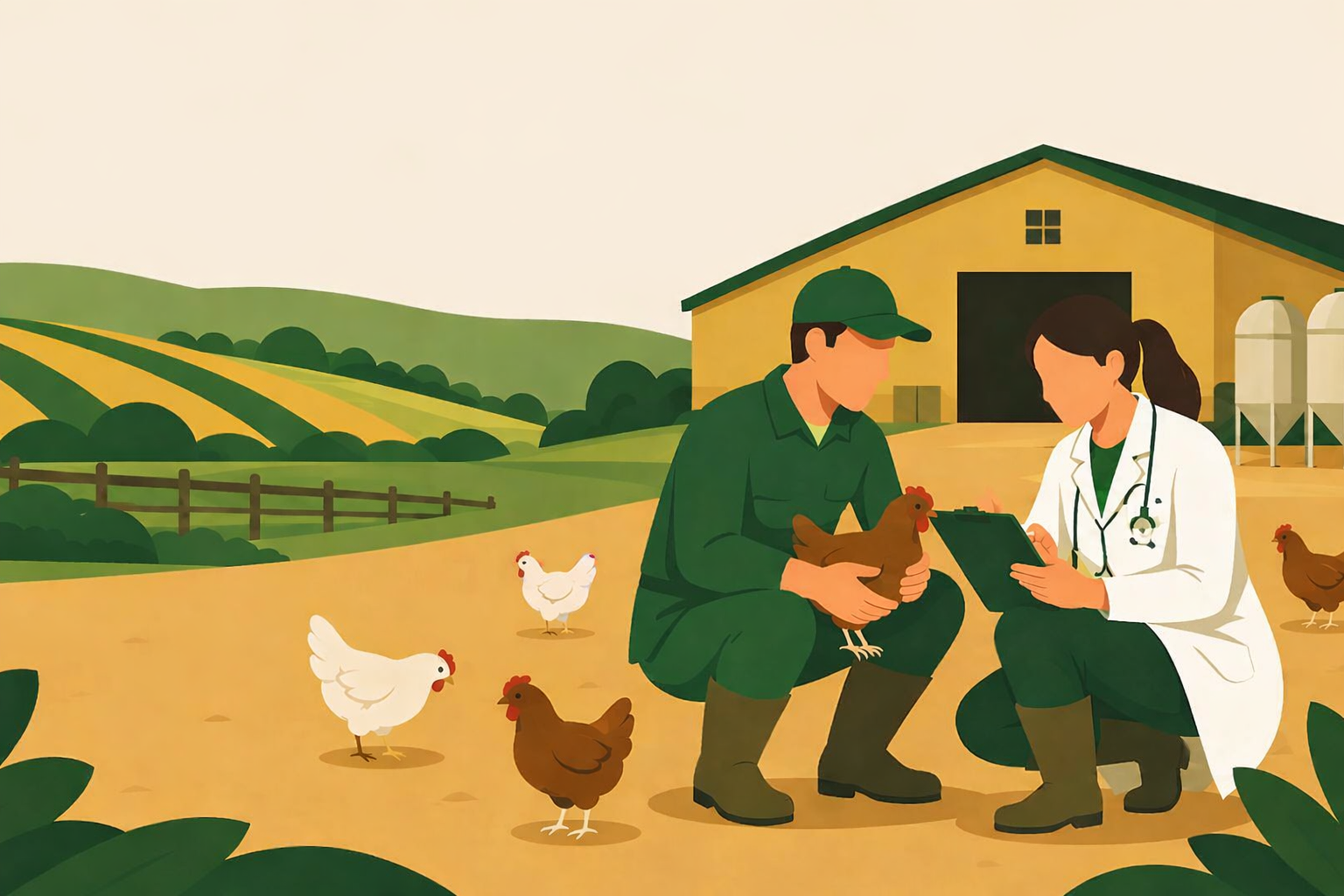
A withdrawal period is counted from the moment you give the medicine. During it, products from the treated animal should not be eaten. For laying hens, that mostly means eggs. The active substance, or rather its residues, breaks down and leaves the body gradually, not straight after the dose. The withdrawal period is the time needed for those residues to fall below a safe level. If you keep a few hens in the backyard and your family eats the eggs almost every day, this is not a formality. It is a real inconvenience: for the whole period you have to set eggs aside or not eat them.
Why one product has a withdrawal period and another does not
The length of the egg withdrawal period is not a feature of worming in general. It belongs to a specific product and its approval. Some wormers state an egg withdrawal period in days on the leaflet. Other products, developed and approved with commercial laying flocks in mind (where a break in egg collection means a real loss), are labeled by the maker for use in laying hens with no egg withdrawal, or with a very short one. This is not a rule for a whole group of medicines. You need to check it for each product separately.
Same substance, different products, different withdrawal
Even products based on the same active substance (for example fenbendazole) can differ in withdrawal period. It depends on the form of the medicine, its strength, how it is given and how the product was approved. So the name of the active substance alone tells you nothing about egg withdrawal. Only the current leaflet (the product's summary of characteristics) for the pack in your hand decides.
How to check the withdrawal period of a specific product
Always start with the leaflet
The egg withdrawal period, if there is one, is stated in the leaflet in the pack and in the veterinary product's summary of characteristics that the maker files with the regulator. That document applies to the product. It does not matter what someone wrote in a video comment or a forum post. The withdrawal period may have changed at a later approval, or may refer to a different form of the medicine.
If in doubt, ask, don't guess
If the leaflet is unclear or got lost at purchase, ask the seller at a farm supply store with a veterinary counter, a pharmacist or your vet. They can give exact, current information for that pack. Do not assume a product has no withdrawal just because it is advertised for laying hens. Verify it with every purchase, because the composition and approval of products get updated.
What about a natural dewormer?
Many keepers look for a natural dewormer for chickens, hoping to avoid withdrawal periods altogether. Herbal and home remedies lack tested figures, so there is no proof they clear a heavy worm burden. If your hens show signs of worms, talk to your vet and ask whether a diagnosis, such as a fecal egg count, makes sense before you treat. Our guides on nettle for chickens and apple cider vinegar for chickens cover common home additions. Keep in mind that anthelmintics in general should be used with care in laying birds and following the maker's recommendation, because some can affect egg production, egg quality and fertility, as the Ross Parent Stock Management Handbook 2023 notes.
A practical approach if you want to keep eating your eggs
Option 1: a product labeled for use with no egg withdrawal
Some poultry wormers are advertised as suitable for laying hens. Before you give one on the assumption that you can keep eating the eggs, check the label and leaflet of the pack you actually bought. Makers can change composition and approval, and what someone read online once may not apply to your batch. Only confirmation from the leaflet or from your vet gives certainty. For worm types and signs, see worm infections in laying hens.
Option 2: the standard withdrawal period and a temporary break from eating eggs
If you have a product with a stated egg withdrawal period, or you are not sure about a specific product, the safe default is to follow the stated period. Set the eggs aside or do not eat them for the number of days given. It is inconvenient, but it is the only route that needs no guessing. Assuming a product probably has no withdrawal without checking is the one mistake really worth avoiding.
Keep a record
Write down the product, the date, the flock and the date eggs are safe again. A simple log stops you from mixing treated and untreated eggs. Good feeding, clean housing and a well-kept run also lower the worm pressure; see the chicken run and feeding laying hens.
Frequently asked questions
What is a natural dewormer for chickens?add
People use the term for herbal or home remedies such as garlic, nettle, pumpkin seeds or apple cider vinegar. They lack tested figures, so nobody can say how well they work against worms. If you suspect worms, ask your vet about a diagnosis and a treatment plan, and check any product's withdrawal period before you eat the eggs.
What can I use to worm chickens with no egg withdrawal?add
Some poultry wormers are labeled by the maker as suitable for laying hens with no egg withdrawal, or with a very short one. You must confirm this on the leaflet of the pack you bought, not assume it. Approvals and composition get updated, so if in doubt ask a vet or a pharmacist before you decide a product needs no withdrawal.
How can I tell if a chicken has worms?add
Typical signs are weight loss despite a good appetite, lower egg production, dull feathers and general poor condition. With a heavier burden you may see a pale comb (anemia) or worms in the droppings. Signs can be vague, and a light burden may show nothing at all, so ask a vet if in doubt.
Which chicken wormer has no withdrawal period?add
You cannot name one universal wormer with no withdrawal. The egg withdrawal period belongs to a specific product and its current approval, not to the whole class of anthelmintics. Some products for laying hens are labeled for use without holding back eggs, but always verify this on the leaflet or ask your vet or pharmacist. The brand name or active substance alone does not settle it.
When is the best time to worm chickens?add
Preventive worming a few times a year is commonly advised, and more often for flocks with access to a run than for birds kept indoors only. The exact schedule depends on housing, flock size and local risk, so set it with your vet instead of following one fixed calendar.
Sources & resources
- linkEuropean Medicines Agency: Veterinary medicines regulatory information
- linkMerck Veterinary Manual: Internal Parasites of Poultry
- linkRoss Parent Stock Management Handbook 2023 (Aviagen)
Prepared by: DlaFerm Team based on data from the sources listed · Publisher: INSTA-TECH sp. z o.o.
Want worming dates and withdrawal periods under control?
DlaFerm keeps a <a href="/ewidencja-leczenia-i-karencja-lekow">treatment and withdrawal record</a> for your flock, tracks withdrawal periods and reminds you of due dates. Create a free farm account or get in touch and we will show you how it works.
Phone
+48 796 258 151