Marek's disease in chickens: signs, causes and prevention
Marek's disease is a highly contagious viral disease of chickens. It mostly hits young birds and shows up as slowly spreading paralysis of the legs or wings. Here is what causes it, how to spot the signs, and why vaccinating chicks right after hatching is the only effective protection for your flock.
verifiedFrom the team that has organised work on poultry farms for years.
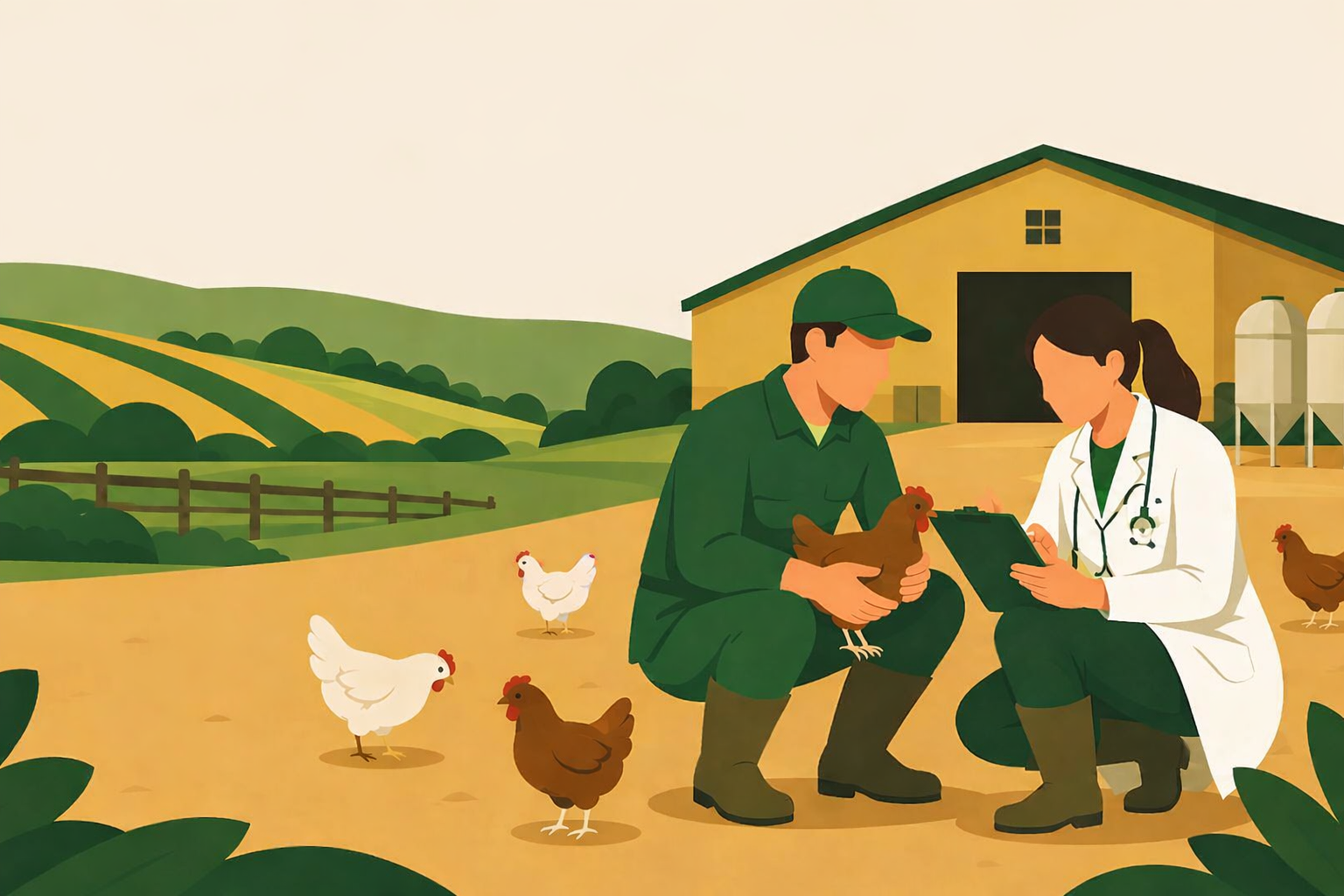
Marek's disease (MD) is a highly contagious viral disease of chickens. It is caused by the MDV virus from the Herpesviridae family (genus Mardivirus), a poultry herpesvirus. The difference matters, because keepers looking at disease signs often mix it up with Newcastle disease, which is caused by a paramyxovirus, or with avian influenza (HPAI), which is caused by an influenza virus. Marek's disease comes from a completely different virus family than both, although like them it is a serious, well-documented viral disease of chickens.
Why it matters to you as a keeper
Marek's disease is one of the most common causes of tumors (lymphomas) and paralysis in unvaccinated young chickens. In flocks without vaccination the losses can be serious. So knowing the signs and, above all, how to prevent it matters more than trying to treat it, because in practice there is no treatment.
How the infection spreads
The virus spreads mainly through the air. Birds breathe in dust and dander shed from the feather follicles of infected birds. The virus is very hardy and can survive in dust, litter and housing for a long time, even with no sick birds present. That is why biosecurity and regular cleaning of the coop count here. It is not only about avoiding contact with a sick bird, but also about the environment where the virus lingers.
Signs of Marek's disease in chickens
Nerve form: paralysis of the legs and wings
This is the most typical form. The virus attacks the peripheral nerves and causes progressive paralysis, usually uneven between the two sides. The classic sign is one leg stretched forward and the other back: the bird sits in a split and cannot stand. A wing may also be paralyzed (drooping) or the neck. Keep in mind that leg problems in chickens have other, more common causes (deficiencies, injuries, developmental defects). A limp alone does not mean Marek's disease. But paralysis with the typical split posture in a young, unvaccinated bird is a signal to call your vet. See also our overview of poultry disease signs.
Eye form
The virus can attack the iris of the eye and discolor it (so-called gray eye or pearly eye). The pupil becomes irregular and ragged instead of round. The affected bird may see poorly.
Skin and visceral form (tumors)
Marek's disease is one of the more common causes of tumors (lymphomas) in chickens. Tumors can form in the feather follicles (skin form, seen as thickening at the base of the feathers) and in internal organs: liver, spleen, ovary and heart. The visceral form is hard to recognize in a live bird and often shows up only at post-mortem.
Preventing and treating Marek's disease
Can Marek's disease be cured?
No. A bird that already shows signs (paralysis, tumors) has no effective causal treatment. Treating the symptoms does not reverse nerve damage or remove tumors. So all the effort goes into prevention, not into treating birds that are already sick. A general prevention program helps you keep this in order.
Day-1 vaccination: the hatchery standard
The basic and highly effective protection is vaccination against MDV, given to chicks on the day of hatching. It is given either in ovo (in the egg, just before hatching) or under the skin, before the bird meets the virus in its natural environment. This is standard practice in the great majority of commercial hatcheries in Poland and the European Union, so chicks bought from such hatcheries are in practice protected.
A note for keepers who hatch their own eggs
This detail matters for hobby keepers. If you hatch eggs yourself in a home incubator, your chicks usually do not get the day-1 vaccination that professional hatcheries give. Such a flock is more exposed to Marek's disease, especially if the virus has already circulated in the area (coop, litter, neighboring flocks). Factor this into your biosecurity planning and ask your vet about the vaccination options available to you. A clean, well-managed coop also helps limit the virus load.
Frequently asked questions
What causes Marek's disease in chickens?add
The disease is caused by the MDV virus (Marek's Disease Virus) from the Herpesviridae family, a highly contagious poultry herpesvirus. Infection happens mainly through the air: birds breathe in dust and dander shed from the feather follicles of infected birds. The virus is very hardy and can survive in dust and litter for a long time, so keeping the coop clean really matters.
How can I tell if my chicken has Marek's disease?add
The disease takes three forms: nerve (progressive paralysis of the legs or wings, typically uneven, with a split posture), eye (discolored iris, irregular pupil, so-called gray eye) and skin or visceral (tumors in the feather follicles or internal organs). It most often hits young birds, usually between 8 and 20 weeks of age. Only a vet can confirm the diagnosis.
What are the symptoms of Marek's disease?add
The most typical are progressive paralysis of the legs or wings (one leg forward, the other back), changes in the eye (discolored iris, irregular pupil) and tumors, seen in the feather follicles or found in internal organs. The signs usually build up gradually in young birds.
Is there a treatment or cure for Marek's disease?add
No. A bird with clinical signs has no effective treatment. The only real protection is prevention: vaccinating chicks against MDV on day 1, which is standard in commercial hatcheries. Keepers who hatch eggs at home usually cannot get this vaccination and should expect a higher risk in their flock.
Sources & resources
- linkMerck Veterinary Manual — Marek's Disease in Poultry
- linkWOAH (World Organisation for Animal Health) — Marek's Disease
- linkPoultry Extension — Marek's Disease
Prepared by: DlaFerm Team based on data from the sources listed · Publisher: INSTA-TECH sp. z o.o.
Want vaccinations and flock health history always at hand?
DlaFerm keeps records of your flock's vaccinations and treatments with our <a href="/program-do-ewidencji-kurnika">coop records module</a> and reminds you of due dates. Create a free farm account or get in touch and we will show you how it works.
Phone
+48 796 258 151