Poultry feed mixtures — starter, grower, finisher
Complete feed (a ready-made, balanced mixture that covers all the bird's needs) looks like one bag, but inside several components work together. We explain what each of them does, why the feed changes as the bird ages, and which feed form to use at each stage of rearing.
verifiedDel equipo que lleva años organizando el trabajo en granjas avícolas.
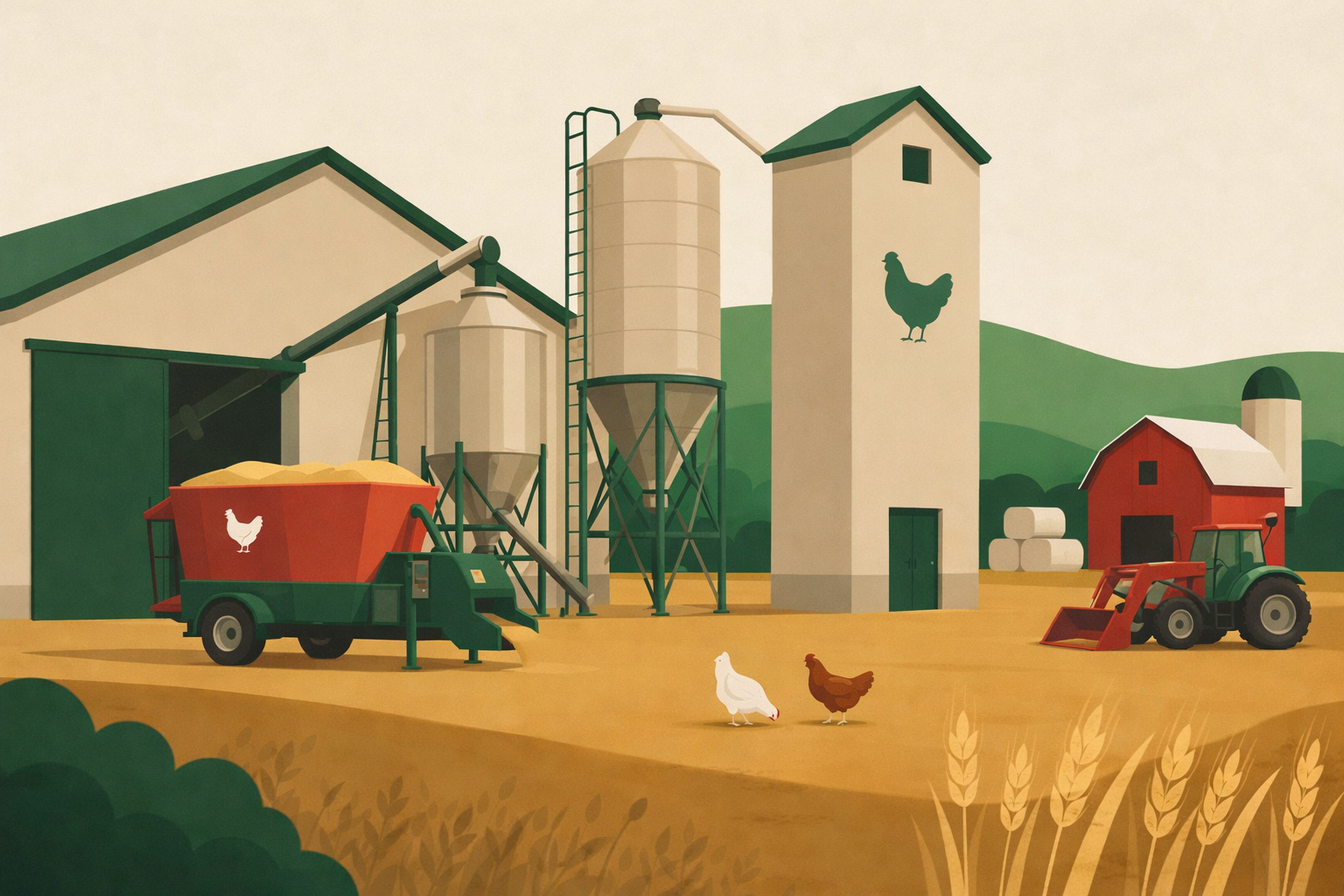
Complete feed (a ready-made, balanced mixture that covers all the bird's needs) is a finished product: you buy it in bags and pour it into the feeder — nothing else needs to be added. But to understand why starter feed costs more than finisher feed and what is written on the label, it helps to know what it is made of and how each ingredient works. This guide is part of the poultry nutrition cluster — a broader view of broiler nutrition is available in broiler nutrition — protein and energy norms, and phase tables in broiler feeding phase tables.
Where does the information in this guide come from?
Indicative data are based on IZ-PIB "Normy żywienia drobiu" (2025) and general feed technology principles. The exact composition of any given mixture is the commercial secret of the feed manufacturer. Always read the label and consult a nutritionist or animal scientist — especially if you are seeing mortality, slow growth or feathering problems.
What goes into complete poultry feed
Each ingredient plays a different role. Together they form a ready-made mixture that meets all the bird's needs — without needing to add anything extra.
Cereals (maize, wheat) — provide energy
Maize and wheat are the main energy carriers in poultry feed. Their starch (the plant's stored sugar) is digested by the bird into glucose, which drives growth and keeps the body warm. Maize also gives the natural yellow colour to egg yolk and skin. Cereals typically make up the largest share of the feed recipe — often more than half.
Soybean meal (high-protein feed from soya) — provides protein
Soybean meal (high-protein feed made from soya) is produced after the oil has been extracted from the soya bean. It is the main source of protein and amino acids (the building blocks from which the bird's muscles are made). Poultry cannot build muscle without an adequate protein supply — which is why soybean meal is present in almost every complete feed for hens or broilers. Rapeseed meal is sometimes used as an alternative, but it contains slightly fewer amino acids.
Vegetable or animal fat — concentrates energy
Fat contains more than twice the energy per kilogram of cereal. Adding even 2–5% fat to the feed allows more energy to be packed into a smaller portion. This is especially important in finisher feed — birds before slaughter need a great deal of energy to gain weight. Fat also improves feed palatability and the absorption of fat-soluble vitamins (A, D3, E, K).
Minerals — calcium, phosphorus, sodium
Calcium and phosphorus build bones and eggshells. A laying hen at peak production needs several times more calcium than a broiler of the same age. That is why layer feed differs from broiler feed. Sodium (sodium chloride, i.e. common salt) regulates the body's water balance. A salt deficiency causes feather pecking and restlessness in the flock. More on layer nutrition: layer nutrition — calcium and protein norms.
Premix — vitamins, trace minerals and amino acids
A premix (a supplement of vitamins, trace minerals and amino acids) is a concentrated package of everything not adequately present in cereals and meals: vitamins (A, D3, E, K, B-complex), trace minerals (zinc, manganese, selenium, iodine), and often synthetic amino acids — lysine, methionine, threonine. The premix is a small percentage of the total mix by weight, but without it birds grow slowly, develop weak bones and poor feathering.
Enzymes and other additives
Modern mixtures often include enzymes (e.g. phytase, which releases phosphorus from plants) and acidifiers that improve digestion and gut health. A coccidiostat (a substance protecting the bird against coccidiosis — a parasitic gut disease) is a separate category: its use is strictly regulated and requires a withdrawal period before slaughter. Details: withdrawal periods for poultry medicines.
Starter, grower and finisher feed — differences and forms
The bird's age determines which feed it needs. The older the bird, the less protein but more energy — and coarser feed form.
Starter feed (first weeks of life) — high protein, crumble
Starter feed is given to chicks from day one until approximately weeks 2–3 (broilers) or longer (turkeys, laying hens). It contains a high level of protein — indicatively 20–22% or more — because the chick is rapidly building muscle and organs. Feed form: crumble (crushed pellet — for young birds). Small pieces are easier for a small chick to swallow and reduce feed waste. More on broiler nutrition: broiler nutrition — norms.
Grower feed (middle weeks) — lower protein, pellet
Grower feed is given during the middle stage of rearing. Protein is lower than in starter feed — the bird is still growing but muscle-building slows down. The energy share in the recipe rises — the bird is larger and needs more fuel. Form: pellet (for older birds — less waste and better intake). The transition from crumble to pellet should be gradual over 2–3 days.
Finisher feed (before slaughter) — low protein, high energy, pellet
Finisher feed is given for the final few to several days before planned slaughter. Protein is at its lowest in the whole nutrition programme. Energy is at its highest. The bird is depositing fat and completing growth. IMPORTANT: finisher feed often contains no coccidiostat or other additives subject to a withdrawal period — precisely so that the meat is clean. Check this on the label or with your feed supplier. Details: withdrawal periods for poultry medicines.
Meal, crumble, pellet — feed form matters
Meal (loose) is a ground mixture of all ingredients. Chicks can eat it, but a great deal is scattered and wasted. Crumble (crushed pellet — for young birds) is pellet broken into small pieces — a compromise between meal and pellet. Pellet (for older birds) is compressed cylindrical pieces. Birds eat them more willingly, waste less and achieve better growth rates. The choice of form depends on the bird's age and the feed manufacturer's recommendation. For laying hens, meal or crumble is often used alongside separately supplied limestone grit for calcium.
Feed recipe calculator — when you want to do the maths yourself
Farmers with access to raw materials (their own grain, meal) sometimes formulate their own mix. This is possible but requires knowledge of the chemical composition of each ingredient and balanced amino acids — not just crude protein. To get started: feed recipe calculator. Remember that a home-made mixture without a premix is not a complete feed and may cause deficiencies.
Frequently asked questions about poultry feed mixtures
What is complete feed?add
Complete feed (a ready-made, balanced mixture) is a finished product that on its own covers all the bird's nutritional needs — energy, protein, amino acids, vitamins and minerals. Nothing needs to be added. You buy the bags, fill the feeder, and the bird has everything it needs for healthy growth.
What is a premix and can I go without it?add
A premix (a supplement of vitamins, trace minerals and amino acids) is a concentrated package of vitamins, minerals and amino acids. When you buy ready-made complete feed, the premix is already included — you do not need to buy anything extra. A premix is only needed if you are mixing feed yourself from raw materials (grain + meal). Without premixes, birds will grow slowly and fall ill.
Why is starter feed more expensive than finisher?add
Starter feed contains more protein (mainly from expensive soybean meal), vitamins and amino acids. All of this costs more than the grain and fat that dominate in cheaper finisher feed. The price is justified — a proper start to rearing determines the results of the entire flock.
What is the difference between crumble and pellet?add
Crumble (crushed pellet — for young birds) is pellet broken into small pieces — easier for a small chick to swallow. Pellet (for older birds) is compressed pieces in the shape of a cylinder. Birds eat pellets more willingly and waste less of them, so older chicks and turkeys should receive pellets rather than meal.
Can chicks be given layer feed?add
No — layer feed has a completely different composition. It contains a high level of calcium, which is essential for building eggshells. That amount of calcium can damage the kidneys of a growing chick. Always give feed appropriate to the bird's age and production purpose.
What is a withdrawal period and where can I find it for my feed?add
The withdrawal period (the time before slaughter during which the bird must not receive feed containing a medicine or coccidiostat) is stated on the feed label or in the product leaflet. If the information is not there — ask your feed supplier or veterinarian. Details: withdrawal periods for poultry medicines.
How often should the feed be changed between phases?add
Feed changes are made gradually — over 2–4 days, old and new feed are mixed in increasing proportions of the new until the old is fully replaced. A sudden switch can cause nutritional stress and reduce feed intake for several days. Monitor the birds after each change — a drop in feed intake or diarrhoea is a signal to lengthen the transition period. Exact schedules for individual species are in the broiler feeding phase tables.
Fuentes y materiales
Manage poultry nutrition in DlaFerm.pl
Want to record feed consumption, phase changes and flock results in one place? Create a free farm account or write to us.
Teléfono
+48 796 258 151